MSW’s Growing Impact Across New Jersey’s Commercial Real Estate Landscape

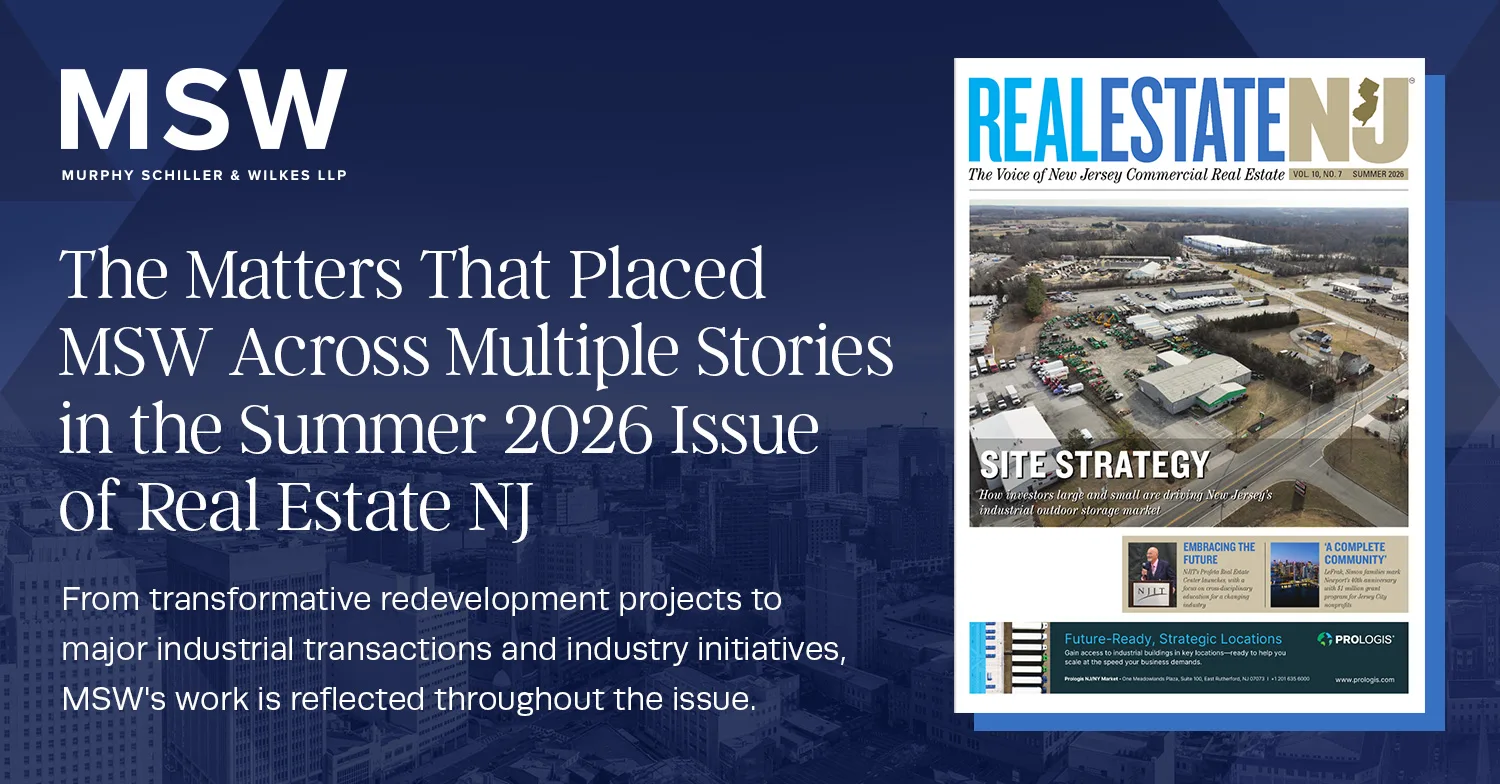
The Summer 2026 issue of Real Estate NJ highlights several of the most significant projects, initiatives, and industry developments shaping the state’s commercial real estate market. We are proud to share that Murphy Schiller & Wilkes LLP (MSW) is featured throughout the publication, reflecting the breadth of our work, the strength of our team, and our continued growth as a leading advisor in the New Jersey real estate industry.

While recognition is always appreciated, these features tell a larger story. They underscore MSW’s increasing role in some of New Jersey’s most complex and transformative real estate projects and our commitment to delivering exceptional results for clients across every sector of the market.

Counsel on the Transformative Red Bank Train Station Redevelopment

One of the issue’s featured stories highlights the Denholtz Red Bank Train Station Redevelopment Project, a landmark public-private partnership that is poised to reshape downtown Red Bank.

MSW is serving as lead counsel in connection with the transaction with NJ TRANSIT, handling the purchase and sale agreements, ground lease arrangements, asset transfers, and related transactional matters. The project also showcases the depth of our multidisciplinary real estate platform. Tom Garlick is leading entitlement and land use efforts, with support from Chris Murphy, while Brendan Pytka is overseeing the PILOT structure and the approximately $90 million Aspire Tax Credit application process.

Projects of this scale require seamless coordination among transaction, land use, government incentives, and public-sector stakeholders. The Red Bank redevelopment exemplifies the collaborative approach that has become a hallmark of MSW’s real estate practice.

Advising on Major Industrial Leasing Activity

The issue also includes coverage of the SNS Real Estate Investment lease transaction on page 16, another significant matter in which MSW represented key interests. Industrial and logistics assets remain a critical component of New Jersey’s commercial real estate market, and transactions of this nature demonstrate both the continued strength of the sector and MSW’s ability to guide clients through sophisticated leasing arrangements.

As demand for strategically located industrial space continues to evolve, our team remains focused on helping owners, investors, and tenants navigate complex negotiations and achieve their business objectives.

Supporting the Future of the Industry

Another feature highlights the launch of the NJIT Profeta Real Estate Center, an important initiative designed to strengthen education, research, and industry engagement within New Jersey’s commercial real estate community.

MSW is proud to support efforts that help cultivate the industry’s next generation of leaders. Chris Murphy was honored to be featured in the article as a member of the Center’s Board of Directors, reflecting both his personal commitment and the firm’s broader dedication to the advancement of the real estate profession.

Educational institutions and industry partnerships play a vital role in ensuring the continued growth and success of the commercial real estate sector, and we are excited to be involved in this important endeavor.

Expanding Our Platform and Capabilities

The publication also recognizes the continued growth of our firm, including the addition of Daniel Perlman, Eric Alvarez, Paige Guarino, and Michael Higgins to the MSW team.

Attracting exceptional talent has been a central component of our growth strategy. As our client base expands and transactions become increasingly sophisticated, we remain committed to building a platform that provides clients with experienced legal counsel across a broad range of practice areas.

These additions further strengthen our ability to serve developers, investors, lenders, institutions, public entities, and businesses throughout New Jersey and beyond.

More Than Recognition, A Reflection of Momentum

The multiple appearances of MSW throughout Real Estate NJ are not isolated achievements. Rather, they reflect a broader trend that we are experiencing across the firm.

We continue to advise on increasingly complex and high-profile matters, earn the trust of leading market participants, and play a central role in projects that are helping to shape New Jersey’s future. This momentum is driven by one fundamental factor: the quality of our people and the excellence of their work.

Every successful transaction, development approval, financing, lease, and strategic initiative requires collaboration across practices and departments. The accomplishments highlighted in this issue are the result of countless contributions from attorneys, paralegals, administrative professionals, and support staff working together to achieve outstanding results for our clients.

As we look ahead, we remain energized by the opportunities before us and grateful for the trust our clients place in us. We are proud of what our team has accomplished and even more excited about what lies ahead.

View the Summer 2026 issue of Real Estate NJ here:
https://re-nj.com/flipbook/06_v2-2026/RENJ_0708_26_Combo_v1.html

At Murphy Schiller & Wilkes LLP, we remain committed to helping clients navigate complex real estate opportunities and delivering the strategic counsel that drives successful outcomes across New Jersey and the region.

BINJE Names Kellen Murphy, Chris Murphy, Matthew Schiller and Charles Wilkes Among the Best Commercial Real Estate Leaders 2026

Murphy Schiller & Wilkes LLP is proud to announce that Kellen Murphy, Chris Murphy, Matthew Schiller and Charles Wilkes have been recognized by BINJE as part of its “Best Commercial Real Estate Leaders 2026” series.

Full publication here: BINJE_073026

This honor highlights exceptional attorneys who have demonstrated leadership, expertise, and influence in the commercial real estate industry. Kellen, Chris, Matthew and Charlie are highly regarded for their deep understanding of complex real estate transactions, forward-thinking strategies, and unwavering commitment to client success.

At MSW, they play a pivotal role in representing developers, investors, institutions, and businesses in all aspects of real estate acquisition, financing, development, and leasing.
Their inclusion in BINJE’s 2026 list underscores their continued impact on shaping the commercial real estate landscape throughout New Jersey and beyond.

Congratulations on this well-deserved recognition.

New Jersey Supreme Court Raises the Bar for “Inherently Beneficial” Use Variances

By Matthew Gilson and Chris Murphy

On July 13, 2026, the New Jersey Supreme Court issued a ruling that changes how “inherently beneficial use” variance applications will be evaluated under the Municipal Land Use Law (MLUL), and it’s going to matter for a lot of projects, from senior housing and assisted living facilities to hospitals, schools, childcare centers, group homes, and renewable energy installations.

Developers seeking variances for inherently beneficial uses can no longer coast on that label alone. The Court has revised the fourth step of the long-standing Sica v. Board of Adjustment of Wall balancing test to require applicants to affirmatively show that their proposed variance won’t substantially impair the intent and purpose of the local zone plan and zoning ordinance. Simply put: “inherently beneficial” gets your foot in the door, but it doesn’t win the case anymore.

That said, this isn’t as strict as it might sound. The Court was careful to clarify that this new requirement is not the same as the heightened “quality of proof” standard from Medici v. BPR Co., which still applies only to uses that are not inherently beneficial.

Some Background: How We Got Here

To understand why this matters, it helps to know the legal landscape the Court was working with.

New Jersey law defines an “inherently beneficial use” (N.J.S.A. 40:55D-4) as one that’s “universally considered of value to the community because it fundamentally serves the public good and promotes the general welfare.” Hospitals, schools, childcare centers, group homes, and wind/solar energy facilities all fall into this category.

Back in 1987, Medici v. BPR Co., 107 N.J. 1 (1987), set a tough evidentiary bar for the second “negative criterion” under the MLUL, but only for uses that weren’t inherently beneficial. Then in 1992, Sica v. Board of Adjustment of Wall, 127 N.J. 152 (1992), held that this enhanced Medici standard shouldn’t apply to inherently beneficial uses, and instead laid out a four-step balancing test:

  1. Identify the public interest at stake.
  2. Identify the detrimental effects of granting the variance.
  3. Consider reasonable conditions that could reduce those detriments.
  4. Weigh the positive and negative criteria to decide whether the variance would cause a substantial detriment to the public good.

Then, in 1997, the Legislature amended N.J.S.A. 40:55D-70 to make clear that all variance applicants, regardless of how beneficial their use might be, need to satisfy both negative criteria. The idea was to restore some balance, so municipalities could still evaluate site-specific impacts even when a project serves an undeniably good public purpose.

Fast forward to this year’s case, and the Supreme Court decided that the original Sica framework hadn’t quite kept pace with that 1997 amendment, which is exactly what it set out to fix.

The Case: Monarch Communities in Montville Township

The dispute arose from a fairly typical, if contentious, senior housing proposal. The property at issue sits on eight acres at 205–207 Changebridge Road in Montville Township, zoned R-20A residential. It’s currently a farm with a small single-family home, tucked in among single-family residences, a townhouse development, a childcare facility, and the municipal complex.

In February 2020, Monarch Communities, LLC applied for a use variance under N.J.S.A. 40:55D-70(d)(1) to build a 165-unit, three-story senior housing community, combining congregate apartments, assisted living, and memory care, with 15% of the units set aside as affordable housing. Nobody disputed that this was an inherently beneficial use.

Even so, after a seven-day hearing, the Zoning Board denied the application. The Board acknowledged the inherently beneficial nature of the project but found that its benefits were “substantially outweighed by the detrimental effects upon the integrity of the zoning plan.” Monarch appealed, and the trial court reversed and remanded. The Appellate Division then affirmed that reversal, reasoning that the master plan didn’t control because the implementing zoning ordinance hadn’t actually been adopted. The Supreme Court took up the case to decide whether the Appellate Division had properly applied the second negative criterion.

What the Court Actually Changed

The Supreme Court rewrote the fourth step of the Sica test. Here’s the new language, straight from the opinion:

“Fourth, the Board should determine whether the applicant has made a showing that the variance or other relief sought will not substantially impair the intent and the purpose of the zoning plan and zoning ordinance. If the applicant has not made such a showing, the variance may not be granted. If the applicant has made such a showing, the Board should then weigh the positive and negative criteria and determine whether, on balance, the grant of the variance would cause a substantial detriment to the public good.”

In plain English, this turns the fourth step into a two-part gate:

  1. Threshold showing: The applicant must first affirmatively prove that the variance won’t substantially impair the municipality’s zone plan and zoning ordinance. If they can’t clear this bar, the application is denied – full stop, no further balancing required.
  2. Balancing, but only if you clear the threshold: If the applicant does make that showing, the board then moves on to weigh the positive and negative criteria to determine whether granting the variance would still cause a substantial detriment to the public good.

What This Means for Developers Going Forward

The practical takeaway is straightforward: the “inherently beneficial” label is no longer a shortcut. Applicants need to come to the table with real, substantive evidence, not just an assertion that their project serves the public good.

In practice, this means:

  • Retaining planning experts early. You’ll need someone who can dig into the master plan and zoning ordinance in real detail.
  • Making the affirmative case. Your experts need to explain specifically why the proposed use is consistent with, or at least doesn’t undermine, the zone plan’s overall vision.
  • Addressing site-specific factors. Boards and courts will want to see what distinguishes your particular site and application from something that looks more like a general rezoning request.

To be clear, this doesn’t mean inherently beneficial use applicants now face the same uphill climb as everyone else. The Court reaffirmed that the tougher Medici proof standard still applies only to non-inherently beneficial uses. But “more than a bare assertion of inherent public benefit” is now the floor and applicants have to actually engage with the zoning plan, not just point to the nature of their use and expect that to carry the day.

What Clients Should Do Now

If you have a use variance application pending for an inherently beneficial use, now’s the time to take a hard look at your record:

  • Make sure you have an affirmative evidentiary showing on the second negative criterion; specifically, the impact on the zone plan and zoning ordinance.
  • If that showing is thin, supplement the record with expert testimony before it’s too late.
  • Get your planning experts involved early to put together a thorough analysis of the master plan, zoning ordinance, and the zoning history of your specific property.
  • Reframe your presentation: lead with why the proposed use doesn’t impair the zone plan, not just why the use is inherently beneficial.
  • And, as always, work with experienced land use counsel to navigate the process. This ruling adds a new layer of complexity that’s worth getting right the first time.

Contact Us

For more information, please contact the MSW Land Use Team:

Matthew Gilson
Partner
Office: (973) 241-3478
mgilson@murphyllp.com

Chris J. Murphy
Partner
Office: (973) 705-7421
cmurphy@murphyllp.com

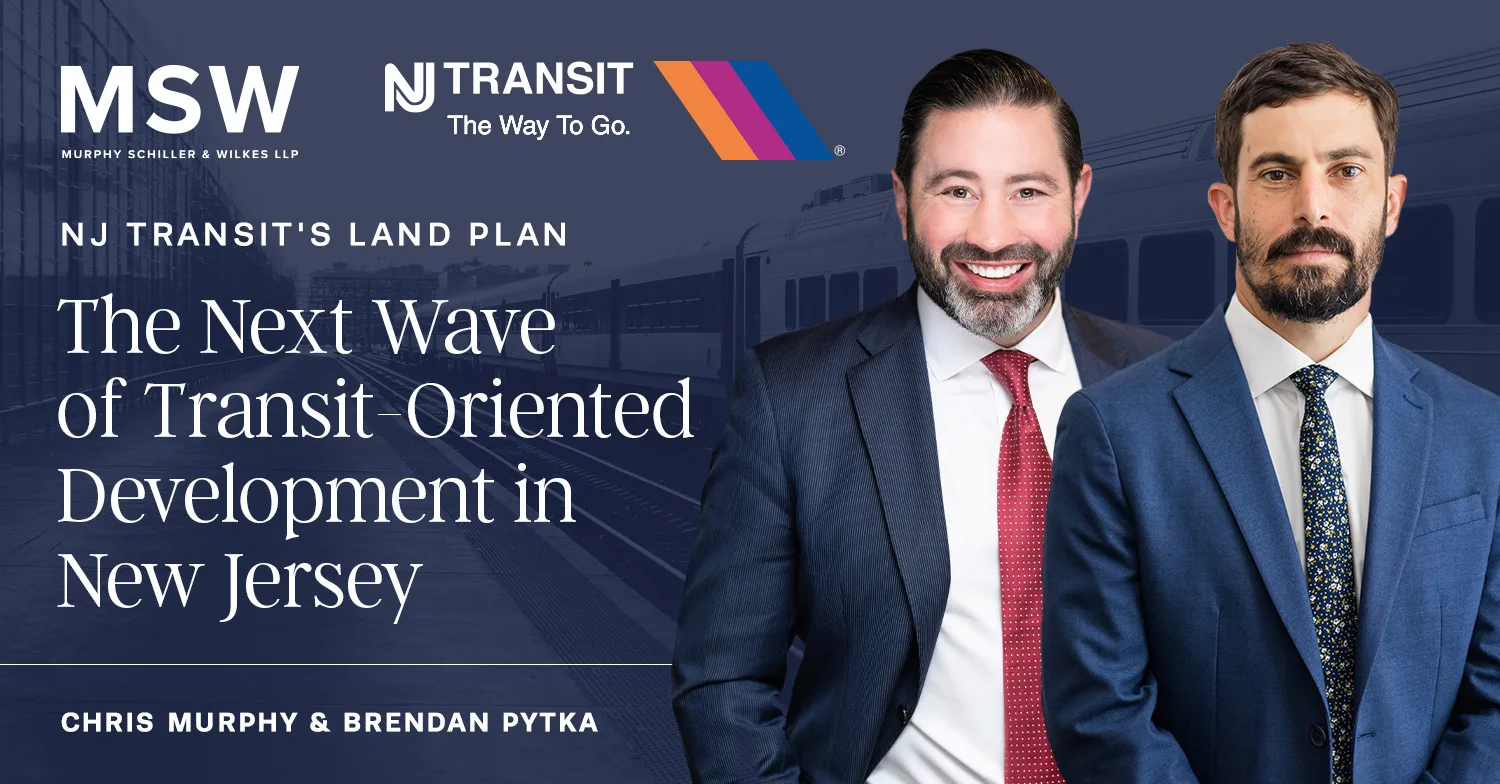
NJ TRANSIT’s LAND Plan: The Next Wave of Transit-Oriented Development in New Jersey

NJ TRANSIT has begun implementing its ambitious LAND Plan (Leveraging Assets for Non-Farebox Dollars), a long-term initiative designed to unlock the development potential of approximately 8,000 acres of agency-owned property throughout New Jersey. The program seeks to generate new revenue streams for NJ TRANSIT while helping address New Jersey’s housing shortage through transit-oriented development (TOD), mixed-use projects, and strategic public-private partnerships. NJ TRANSIT has identified the potential for thousands of new housing units, substantial economic activity, and significant long-term revenue generation through the strategic redevelopment of underutilized land adjacent to transit assets.

For developers, investors, and institutional partners, the LAND Plan represents one of the most significant public-sector development initiatives to emerge in New Jersey in decades.

A Rare Statewide Development Platform

Unlike a traditional municipal redevelopment opportunity, the LAND Plan offers access to a statewide portfolio of transit-adjacent assets located in both established urban markets and emerging growth corridors. These sites share one increasingly scarce characteristic: direct access to transportation infrastructure.

NJ TRANSIT began bringing LAND Plan opportunities to market in 2026, starting with its Bayonne 34th Street Station solicitation, and has identified a pipeline of additional sites throughout the state, including properties in Bordentown, Burlington South, Liberty State Park, Netherwood, Pennsauken, Princeton Junction, Riverside, Trenton, and Union City. The agency has also indicated that it will continue to consider unsolicited development proposals involving NJ TRANSIT-owned property that advance its transit-oriented development objectives.

This combination of formal procurements and flexibility for developer-driven proposals presents opportunities for both established TOD developers and new entrants seeking a foothold in New Jersey’s evolving development landscape.

More Than Real Estate: A Public-Private Partnership Opportunity

Developers evaluating LAND Plan opportunities should recognize that these projects are far more than conventional real estate deals. They are sophisticated public-private partnerships that require navigating multiple layers of governmental, regulatory, financial, and community stakeholder interests.

Successful projects will frequently require the integration of:

  • Ground leases and master development agreements
  • Public procurement and contracting requirements
  • Municipal redevelopment plans and redevelopment agreements
  • Local and state land use approvals
  • Affordable housing obligations
  • Environmental remediation and permitting issues
  • Parking, mobility, and transportation planning
  • Tax credits, incentives, and public financing tools
  • Community engagement and stakeholder coordination

In many respects, developers responding to LAND Plan opportunities will be evaluated not only on project design and financial capability, but also on their ability to navigate a complex public-sector framework and deliver transformative projects that advance both local and statewide policy objectives.

The Bayonne 34th Street Project Sets the Tone

NJ TRANSIT’s first LAND Plan solicitation demonstrates the type of opportunity the agency intends to bring to market.
The Bayonne 34th Street Station RFQ/P encompasses approximately 4.3 acres adjacent to the Hudson-Bergen Light Rail Station. NJ TRANSIT envisions a vibrant mixed-use and mixed-income development featuring residential uses, ground-floor retail, enhanced commuter amenities, sustainable design elements, and strengthened connectivity to the region’s transit network.

Notably, the solicitation highlights a number of potential economic development tools that may support project feasibility, including:

  • Aspire Tax Credits
  • Brownfields Redevelopment Incentives
  • Payment In Lieu of Taxes (PILOT) agreements
  • Redevelopment Area Bonds (RABs)

The inclusion of these tools underscores a critical reality of many LAND Plan projects: the most competitive and financeable proposals will likely require sophisticated capital-stack strategies that effectively combine private investment with available public incentives and financing mechanisms.

Why Developers Should Be Preparing Now

Although many LAND Plan opportunities are still in the early stages of rollout, developers interested in participating should begin evaluating potential opportunities well before solicitations are released.

Early-stage diligence should include consideration of:

  • Ownership and site-control structures
  • Ground lease economics and risk allocation
  • Redevelopment area designations and municipal planning objectives
  • Entitlement pathways and zoning considerations
  • Affordable housing requirements
  • Infrastructure and transportation obligations
  • Incentive eligibility and application timing
  • Community and political considerations
  • Financing and capital-stack strategies

Developers that understand these issues in advance will be better positioned to move decisively when opportunities become available and to submit proposals that address both market realities and public-sector priorities.

How MSW Can Help

Our team has significant experience representing developers in complex public-private real estate transactions throughout New Jersey, including projects involving NJ TRANSIT and other governmental entities.

What distinguishes our team is our ability to provide a fully integrated platform of legal services from project conception through closing and delivery.

Real Estate and Transactional

Our attorneys routinely structure and negotiate:

  • Purchase and sale agreements
  • Ground leases
  • Master developer agreements
  • Redevelopment agreements
  • Joint venture arrangements
  • Public-private partnership transactions
  • Financing and closing documents

Land Use, Redevelopment and Entitlements

We guide developers through:

  • Local redevelopment designations and planning processes
  • Municipal, county, and regional approvals
  • State permitting and regulatory approvals
  • Environmental review and compliance
  • Community engagement strategies
  • Project entitlements through local and state governmental agencies

Economic Incentives and Project Finance

Our team has extensive experience securing and structuring:

  • Aspire Tax Credits
  • PILOT agreements
  • Redevelopment Area Bonds
  • Brownfields redevelopment incentives
  • Infrastructure financing
  • Other state and local economic development programs

Collectively, our attorneys have helped secure more than $400 million in Aspire tax credit awards and have extensive experience negotiating PILOT agreements and advising clients on incentive-backed redevelopment projects throughout New Jersey.

The Opportunity Ahead

The LAND Plan reflects more than a real estate initiative; it is a strategic effort to reshape how communities grow around New Jersey’s transit network. By leveraging publicly owned assets to create housing, attract investment, and generate long-term revenue, NJ TRANSIT is creating a new generation of “live-and-ride” communities across the state.

For developers, the opportunity is significant. But success will require more than identifying a strong site. It will require the ability to structure complex public-private partnerships, secure entitlements, assemble incentive packages, navigate stakeholder interests, and execute transformative projects from start to finish.

MSW is uniquely positioned to assist clients at every stage of that process. As additional LAND Plan opportunities come to market, our team stands ready to help developers evaluate, pursue, structure, finance, entitle, and close these landmark projects.

For more information about NJ TRANSIT LAND Plan opportunities, please contact:

Chris J. Murphy
Chair, Land Use, Zoning and Redevelopment
Chair, Tax Credits & Incentives
Phone: (973) 705-7421
Email: cmurphy@murphyllp.com

Brendan Pytka
Director of Tax Credits & Incentives
Phone: (862) 418-3702
Email: bpytka@murphyllp.com

MSW Partner Chris Murphy to Speak at 2026 Governor’s Conference on Housing and Economic Development

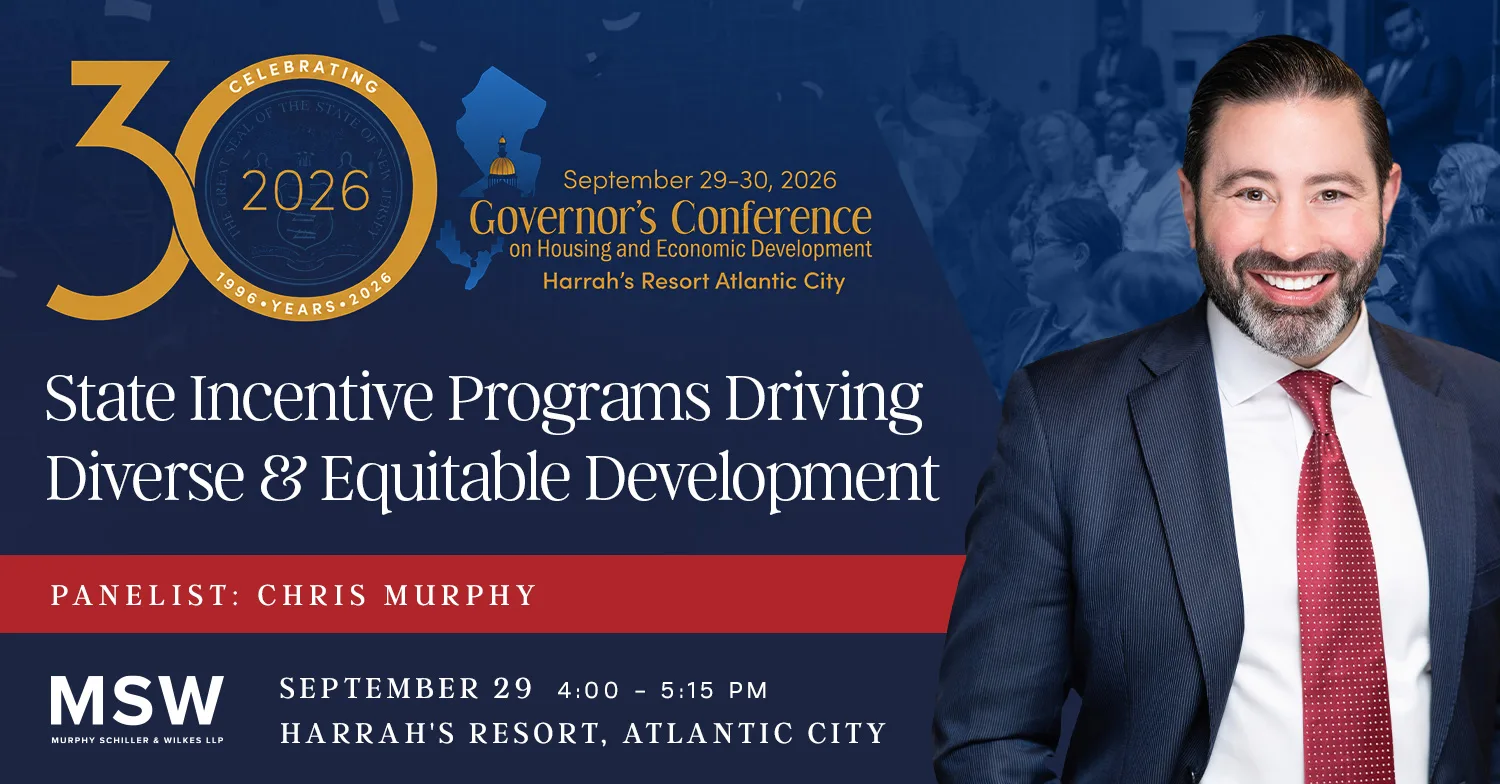
Murphy Schiller & Wilkes LLP (MSW) is proud to announce that partner Chris Murphy will serve as a panelist at the 2026 Governor’s Conference on Housing and Economic Development, one of New Jersey’s premier gatherings of leaders in real estate, economic development, government, and community investment.

Chris will participate in the panel discussion:

State Incentive Programs Driving Diverse Projects, Equitable Development in New Jersey
Date/Time: 4:00 PM – 5:15 PM
Location: Wildwood 25/26

As New Jersey continues to leverage a broad range of incentive programs to catalyze transformative development, this session will explore how state-supported initiatives are helping bring impactful projects to life across the state. Panelists will discuss the role of historic redevelopment tax credits, financing tools for mixed-use and arts-related developments, film industry incentives, and other programs that are helping close financing gaps, attract private investment, and advance community-focused development.

Drawing on his extensive experience advising developers, investors, and project stakeholders, Chris will share insights on how incentive programs can be strategically utilized to support equitable development, expand affordable and market-rate housing opportunities, and strengthen communities throughout New Jersey.

The discussion will feature developers and industry experts who are actively leveraging these programs to create vibrant neighborhoods, drive economic growth, and deliver projects that generate long-term value for residents and businesses alike.

We look forward to Chris contributing to this important conversation about the future of housing, redevelopment, and economic investment in New Jersey.

For more information, please click here: Home – 2026 Governor’s Conference on Housing and Economic Development

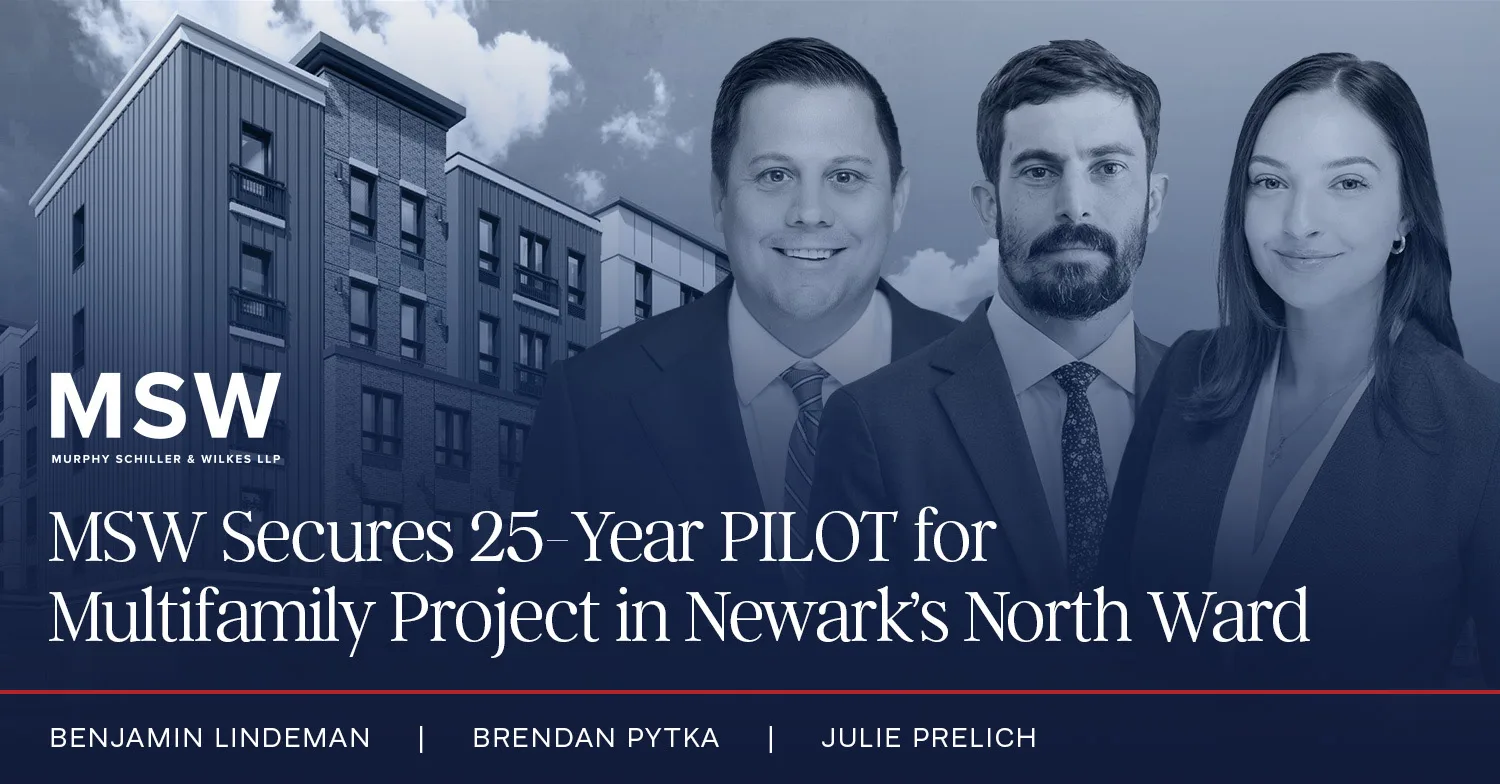
MSW Secures 25-Year PILOT for Multifamily Project in Newark’s North Ward

The MSW Tax Credits & Incentives team recently secured a 25-year Payment in Lieu of Taxes (PILOT) agreement for the development of a new five-story, 65-unit residential building in Newark’s North Ward. The project will include 52 market-rate residential units and 13 affordable housing units, helping to expand housing opportunities within the community. Residents will also enjoy a variety of amenities, including a fitness center and resident lounge.

MSW attorney Benjamin Lindeman led the project team, working alongside Brendan Pytka, MSW’s Director of Tax Credits & Incentives, and paralegal Julie Prelich.

Congratulations to our team and all project stakeholders on reaching this important milestone. We are proud to support a development that will contribute to the continued growth and revitalization of Newark’s North Ward.

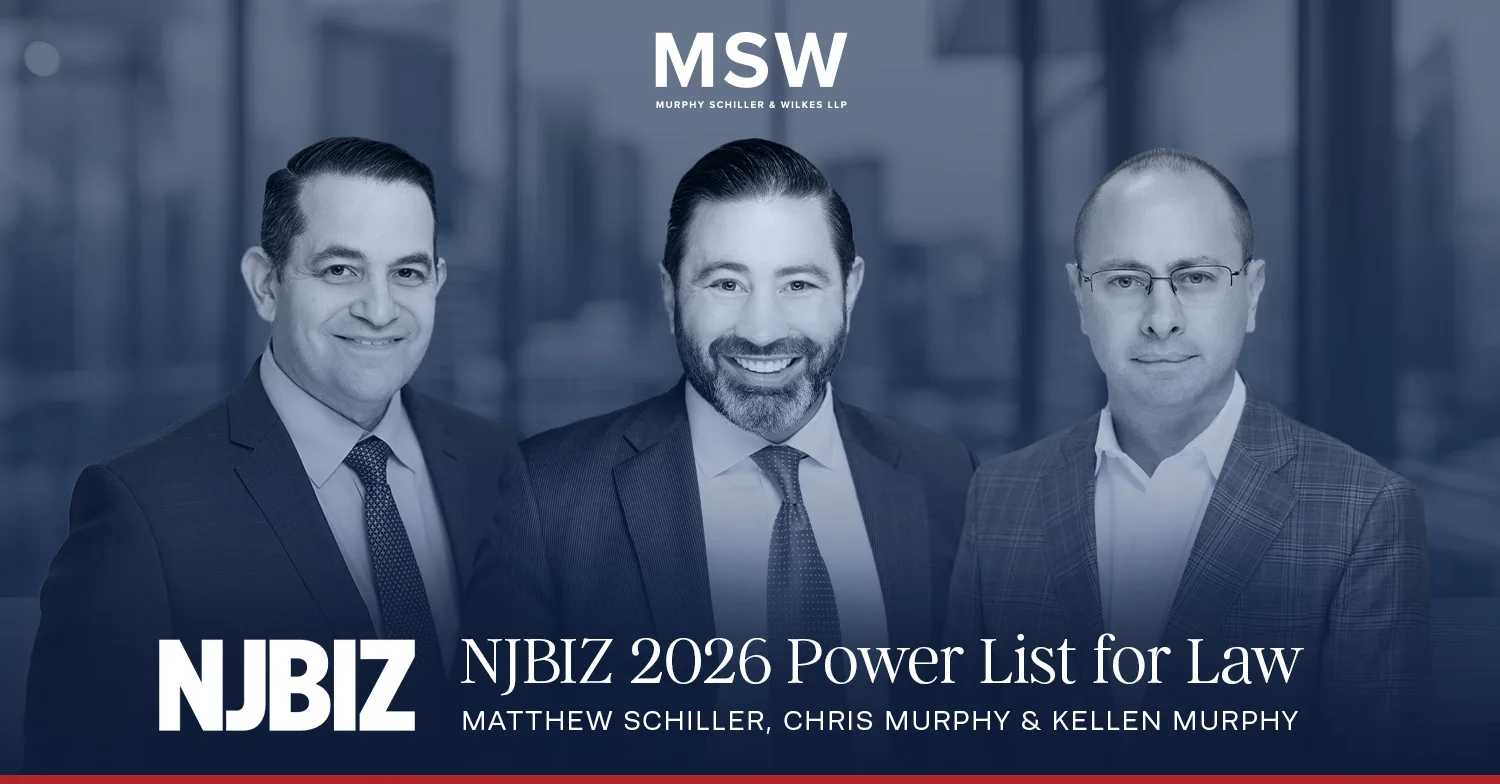
MSW Partners Kellen Murphy, Chris Murphy, and Matthew Schiller Named to NJBIZ 2026 Law Power List

MSW is proud to announce that partners Kellen Murphy, Chris Murphy, and Matthew Schiller have been recognized in the 2026 NJBIZ Law Power List, an annual distinction honoring attorneys who have demonstrated exceptional leadership, professional achievement, and meaningful contributions to New Jersey’s legal and business communities.

Compiled by the editorial staff of NJBIZ, the Law Power List recognizes legal professionals who have earned public attention and respect through their professional accomplishments, public service, and impact on the state. According to NJBIZ, honorees are selected based on reporting throughout the year, input from industry experts, and recommendations from readers. The list highlights individuals whose efforts help make New Jersey a better place to live, work, and do business.

The recognition comes at a time when the legal profession continues to navigate unprecedented change. In announcing the 2026 Law Power List, NJBIZ noted the growing challenges facing attorneys across the profession, including evolving client expectations, alternative fee arrangements, talent recruitment and retention, advances in artificial intelligence, and an increasingly complex regulatory environment.

“To have three of our partners recognized by NJBIZ is an incredible honor and a testament to the talent, dedication, and leadership that Kellen, Chris, and Matthew bring to our clients and our firm every day,” said Charles Wilkes, Co-Founding Partner and Executive Committee Member. “Their inclusion on this year’s Law Power List reflects not only their professional excellence, but also their longstanding commitment to serving our clients, strengthening our communities, and advancing the legal profession in New Jersey.”

Throughout their careers, all three have built reputations for delivering strategic counsel, achieving successful outcomes for clients, and providing leadership both within the legal community and beyond. Their recognition underscores MSW’s continued commitment to excellence, innovation, and client service.

“We are honored by this recognition from NJBIZ,” said Chris Murphy. “The legal profession is evolving rapidly, and we are fortunate to work alongside outstanding colleagues and clients who challenge us to provide thoughtful, practical solutions every day. This recognition belongs to the entire MSW team.”

The 2026 NJBIZ Law Power List highlights attorneys who have successfully adapted to a legal landscape marked by increasing complexity and change while continuing to provide exceptional counsel and leadership. MSW congratulates Kellen Murphy, Chris Murphy, and Matthew Schiller on this well-deserved recognition.

For more information, please click here: 2026 NJBIZ Law Power List

MSW Helps Client Secure Land Use Approvals for Multifamily Project in Passaic

Murphy Schiller & Wilkes LLP(MSW) is proud of have helped our client, 54 Holdsworth LLC, secure site plan approval and bulk variance relief for the development of a 9-unit mixed market and affordable residential project in the City of Passaic. This thoughtful and well-designed project will bring much needed updated housing stock to the area. The project team was led by MSW attorneys Matthew Gilson and Benjamin Lindeman, and included Kiersten Osterkorn of Omland & Osterkorn, Inc., Tom Rybak and Greg Hasaj of T.M. Rybak and Associates, traffic engineers Conor Hughes and Corey Chase from Dynamic Traffic, and planner Gabriel Bailer from Harbor Consultants. MSW paralegal Jahynis Cabral contributed significantly to the application process. This project represents MSW’s second approval for St. Nicholas Catholic Church as they look to convert surplus church property into much needed housing for the city.

MSW – Q2 2026 Transaction Highlights

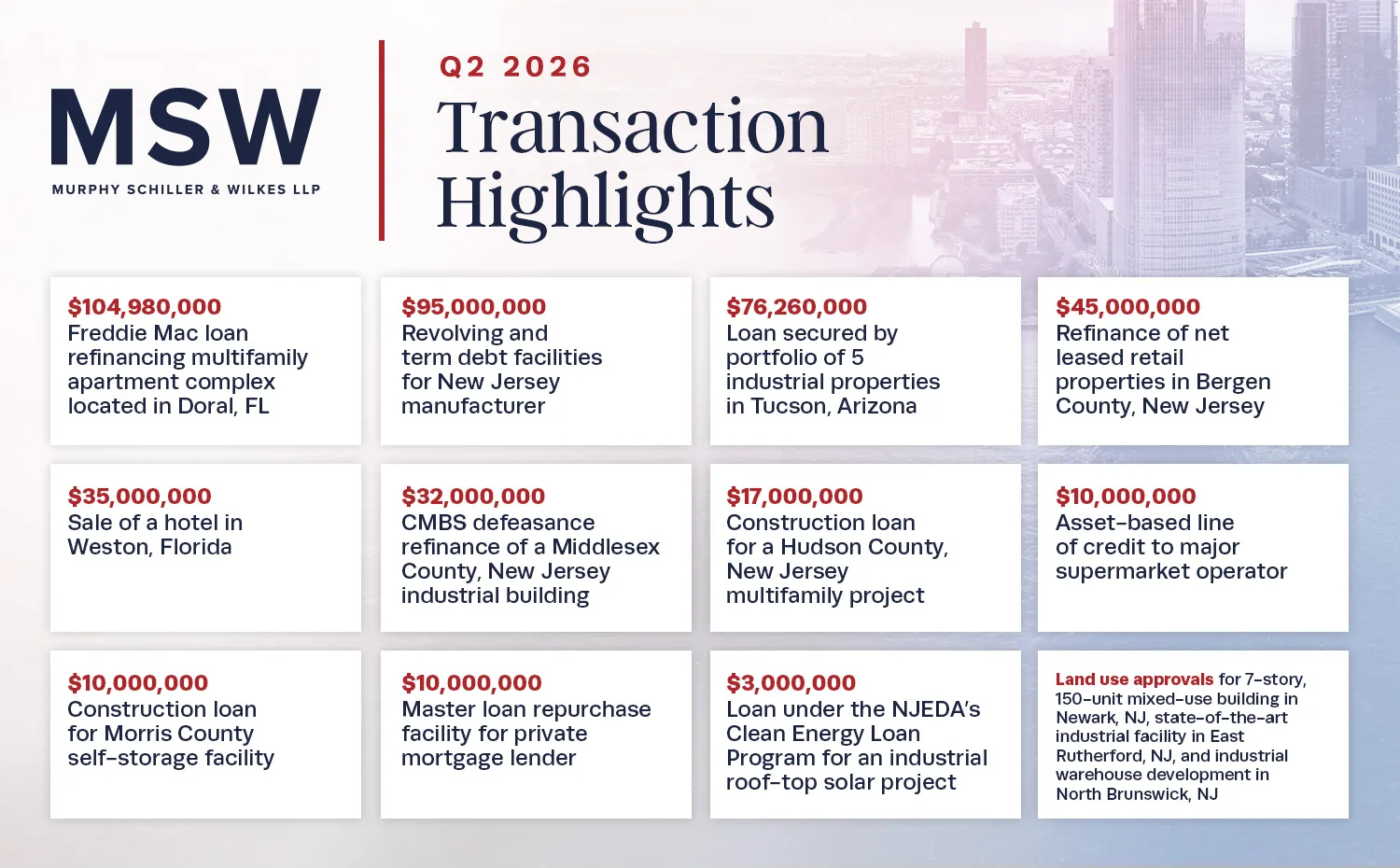
The second quarter of 2026 was incredibly busy for the attorneys at Murphy Schiller & Wilkes LLP (MSW). The firm acted as lead counsel in connection with the acquisition and sale of properties in all asset classes, helped our clients negotiate significant lease transactions, represented both lenders and borrowers in connection with financing CRE deals, both locally and nationally, and secured noteworthy approvals for major industrial, multi-family, and retail projects throughout New Jersey.

In Q2 2026, the firm represented the following:

  • Borrower in connection with $104,980,000 Freddie Mac loan refinancing multifamily apartment complex located in Doral, Florida.
  • National bank in closing $95,000,000 in revolving and term debt facilities for New Jersey manufacturer, secured by business and real estate assets.
  • Borrower in connection with modification of $76,260,000 loan secured by portfolio of 5 industrial properties in Tucson, Arizona.
  • National bank in closing $45,000,000 refinance of net leased retail properties in Bergen County, New Jersey.
  • Seller in connection with the $35,000,000 sale of a hotel in Weston, Florida.
  • New Jersey bank in connection with the $32,000,000 CMBS defeasance refinance of a Middlesex County, New Jersey industrial building.
  • New Jersey bank in connection with a $17,000,000 construction loan for a Hudson County, New Jersey multifamily project.
  • National bank in closing $10,000,000 asset-based line of credit to major supermarket operator.
  • Developer in connection with $10,000,000 construction loan for Morris County self-storage facility.
  • Private mortgage lender in connection with $10,000,000 master loan repurchase facility.
  • New Jersey bank in connection with a $3,000,000 loan under the NJEDA’s New Jersey Clean Energy Loan Program for an industrial roof-top solar project.
  • Land Use Approvals for Industrial Warehouse Development in North Brunswick, New Jersey.
  • Land Use Approvals for State-of-the-Art Industrial Facility in East Rutherford, New Jersey.
  • Land Use Approvals for 7-story, 150-unit mixed-use building in Newark New Jersey.
  • Negotiated multiple substantial office leases on behalf of major landlord client in Northern New Jersey.