MSW Secures Unanimous Approval for Commercial Redevelopment Project in Rahway

MSW represented Aerovista Holdings, LLC in securing land use approvals for the substantial rehabilitation of a property located in Rahway, New Jersey. The project involved the redevelopment of a former dry-cleaning facility situated within a residential district. The property will be converted to support the operations of a client that provides services at Newark Liberty International Airport.

To facilitate the project, MSW successfully obtained a d(1) use variance, a d(4) floor area ratio (FAR) variance, and multiple c variances relating to setbacks and signage. The proposed improvements include façade enhancements, site beautification measures, revised ingress and egress configurations, and upgrades necessary to bring the facility into compliance with current fire safety requirements.

MSW counsel Aileen Brennan led the project team, developed the land use strategy, and presented the application before the Rahway Planning Board. Through her advocacy and coordination of the project professionals, the application received unanimous approval and was successfully advanced through the municipal review process during a single one-hour hearing.

This approval positions Aerovista Holdings to modernize and improve a long-standing commercial property while enhancing the site’s appearance, safety, and functionality for future operations.

For more information on the MSW Land Use, Zoning and Redevelopment Practice Group, click here: Land Use, Zoning and Redevelopment – MSW

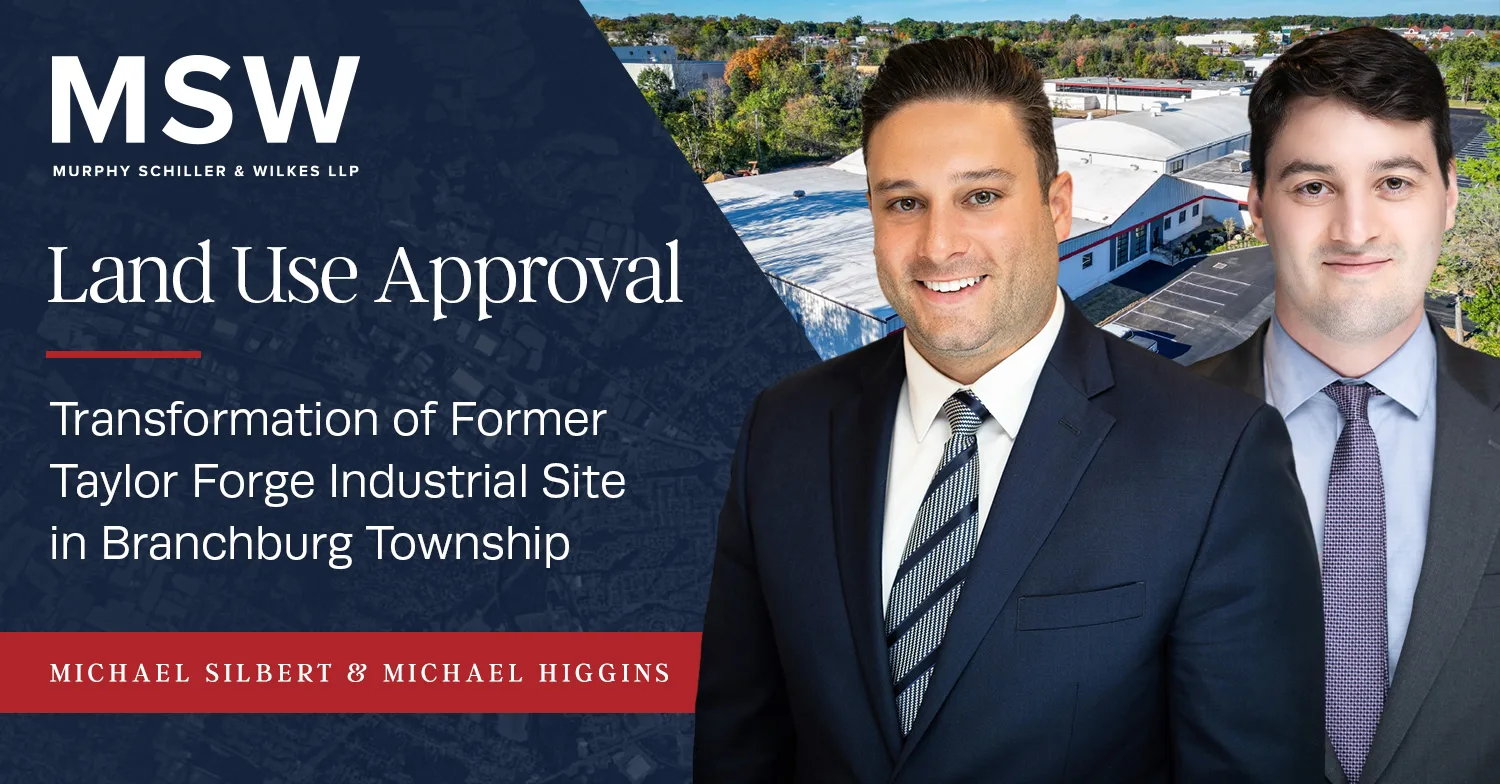
MSW Secures Land Use Approval for Transformation of Former Taylor Forge Industrial Site in Branchburg Township

Murphy Schiller & Wilkes LLP is pleased to announce that the Branchburg Township Board of Adjustment granted D(1) use variance relief and preliminary and final major site plan approval for the transformation of the former Taylor Forge industrial complex at 22 Readington Road into a multi-tenant indoor recreational facility. The approval represents a significant milestone in the revitalization of the approximately 10-acre property, allowing the existing industrial buildings to be adaptively repurposed into a recreational destination offering activities such as indoor soccer, cricket, pickleball, cheerleading, gymnastics, and other indoor sports and recreational uses.

The applicant, Commerce Park Investors, under the leadership of Principal Roy Pascal and Project Lead Nicholas Gareffa, has already made a substantial financial investment in rehabilitating and improving the former industrial complex. The Board’s approval will allow the applicant to build upon those improvements, breathe new life into a longstanding industrial property, and create a recreational destination serving residents and families throughout Branchburg Township and the surrounding communities.

The application involved complex land use and site planning considerations, including the conversion of an industrial property to recreational uses not otherwise permitted in the underlying zoning district, as well as parking, traffic circulation, pedestrian safety, and site improvements.

The MSW legal team consisted of attorneys Michael Silbert and Michael Higgins, with the assistance of paralegal Jahynis Cabral, working alongside an experienced team of land use professionals:

  • Civil Engineering: Craig Stires, Stires Associates
  • Traffic Engineering: Gary Dean and Doug Polyniak, Dolan & Dean
  • Professional Planning: Justin Auciello, Cofone Consulting Group
  • Architecture: Ben Horton, Ben Horton Architecture & Design

MSW congratulates Commerce Park Investors on this important achievement and thanks the Branchburg Township Board of Adjustment, its professionals, and Township representatives for their time, consideration, and collaboration throughout the application process.

We are proud to have played a role in securing an approval that will transform an underutilized industrial property into a vibrant recreational destination and contribute to the continued growth and vitality of the Branchburg community.

For more information on the MSW Land Use, Zoning and Redevelopment Practice, click here: Land Use, Zoning and Redevelopment – MSW

Charles J. Wilkes to Speak on Leasehold Financing at NJICLE Seminar

Murphy Schiller & Wilkes LLP (MSW) partner Charles J. Wilkes will speak at the New Jersey Institute for Continuing Legal Education’s Advanced Topics in Commercial Leasing seminar on Thursday, November 19, 2026.

Wilkes will be presenting “Keep the Money Flowing: Leasehold Financing Issues from a Landlord and Tenant Perspective.” The session will explore how landlords and tenants approach leasehold financing when negotiating commercial leases. The program will also cover lease termination and enforcement, additional rent pass-throughs, and the use of AI in commercial lease transactions.

The seminar runs from 9:00 a.m. to 4:00 p.m. and is available in person at the New Jersey Law Center and online.

For more info or to register: https://njsba.com/event/advanced-topics-in-commercial-leasing-2026/

MSW Welcomes Elza Kabashi as Paralegal in Transactional Commercial Real Estate Practice Group

NEWARK, N.J. – Murphy Schiller & Wilkes LLP (MSW) is pleased to announce that Elza Kabashi has joined the firm as a Paralegal in the firm’s Transactional Commercial Real Estate Practice Group.

Kabashi brings nearly a decade of commercial real estate experience to MSW, having supported a broad range of real estate transactions, including acquisitions, dispositions, financing and refinancing matters, leasing, due diligence, and closing coordination. She has extensive experience working with attorneys, lenders, title companies, surveyors, municipalities, brokers, and other professionals throughout all stages of commercial real estate transactions.

“We are excited to welcome Elza to the firm,” said Kellen F. Murphy, Managing Partner at MSW. “Her experience, attention to detail, and deep understanding of the transactional process make her an outstanding addition to our commercial real estate team. Elza will play an important role in continuing to provide the high level of service and responsiveness that our clients have come to expect from MSW.”

Prior to joining MSW, Kabashi served as a Senior Real Estate Paralegal at a regional law firm, where she supported a high-volume commercial real estate practice involving acquisitions, dispositions, financing transactions, leasing, and development-related matters. Her experience includes title and survey review, zoning and land use due diligence, entity governance matters, escrow administration, and the preparation and coordination of transaction documents.

Kabashi earned her Bachelor of Arts in Psychology, magna cum laude, from Kean University. She is a New Jersey Notary Public and is bilingual in English and Albanian.

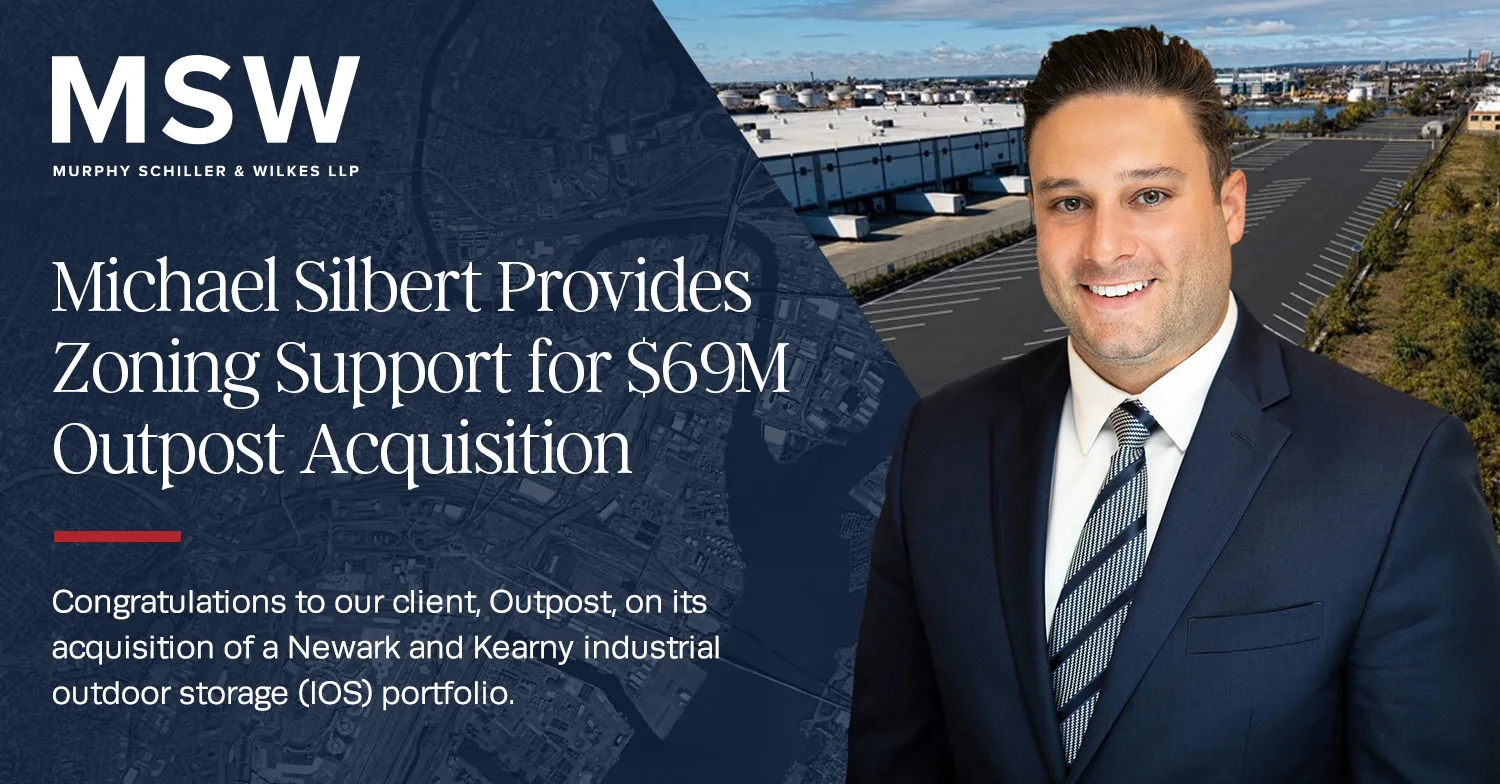
Michael Silbert Provides Zoning Support for $69M Outpost Acquisition

Congratulations to our client, Outpost, on its acquisition of a Newark and Kearny industrial outdoor storage (IOS) portfolio.

Murphy Schiller & Wilkes LLP (MSW) was pleased to support Outpost in connection with this transaction. MSW land use attorney Michael Silbert supported the transactional team by providing zoning analysis and land use guidance related to the acquisition.

Congratulations to Outpost and all parties involved in bringing this significant transaction to a successful closing.

Thanks to Real Estate NJ for sharing the news: Meadow Partners, Criterion sell Newark and Kearny IOS portfolio to Outpost for $69 million – Real Estate NJ

For more information, contact Michael Silbert at msilbert@murphyllp.com or (862) 418-2331.

The Payroll Record Follows the Subsidy: New Jersey’s New Records Law and Your PILOT Project

In effect since October 20, 2026, P.L. 2025, c.152 extends State payroll-records oversight to work connected to PILOTs, redevelopment incentives, and other public financial assistance, including work at existing tax-abated properties.

If your project benefits from a tax exemption, a payment in lieu of taxes (PILOT) agreement, or another form of public support, your contractors’ payroll records are now within the State’s reach. Since October 20, 2026, P.L. 2025, c.152 has expanded the authority of the New Jersey Department of Labor and Workforce Development to obtain employment records from employers performing work connected to public financial assistance.

The law reaches well beyond conventional public construction. It expressly covers work associated with loans, grants, incentives, tax exemptions, and other forms of public financial assistance. As a result, work at privately developed properties operating under long-term tax exemptions or PILOT agreements may fall within its scope.

The law does not automatically impose prevailing-wage requirements on every subsidized project. What it does is expand the circumstances in which contractors may be required to produce records of wages, hours, and employment conditions.

That distinction has immediate consequences for projects under construction, transactions approaching closing, and operating buildings planning capital work.

A Broader Definition of Work for a Public Body

The legislation amends N.J.S.A. 34:11-56.31, expanding the investigative authority of the Commissioner of Labor and Workforce Development (the “Commissioner”) beyond traditional public works.

Covered work includes construction, reconstruction, demolition, alteration, custom fabrication, duct cleaning, repair, and maintenance. Coverage can arise from work under a publicly funded contract, work on certain publicly owned or leased premises, or work undertaken in connection with public financial assistance.

The definition expressly includes financial assistance approved, funded, authorized, administered, or provided by a public body. It also reaches work undertaken to satisfy a condition of receiving that assistance.

For redevelopment projects, this is the critical language. A privately owned building may still fall within the statutory framework when the work bears the required connection to public assistance.

Private ownership, in other words, does not end the coverage inquiry. For a developer holding a PILOT agreement, the analysis begins with the financial agreement, the statute authorizing it, and the specific work being performed.

Payroll Reporting Is Not the Same as Prevailing Wage

The legislation separates two distinct obligations: producing employment records on request and paying prevailing wages.

Under N.J.S.A. 34:11-56.31(e), the Commissioner must establish a separate filing process for employers whose work is not subject to the New Jersey Prevailing Wage Act, N.J.S.A. 34:11-56.25 et seq., or another statutory prevailing-wage requirement.

The statute thus contemplates that an employer may owe a records-production obligation without owing prevailing wages.

The amendment does not, however, displace existing prevailing-wage obligations, nor does it replace the periodic certified-payroll requirements that already apply to covered contractors.

The analysis therefore runs on two independent tracks. First, determine whether the work triggers prevailing-wage requirements under the applicable incentive statute, financial agreement, or other law. Second, and regardless of that answer, determine whether the expanded records-production provisions apply.

Conflating the two obligations creates avoidable compliance risk in both directions: overcompliance that inflates construction pricing and distorts financing assumptions, and undercompliance that leaves a project unprepared for a records request.

The Ten-Day Production Requirement

The amended statute authorizes the Commissioner or an authorized representative to request records relating to wages, hours, and other employment conditions from employers or contractors engaged in covered work.

Under N.J.S.A. 34:11-56.31(e), the requested records must be filed with both the Commissioner and the relevant public entity within ten days after receipt of a qualifying request.

The law also provides a potential payment-withholding remedy for noncompliance. Where the statutory conditions are satisfied, the Commissioner may direct the responsible public fiscal officer to withhold up to 25% of the applicable contract payment, subject to a $100,000 maximum.

The withholding remedy is tied to payments under the applicable public contract. It should not be read to authorize withholding of private construction draws or lender advances.

The practical consequences, however, can travel well beyond the public payment. A withheld contractor payment can ripple into construction schedules, subcontractor relationships, and project cash flow.

For lenders, the question is whether a contractor’s inability to produce records could affect project performance or anticipated public funding. For developers, the immediate task is ensuring that records can be retrieved promptly from the employers responsible for maintaining them.

Ten days is a demanding window, particularly where responsive records sit with second- and third-tier subcontractors.

Existing PILOT Properties Deserve Particular Attention

Among the most consequential open questions is whether the law reaches work performed after a tax-abated development is complete.

Long-term PILOT agreements often remain in effect well beyond the original construction period. During that time, owners may undertake building improvements, mechanical replacements, tenant alterations, repairs, and recurring maintenance.

Because the amended definition expressly includes alteration, repair, and maintenance work, owners should examine whether those activities retain the necessary statutory connection to public financial assistance.

Consider a completed mixed-use development operating under a long-term tax exemption. Several years after opening, the owner undertakes a substantial HVAC replacement or reconfigures commercial space for a new tenant.

The building’s continuing tax exemption raises a legitimate coverage question. The answer will depend on the governing statutory language, the financial agreement, the work involved, and the relationship between that work and the public assistance.

A PILOT does not mean every later service contract is covered. Nor does completion of the original development establish that the records-production provisions no longer apply. Each scope of work should be evaluated on its own terms.

For owners of existing tax-abated properties, the time to answer that question is before approving significant capital work, not after a records request arrives.

The Implications for Development Financing

Payroll-records compliance should be part of the diligence process for any transaction involving public financial assistance.

For new developments, counsel should identify the applicable incentive instruments early enough to build the resulting obligations into construction documents, project budgets, and financing arrangements.

For existing developments, the review should focus on whether planned improvements or ongoing work create obligations that were not previously addressed in the owner’s contracts.

Lenders may reasonably request confirmation that contractors maintain appropriate employment records, that subcontractors have corresponding obligations, and that a process exists for responding to agency inquiries.

Where the withholding remedy could affect a project’s public funding stream, that risk should be evaluated during underwriting.

The goal is not to treat every tax-abated project as a prevailing-wage project. It is to identify the applicable requirements before a records request becomes a construction-administration problem.

Construction Contracts Need a Second Look

Many construction contracts were not drafted with this records-production framework in mind. Developers should confirm that theirs account for it.
Depending on the project, appropriate provisions may include:

  • Obligations requiring contractors to maintain legally required payroll records, with corresponding requirements for covered subcontractors.
  • Records-access provisions permitting timely retrieval of documents responsive to an authorized agency request, with turnaround deadlines shorter than the ten-day statutory period.
  • Cooperation requirements addressing investigations, inspections, and records production.
  • Indemnification and allocation of responsibility for losses, including withheld payments, attributable to a contractor’s failure to satisfy applicable statutory obligations.
  • Procedures requiring coverage review before approving significant alterations, repairs, or maintenance work.

These are recommended contractual safeguards, not requirements expressly imposed by P.L. 2025, c.152.

Contracts negotiated before the October 20, 2026 effective date warrant particular scrutiny. Many lack the flow-down and records-access mechanisms needed to support a ten-day response.

A Related Warning from the Data Center Guidance

In Local Finance Notice 2026-13, issued August 25, 2026, the Department of Community Affairs addressed labor compliance in data center development, including separate prevailing-wage requirements under P.L. 2025, c.335.

That statute is distinct from c.152, but the lesson carries over: public incentives increasingly require developers to evaluate labor compliance alongside financial agreements, land use approvals, and construction financing.

A project’s incentive package can no longer be evaluated solely by the value of its tax benefits.

What Developers Should Do Now

Developers with existing PILOT agreements, active redevelopment projects, or other publicly supported developments should undertake a focused, four-step review.

1. Inventory the financial assistance. Include tax exemption agreements, grants, public loans, guarantees, economic-development incentives, and related redevelopment documents.

2. Identify current and upcoming work. Catalog construction or maintenance work underway or anticipated in the near term.

3. Analyze coverage.
Determine whether the work falls within the statutory definition, whether independent prevailing-wage obligations apply, and which employers may be subject to records requests.

4. Stress-test the contracts. Confirm that construction and maintenance contracts, including subcontractor flow-downs, allow responsive records to be obtained within the ten-day statutory period.

For projects approaching closing, this review belongs in the construction diligence package. For operating properties, a targeted review of capital expenditure plans, maintenance contracts, and existing financial agreements may be the more practical approach.

The Takeaway

P.L. 2025, c.152 does not change the economics of PILOTs or redevelopment incentives. It changes the records obligations that may accompany work connected to them.

The key distinction is straightforward: a project may be subject to expanded payroll-records production without becoming subject to a new prevailing-wage obligation.

Developers should internalize that distinction, review their incentive and construction agreements, and put a reliable records-production process in place now.

For publicly supported development, payroll compliance now belongs in the same conversation as the incentive itself.

Could your project produce subcontractor payroll records within ten days of a request? I welcome questions and perspectives in the comments, or reach out directly to discuss how the new law applies to your portfolio.

This article is for general informational purposes only and does not constitute legal advice. Coverage under P.L. 2025, c.152 depends on the specific facts, financial agreements, and work involved.

MSW Welcomes Jamie Anderson as Counsel in Transactional Commercial Real Estate Practice

NEWARK, N.J. – Murphy Schiller & Wilkes LLP (MSW) is pleased to announce that Jamie Anderson has joined the firm as Counsel in its Transactional Commercial Real Estate Practice Group.

Jamie brings nearly two decades of commercial real estate experience to MSW, including both legal and industry-side roles. Her practice focuses on representing lenders, borrowers, investors, developers, and property owners in a wide range of commercial real estate matters, including acquisitions, dispositions, financings, leasing transactions, and related business matters.

Prior to joining MSW, Jamie practiced with a nationally recognized law firm where she advised clients on sophisticated commercial real estate transactions and financings. She has extensive experience negotiating and documenting purchase and sale agreements, loan documents, leases, and other transaction-related agreements, while managing all aspects of due diligence and closing.

What distinguishes Jamie is the depth of her commercial real estate background. Before becoming an attorney, she spent more than a decade working in the real estate industry, including positions with prominent law firms and a national title insurance company. This experience provides her with a practical understanding of the business, title, and transactional issues that impact real estate deals from inception through closing.

“We are thrilled to welcome Jamie to MSW,” said Matthew J. Schiller, Partner and Chair of the firm’s Transactional Commercial Real Estate Practice Group. “Jamie brings a tremendous combination of legal talent, transactional experience, and practical industry knowledge. Her background gives her a unique perspective on commercial real estate transactions, and we are excited about the value she will bring to our clients and our growing real estate platform.”

Jamie earned her Juris Doctor from Seton Hall University School of Law and her Bachelor of Arts in Justice, Law and Society from American University. She is admitted to practice in New Jersey.

“As our national transactional real estate practice continues to expand, Jamie’s arrival further strengthens our ability to provide sophisticated transactional counsel to developers, investors, lenders, and property owners throughout the country,” Schiller added.

Murphy Schiller & Wilkes LLP Recognized in Best Lawyers 2027 “Best Law Firms” Rankings

Murphy Schiller & Wilkes LLP (MSW) is proud to announce its inclusion in the Best Lawyers®️ 2027 “Best Law Firms” rankings, earning top recognition for excellence in both Real Estate Law and Environmental Law.

MSW achieved a Tier 1 ranking in Real Estate Law (Regional – New Jersey). This honor reflects the firm’s depth of experience in real estate development, land use, redevelopment, financing, and complex transactions, as well as our continued commitment to providing strategic, solutions‑driven counsel to clients throughout New Jersey and the region.

The firm also earned a Tier 3 ranking in Environmental Law (Regional – New Jersey). This recognition underscores MSW’s expanding capabilities in navigating New Jersey’s dynamic environmental regulatory framework, including permitting, compliance, environmental litigation, and brownfield redevelopment.

The Best Law Firms rankings, now in their 17th year, evaluate thousands of firms nationwide through a rigorous process that includes client feedback, peer reviews, and detailed firm submissions. The 2027 rankings recognize top regional firms, highlighting practices that demonstrate exceptional professional achievement and industry leadership.

MSW is grateful to our clients, partners, and colleagues whose trust and collaboration make this recognition possible. We remain dedicated to delivering the high‑quality, forward‑thinking legal counsel that defines our practice.

To view MSW’s full rankings, please visit: https://www.bestlawfirms.com/firms/murphy-schiller-wilkes-llp/91422/US

MSW Wins Summary Judgment in Significant Easement-by-Necessity Dispute

Murphy Schiller & Wilkes LLP partners Brant Forrest and Joseph Natale recently won summary judgment for a commercial property owner in an easement by necessity matter. A neighboring property owner had sued to impose an easement by necessity across our client’s property so it could get access to its landlocked lot and build a structure. The neighbor asked the court to impose the easement based on equitable factors since it could not satisfy all legal requirements for an easement by necessity. MSW argued that the neighbor must satisfy the legal requirements for an easement by necessity and equitable factors cannot supersede this. The court agreed with MSW’s argument and dismissed the complaint with prejudice, confirming that equity follows the law and a party must meet each legal requirement for an easement by necessity, whatever equitable factors it raises.

For more information about MSW’s Litigation Practice Group, please contact the following:

Brant Forrest
Partner
Phone: (973) 320-7591
Email: bforrest@murphyllp.com

Joseph A. Natale
Partner
Phone: (973) 302-5452
Email: jnatale@murphyllp.com