MSW New Jersey Incentives Update (February 2025)

On Monday February 24th, New Jersey Economic Development Authority (NJEDA) held its monthly Board meeting in Trenton, NJ. At this meeting, the NJEDA approved several new initiatives including the acceptance of funding from the New Jersey Department of Treasury for the purchase of New Jersey Transit properties. Through this $100M initiative, the NJEDA will identify underutilized NJT properties and then work to acquire, prepare, market and sell or lease them.

The EDA also approved a Memorandum of Agreement between the NJEDA, New Jersey Department of Environmental Protection (NJDEP) and New Jersey Transit (NJT) to collaborate on the New Jersey Greenway Project. The New Jersey Greenway is a planned 9-mile linear park that will run from Montclair to Jersey City. This Agreement covers Phase I, a .8-mile stretch of the Greenway located in Newark, NJ.

Grants were also awarded through the Urban Investment Fund Grant Program for projects in Paterson, Trenton, Newark, Passaic and New Brunswick. The program aims to support the revitalization of commercial corridors through rehabilitations, building re-use studies, and public space projects.

More information and updates to follow on the MSW Blog.

New Jersey Transit properties

The NJEDA approved funding from the New Jersey Department of Treasury, which will be combined with its own funds to cover the due diligence and purchase of underutilized and vacant NJT-owned properties. Under this $100M plan, the NJEDA would work with NJT to identify properties for development, purchase those properties, prepare them for development or sale, and then market them for sale or lease as a portfolio or individually. NJEDA staff is currently working with NJT to identify those properties and anticipates an announcement in the coming months.

The goal is to transform under-utilized assets, like surface parking lots, into mixed-use transit-oriented developments that revitalize commuter hubs, drive ridership and create affordable housing opportunities.

New Jersey Greenway Project

The Board also approved a Memorandum of Agreement between NJEDA, NJDEP, and NJT for Phase I of the New Jersey Greenway Project, a linear recreational and transit park that in its entirety will span nine miles from Montclair to Jersey City. NJDEP will provide a minimum of $51.3M for Phase I, which will involve the development of a .8m stretch of the Greenway located in Newark, NJ. This initial phase will include walking and bike paths and a series of connected recreation opportunities. The development also reserves a corridor within its footprint for future multimodal transportation.

The NJEDA anticipates seeking the approval of a budget and construction manager in Q2 2025 and for construction to commence Q3 2025.

Urban Investment Fund Grant Program

The Urban Investment Fund Grant Program is a $38M tax credit that supports the revitalization of targeted commercial corridors in eligible municipalities, including Camden, Newark, New Brunswick, Passaic, Patterson and Trenton. Funds could be used in support of:

  • Building rehabilitation
  • Building reuse studies
  • Public space projects

At their February Board meeting the NJ EDA approved the following grants in five of those municipalities:

  • Paterson: $7M grant to support two building rehabilitations, one reuse study, and two public space projects in the Spruce Street commercial corridor
  • Trenton: $7M for two building rehabilitations, including the Roebling Wire Works Building, in the South Broad Street corridor.
  • Newark: Invest Newark received $7M in support of one building rehabilitation and three public space projects, including support for the Lincoln Park Music Festival, in the South Broad Street commercial corridor
  • Passaic: $5.7M grant to support two building rehabilitations and five public space projects as part of a revitalization strategy of the Main Avenue commercial corridor.
  • New Brunswick: $5.7M for one building rehabilitation and two public space projects for the George Street commercial corridor.

The window for applications has closed, but a proposal for grants in support of activity in Trenton is anticipated at a future Board meeting.

For more information, please contact:

Brendan Pytka
Director of Tax Credits & Incentives
Phone: (862) 418-3702
Email: bpytka@murphyllp.com

Chris J. Murphy, Partner
Chair, Tax Credits & Incentives
Phone: (973) 705-7421
Email: cmurphy@murphyllp.com
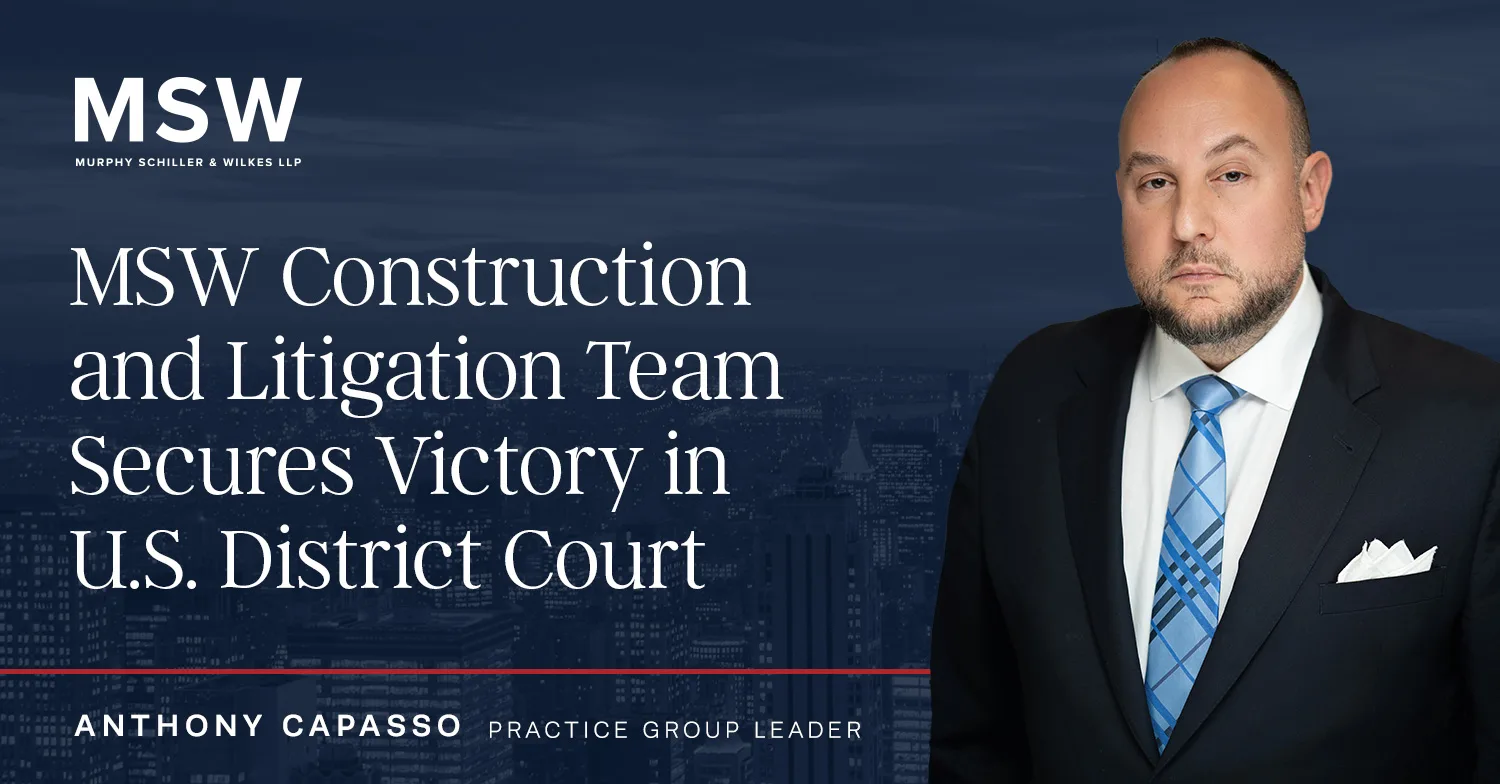

MSW Construction and Litigation Head Anthony Capasso Argues and Obtains Dismissal of Claims Against Client Engineer in United States District Court for the Eastern District of Pennsylvania

MSW’s Construction and Litigation Team head Anthony Capasso swiftly extricated its client engineering firm who performed municipal engineering services in Pennsylvania. The case involved a developer’s failure to obtain approvals for the development of properties and claim that the rejection of approvals violated Equal Protection or Substantive Due Process Clauses of the Fourteenth Amendment of the United States Constitution. Specifically, the developer believed it was unfairly treated, and that defendants’ rejection of development plans were driven by racial animus and with a goal of keeping minorities from living in the township. The developer alleged that the engineering firm hired on behalf of the township played a pivotal role in the township’s scheme to stop the developer from proceeding with its development plan.

MSW moved to dismiss under Rule 12(b)(6) based on the developer’s inability to set forth allegations of specific and consistent acts of racial discrimination by the engineering firm. MSW Construction and Litigation head Anthony Capasso crafted and delivered a multi-faceted argument centering on the developer’s lack of standing, the claims being barred by the two-year statute of limitations under 42 Pa. Cons. Stat. § 5524(2), and the claims being subject to qualified immunity. In its holding, the Court agreed with these arguments and held that the engineering firm’s acts on behalf of the municipality did not constitute discriminatory conduct but only prevented the developer from completing its project, as it would with any other similarly situated developer. Additionally, the Court held that the alleged discriminatory acts, even if true, were outside the statute of limitations and time barred.

MSW Adds Two New Attorneys in Continued Expansion of Construction and Litigation Practice Groups

Newark, NJ, February 14, 2025 – Murphy Schiller & Wilkes (MSW) is pleased to announce that Elias Arroyo and Jesse Tolentino have joined the firm.

Elias Arroyo has joined the firm as Counsel in the Construction Law and Litigation practice groups, where he will represent developers, owners, contractors, subcontractors, construction managers, architects, engineers, and surveyors across a wide array of matters in the real estate development and construction industries. Prior to joining MSW, Elias was a senior litigator at a New Jersey based law firm. Prior to entering private practice, Elias was a law clerk to the Honorable Ana C. Viscomi, J.S.C. at the Superior Court of New Jersey, Middlesex County. Elias received his law degree, cum laude, from Touro College Jacob D. Fuchsberg Law Center, where he was the Managing Editor of the Touro Law Review, and his undergraduate degree, magna cum laude, from Berkeley College.

Jesse Tolentino has joined the firm as an Associate in the Construction Law and Litigation practice groups. In this role, he will advise clients in cases related to contract disputes, delay claims, defective construction claims, design negligence, and shareholder disputes in state and federal courts. Prior to joining MSW, Jesse worked at a national litigation firm in New York City. Jesse received his law degree from Seton Hall University School of Law, and his undergraduate degree from Binghamton University.

“We are incredibly excited to welcome Elias and Jesse to our growing team. Both have considerable experience and will have an immediate impact on our ability to continue to service clients at the highest level,” says Anthony Capasso, chair of the firm’s Litigation and Construction Law practice groups.

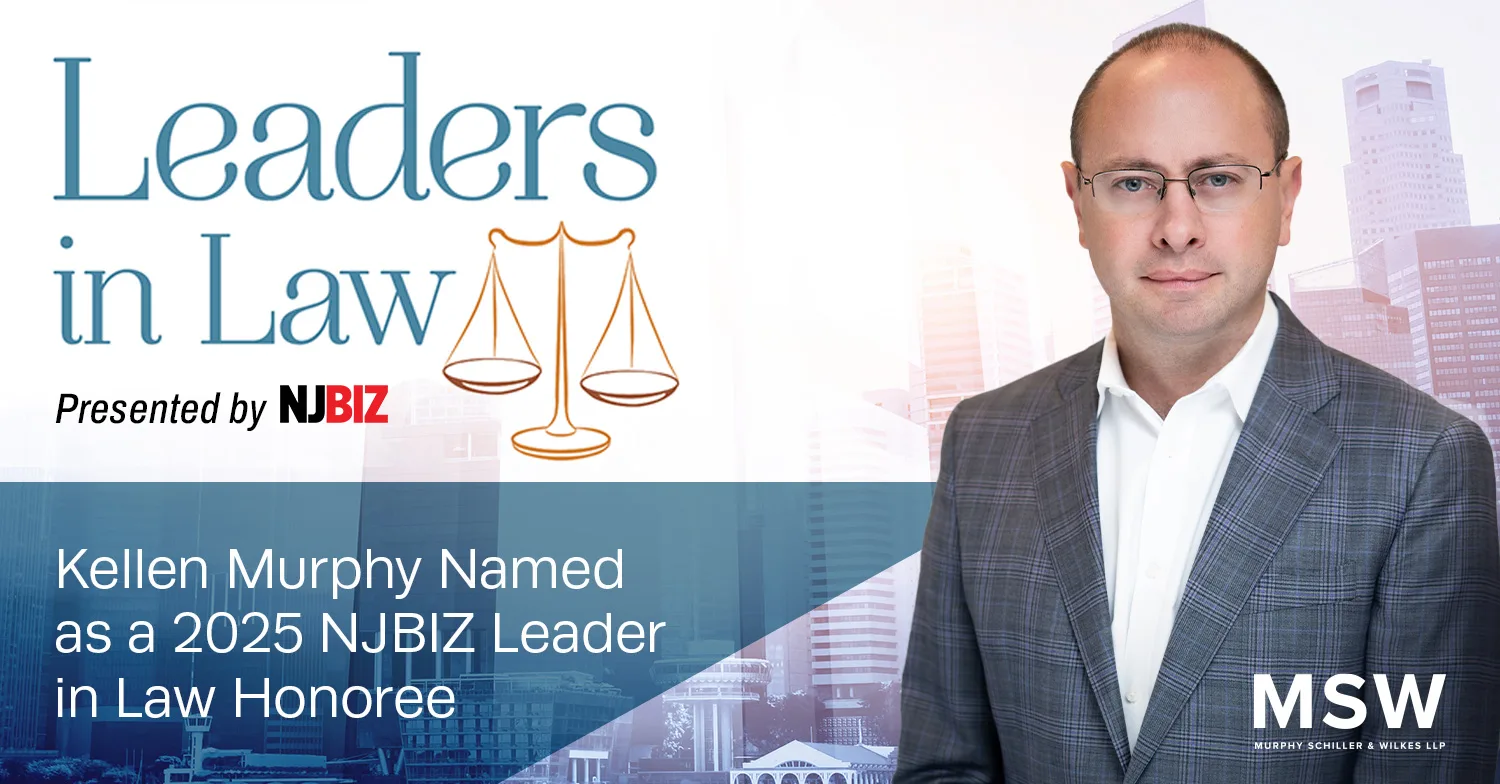
Kellen Murphy Named to NJBIZ Leaders in Law List

Murphy Schiller & Wilkes LLP (MSW) is pleased to announce that Kellen Murphy has been named as a 2025 NJBIZ Leader in Law Honoree. The Leaders in Law awards program honors legal professionals – lawyers and general counsels – whose dedication to their occupation and to their communities is outstanding.

For more information on the awards ceremony and a full list of the 2025 honorees, please click here.

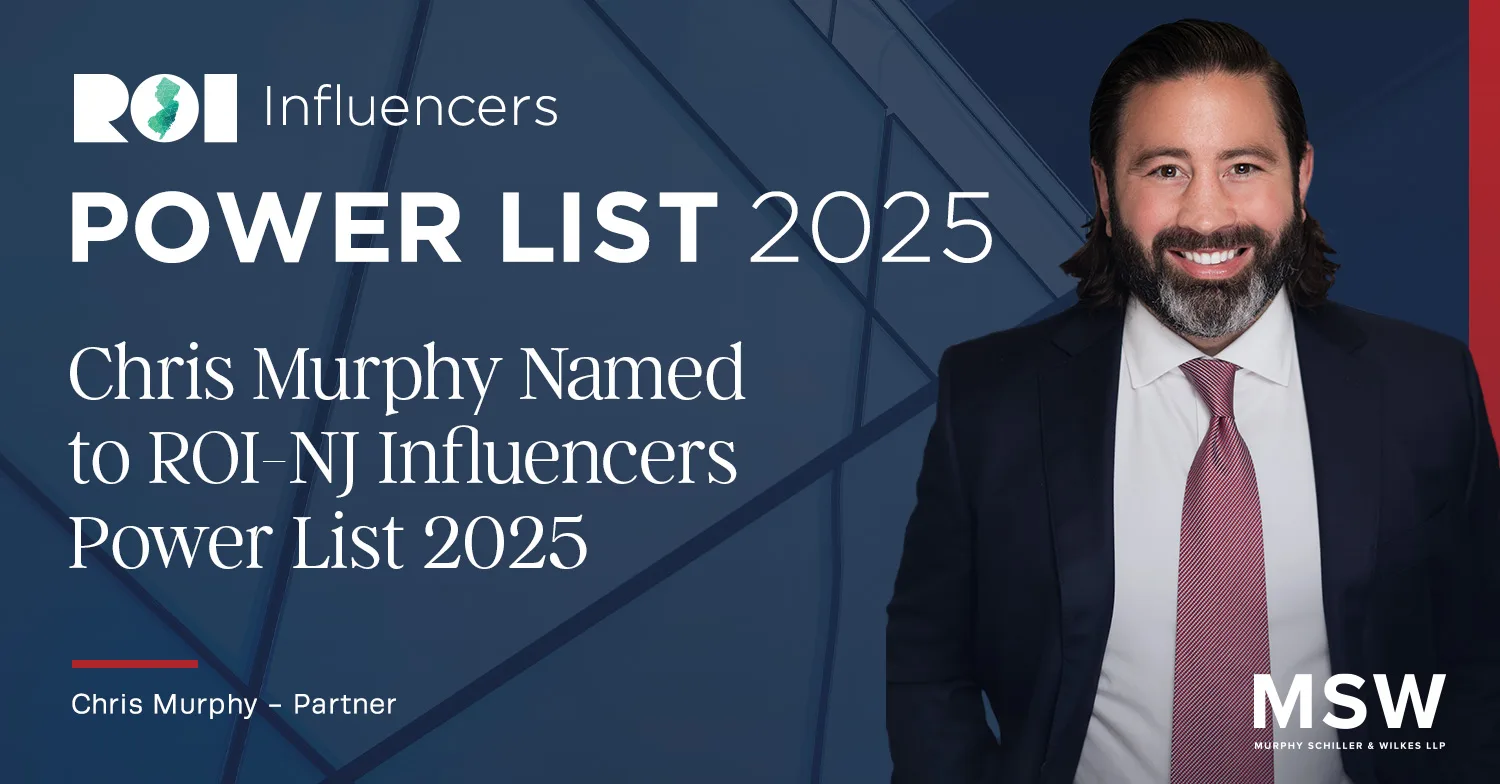
Chris Murphy Named to ROI Influencers: Power List 2025

Murphy Schiller & Wilkes LLP (MSW) is pleased to announce that Chris Murphy has been named to the ROI Influencers: Power List 2025 – Law rankings. The list contains influential power players helping businesses navigate New Jersey’s complex legal and regulatory environment.

The full list can be found here.

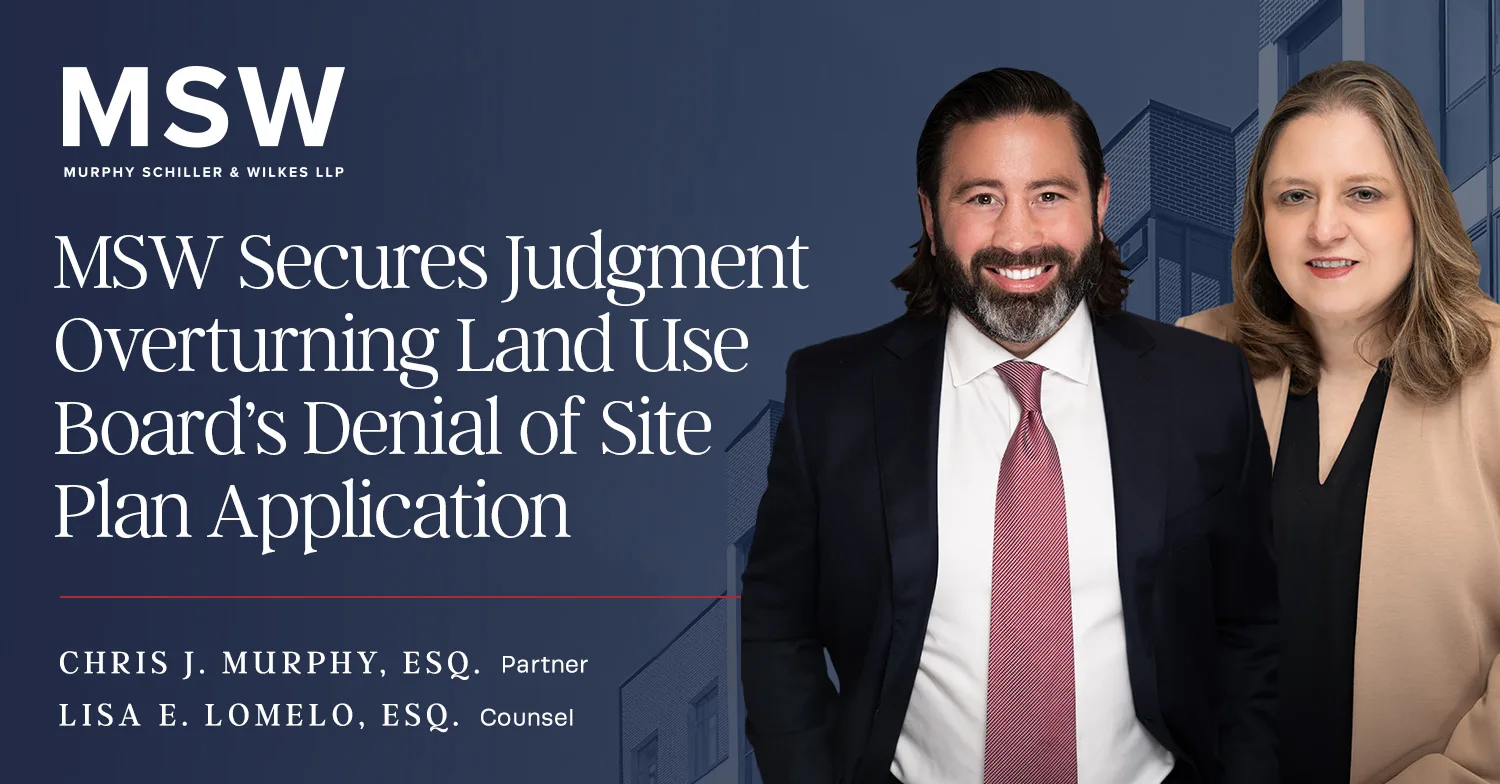
MSW Secures Judgment Overturning Land Use Board’s Denial of Site Plan Application

Murphy Schiller & Wilkes LLP (MSW) obtained a judgment granting approval for its client’s land use application for a multi-family residential development in the City of Orange, reversing the Planning Board’s denial of an application seeking Preliminary and Final Major Site Plan approval. The applicant proposed a 5-story building with parking on the ground floor level. The Planning Board denied the application, citing concerns over the scale of the project and potential problems with off-site parking.

MSW filed a prerogative writ action seeking to reverse the Planning Board’s decision and requesting that the Court approve the application. The Court agreed that the Planning Board acted in a manner that was “arbitrary and capricious,” and denied the application without legal or factual justification. The Court entered judgment approving the Site Plan application. By approving the Site Plan, the client can move forward with the permitting process without going back before the Planning Board.

The decision was a great win for the client, whose project was inappropriately delayed by the Planning Board’s actions. The Municipal Land Use Law intends to provide a level of certainly to developers who propose projects that are permitted and conforming with a municipal zoning ordinance. The Court’s decision upheld the client’s right to proceed.

MSW partner Chris Murphy and counsel Lisa Lomelo led the firm’s efforts, with Chris Murphy presenting the application before the Planning Board, and Lisa Lomelo arguing the prerogative writ action before the Court.

For more information, please reach out to:

Chris J. Murphy, Partner
Chair, Land Use, Zoning and Redevelopment
Phone: (973) 705-7421
Email: cmurphy@murphyllp.com

Lisa E. Lomelo, Esq.
Counsel, Land Use, Zoning and Redevelopment
Phone: (973) 750-4770
Email: llomelo@murphyllp.com

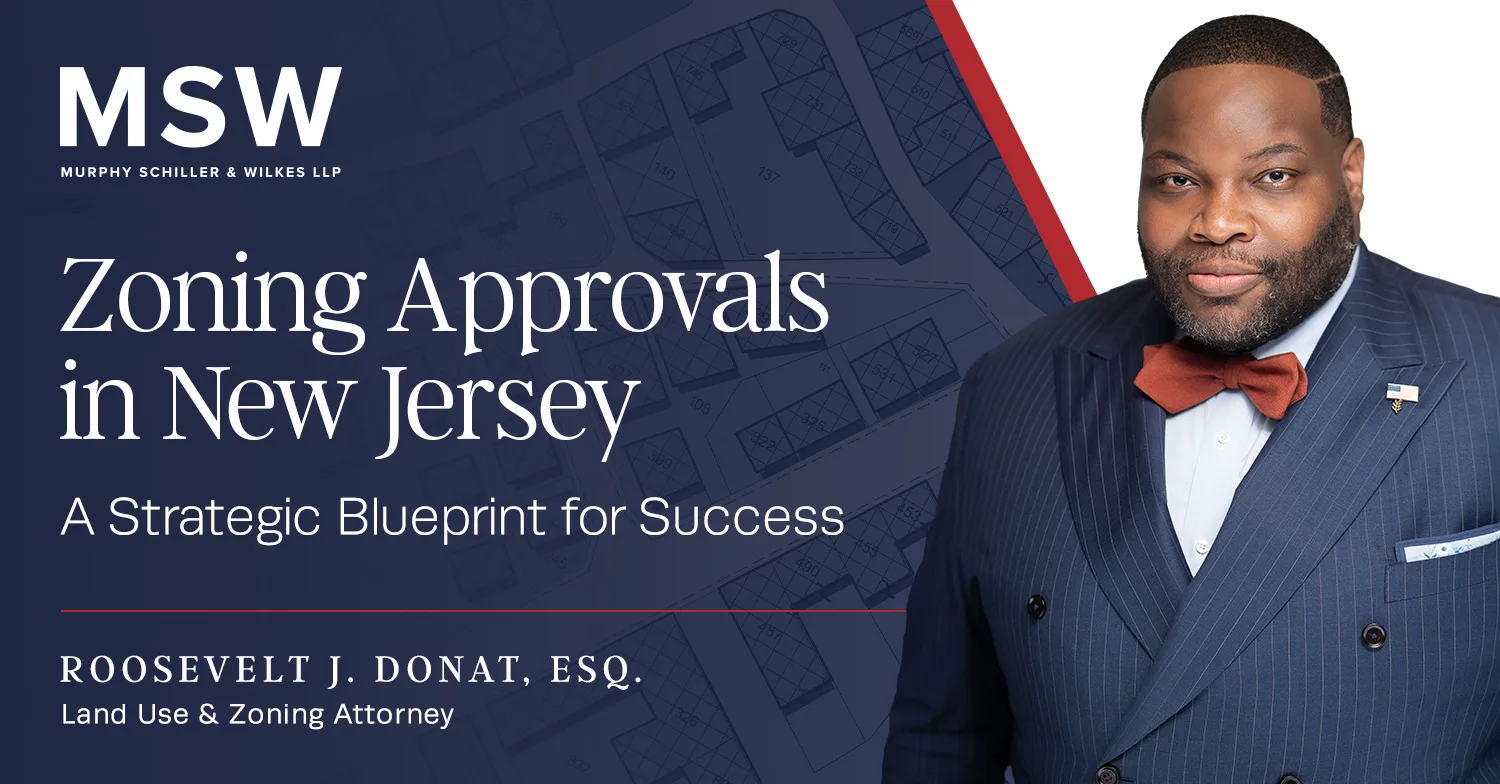
Zoning Approvals in New Jersey: A Strategic Blueprint for Success

Navigating the intricacies of zoning approvals is critical for the success of any construction project in New Jersey, where understanding and effectively overcoming these challenges is not just a compliance requirement but a strategic advantage that significantly impacts project success and profitability. This comprehensive overview offers advanced insights into securing zoning approvals, turning regulatory challenges into opportunities, and paving a clear path forward in the intricate landscape of real estate development.

Understanding Zoning Approvals in New Jersey

Zoning laws in New Jersey are fundamental to land use and development regulations, setting the stage for permissible activities, construction boundaries, and usage specifics across the state. Early mastery of these laws is essential, as it saves time and boosts profitability, allowing developers and investors to optimize their site selection and design processes, thus setting projects on a path to timely approval and financial success.

Strategic Zoning Analysis for Project Optimization

Beyond basic economic evaluations, strategic site analysis in New Jersey delves into the complexities of zoning laws that influence potential development sites. Developers are encouraged to employ advanced techniques such as predictive analytics and scenario planning. These tools not only forecast regulatory changes but also assess their potential impacts on project returns, providing a strategic edge in navigating New Jersey’s unique market.

Innovative Technology in Real Estate: BeyondView’s Impact

One such technology solution in the market for strategic zoning analysis is BeyondView. In a recent briefing with BeyondView’s CEO, Kul Wadhwa, and Board Chair, Peter Cuneo, they highlighted how their Twinning technology not only facilitates but also enhances real estate management. This technology transforms physical structures into precise, interactive, and photorealistic digital twins, streamlining real estate asset management through all stages, from marketing and design to repositioning and operations.

Overcoming Common Zoning Challenges

The complex zoning challenges in New Jersey, ranging from land use restrictions to environmental compliance, necessitate a comprehensive set of tools including advanced negotiation techniques and legal strategies tailored to New Jersey’s specific requirements. To navigate these challenges effectively, you must employ these methods and also understand how to leverage zoning variances and amendments to enhance the feasibility of your projects. Employing counsel familiar with the intricacies of New Jersey’s zoning laws is crucial for success in this dynamic regulatory environment.

Zoning as a Cornerstone of Risk Management

Effective risk management in real estate development hinges on a deep understanding and strategic integration of zoning laws. To maximize project stability and profitability, it is essential to align zoning compliance with broader project risk management strategies. A highly effective risk management tactic involves organizing a pre-application meeting where your legal counsel can preview the project plans with municipal, county, or state officials, depending on the project’s scale. This early engagement allows you to gather crucial feedback before substantial pre- development expenses are incurred. Such proactive measures not only mitigate financial risks but also streamline regulatory processes, ensuring your project progresses on a solid, well- informed foundation.

Advanced Stakeholder Engagement and Community Relations

Securing zoning approval often hinges on effective stakeholder management strategies. Prospective developers should consider organizing virtual town halls, particularly when in-person community meetings are not viable. These virtual engagements enable stakeholders to visualize the project’s impacts comprehensively, enhancing communication and strengthening community relationships. Such proactive engagement smooths the path to approval and sets the stage for successful land use board discussions.

Conclusion: Elevating Zoning Strategy to Achieve Project Excellence

Understanding and expertly navigating zoning approvals is vital for maximizing the success of construction projects in New Jersey. Developers who employ advanced analytical techniques, engage stakeholders through creative strategies, and apply effective risk management can transform zoning challenges into substantial opportunities for growth and profitability. This strategic mastery not only accelerates the approval process but also significantly enhances the project’s potential in New Jersey’s dynamic real estate market.

For more information, please contact:

Roosevelt J. Donat, Esq.
Special Counsel
Land Use, Zoning and Redevelopment
Phone: (973) 705-7414
Email: rdonat@murphyllp.com

Why Every Developer Should Consider the Aspire Tax Credit Program

The Aspire Tax Credit Program (Aspire), administered by the New Jersey Economic Development Authority (NJEDA), is New Jersey’s main developer-focused incentive program, designed to spur residential and commercial development through the provision of tax credits. Established under the Economic Recovery Act of 2020, the program has quickly become an important tool for real estate developers, with the NJEDA having approved over $2,600,000,000 in tax credits for 26 development projects in municipalities across state.

Despite the program’s success and broad applicability, many developers mistakenly believe their developments do not qualify. While all projects must show a financial need and adhere to the program’s requirements, including prevailing wage and affordability standards, the constraints related to geography, project size, and use are far less restrictive than many developers assume.

Beyond the City Limits

A common misconception is that Aspire was designed just for urban centers like Newark and Jersey City. However, the program applies to projects throughout state, with Aspire-eligible sites located in nearly every county. Morristown, Bayonne, Sayreville, Woodbridge, Camden, Hoboken, Fort Monmouth, Newark, New Brunswick, Somers Point, Trenton, Union City, Washington Township, and West Deptford, have all been home to approved Aspire projects.

Both Urban and Suburban areas, as defined by the New Jersey State Development and Redevelopment Plan (SDRP), are Aspire-eligible, as well as:

  • Aviation Districts
  • Port Districts
  • Designated Centers identified by the SDRP
  • Brownfield sites as defined by the “Brownfield and Contaminated Site Remediation Act”
  • Certain other sites with significant environmental remediation costs

Special Mission Non-Profit and some film-related projects are not subject to any geographic restrictions.

Not Just Residential

Although the Aspire program has been a successful gap financing tool for residential projects, it can also fund commercial projects, including office, retail, industrial, film, healthcare and some warehouse and distribution uses. The NJEDA has awarded Aspire tax credits to various commercial and mixed-use projects, including:

  • $271,186,902 to Helix Phase I, a 12-story, 573,400-square-foot office building in downtown New Brunswick.
  • $199,960,465 to the latest NJPAC development, including 577,900 square feet of mixed-used space, including residential, office, retail, office, educational and performance uses.
  • $113,651,245 to a mixed-use project in Woodbridge, including a 244,524 square feet corporate and medical office space.
  • $387,000,000 to Netflix for their new 1,000,000 square feet studio campus in Fort Monmouth.
  • $21,794,281 to the South Ward Wellness Center, a new 46,413 square foot health services center in Newark.

Smaller Projects Qualify

Aspire is not only for large-scale projects. Although the program has awarded tax credits to several large transformative developments, projects as small as $5,000,000 are eligible.

Residential and healthcare services development must meet minimum costs thresholds:

  • $17,500,000 in a municipality with a population greater than 200,000 (Jersey City and Newark)
  • $10,000,000 in other municipalities
  • $5,000,000 in a qualified incentive tract or government-restricted municipality (GRM)

The original three GRMs were Atlantic City, Paterson and Trenton, with New Brunswick, Camden and East Orange added in the latest amendment to the program.

Commercial projects must similarly reach a minimum square footage threshold:

  • 25,000 square feet in a GRM
  • 50,000 square feet in other eligible locations
  • 10,000 square feet if a health care or health services center

A Program Every Developer Should Explore

Aspire is a widely applicable program designed to close financing gaps for residential and commercials projects throughout New Jersey. While it may not be the right fit for every project, developers may be leaving money on the table by not performing due diligence related to Aspire as part of the development process.

The Tax Credit & Incentives team at Murphy Schiller & Wilkes LLP (MSW) can assist. Please feel free to reach out to us with any questions.

Chris J. Murphy, Partner
Chair, Tax Credits & Incentives
Phone: (973) 705-7421
Email: cmurphy@murphyllp.com
Brendan Pytka
Director of Tax Credits & Incentives
Phone: (862) 418-3702
Email: bpytka@murphyllp.com