MSW Welcomes Back Hannah Wolinsky to Its Transactional Real Estate Group

Newark, NJ – Murphy Schiller & Wilkes LLP (MSW) is pleased to announce that Hannah Wolinsky has rejoined the firm as an associate in its transactional commercial real estate practice group. Hannah originally joined MSW in 2021, quickly establishing herself as a valued member of the team. After briefly pursuing another professional opportunity, she has returned to MSW, bringing with her a renewed commitment to serving the firm’s clients and contributing to the continued growth of the firm’s transactional group.

Hannah’s practice focuses on representing developers, investors, lenders, and other stakeholders in a wide range of commercial real estate transactions, including acquisitions, dispositions, financings, and leasing matters. Her experience and dedication to client service have made her a trusted advisor to clients and colleagues alike.

“We are thrilled to welcome Hannah back to the firm,” said Charles J. Wilkes, head of the firm’s Real Estate Finance practice group. “Hannah is a highly skilled transactional attorney. Her deep understanding of the commercial real estate market, combined with her strong work ethic and collaborative approach, make her an invaluable asset to our team. We look forward to her continued contributions as we expand our capabilities and serve our clients’ evolving needs.”

Hannah’s return underscores MSW’s commitment to attracting and retaining top legal talent in the commercial real estate sector. The firm remains dedicated to providing exceptional legal counsel and innovative solutions to clients throughout the country.

Practice Group Series – Distressed Real Estate

Due to MSW’s broad, multi-disciplinary experience in commercial real estate, we are able to efficiently and effectively negotiate and litigate the often complex issues that can arise with distressed real estate assets.

MSW’s transactional and litigation attorneys focus on the representation of institutional real estate lenders, private equity firms, and other investors who own or seek to acquire distressed real estate loans, mortgage-backed securities and real estate, as well as borrowers seeking to restructure or otherwise resolve their troubled debt. In addition, the firm’s attorneys represent lenders and borrowers in commercial foreclosure litigation in New Jersey, New York, and Connecticut.

Practice Group Leader:

Matthew J. Schiller
Partner
Phone: (973) 705-7431
Email: mschiller@murphyllp.com

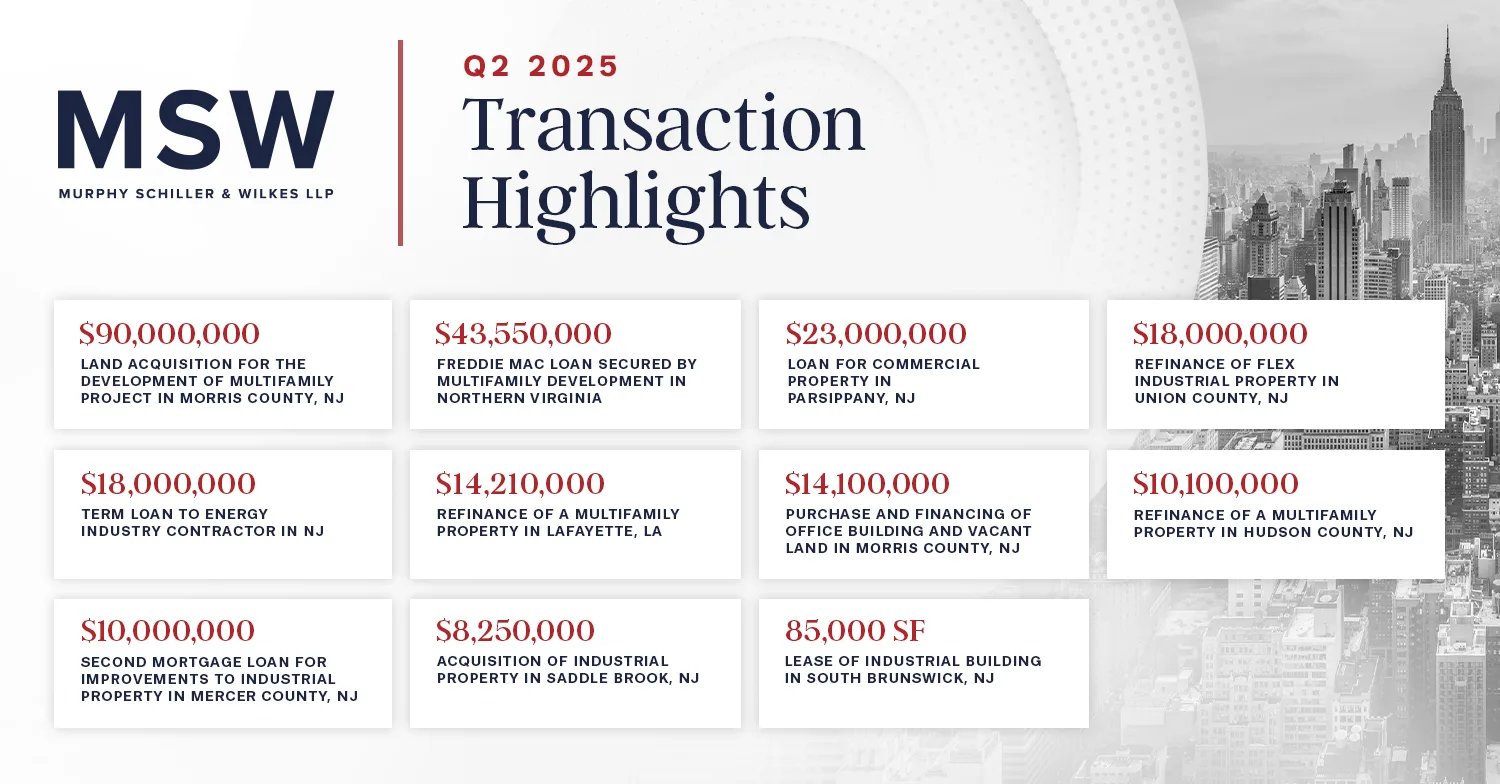
MSW – Q2 2025 Transaction Highlights

The second quarter of 2025 ended strong for the attorneys at Murphy Schiller & Wilkes LLP (MSW). The firm acted as lead counsel in connection with the acquisition and sale of property in all asset classes, helped our clients negotiate large lease transactions, and represented both lenders and borrowers in connection with financing CRE deals, both locally and nationally.

In Q2 2025, the firm represented the following:

  • Developer in connection with $90,000,000 acquisition of entitled land for the development of a 200-unit multifamily project in Morris County, New Jersey.
  • Private equity borrower in connection with $43,550,000 Freddie Mac loan secured by multifamily development in Northern Virginia.
  • Private equity firm in connection with negotiation of participation agreement in connection with $23,000,000 loan for commercial property in Parsippany, NJ.
  • New Jersey bank in connection with an $18,000,000 refinance of a Union County, New Jersey flex industrial property.
  • New Jersey bank in connection with an $18,000,000 term loan to energy industry contractor.
  • National bank in connection with a $14,210,000 refinance of a multifamily property in Lafayette, Louisiana.
  • Developer in connection with $14,100,00 purchase and financing of 117,492 SF multi-tenant office building and 14 acres of vacant land in Morris County, New Jersey.
  • National bank in connection with a $10,100,000 refinance of a multifamily property in Hudson County, New Jersey.
  • New Jersey developer in connection with a $10,000,000 second mortgage loan for improvements to industrial property in Mercer County, New Jersey.
  • Purchaser in connection with $8,250,000 acquisition of industrial property in Saddle Brook, New Jersey.
  • Landlord in connection with lease of 85,000 SF industrial building in South Brunswick, New Jersey.

Significant Changes to New Jersey’s “Mansion Tax” and Realty Transfer Fees

Significant Changes to New Jersey’s “Mansion Tax” and Realty Transfer Fees:

New Seller Obligations Effective July 10, 2025

On June 30, 2025, the New Jersey Legislature enacted new legislation (A5804, S4666) that substantially revises the state’s “mansion tax” and realty transfer fee structure. These changes will impose significant new financial obligations on sellers of certain high-value residential and commercial properties in New Jersey. Of critical importance, the new law shifts the responsibility for payment of “mansion” tax by purchasers to a new supplemental realty transfer fee payable by sellers and significantly increases the applicable rates for qualifying transactions.

Key Changes and Affected Property Classes

Previously, purchasers of the following property types (collectively, “Qualified Property”) with a purchase price of $1,000,000 or more were required to pay a 1% “mansion tax” at closing:

  • Class 2: Residential property
  • Class 3A: Farmland with a building or structure intended or suited for residential use
  • Class 4A: Commercial property (excluding industrial or apartment properties)
  • Class 4C: Cooperative units

Effective July 10, 2025, the obligation to pay the supplemental realty transfer fee will shift from purchasers to sellers (grantors) of Qualified Property. The new supplemental realty transfer fee rates for Qualified Property will be as follows:

1% $1,000,000 – $2,000,000
2% Over $2,000,000 – $2,500,000
2.5% Over $2,500,000 – $3,000,000
3% Over $3,000,000 – $3,500,000
3.5% Over $3,500,000

Notably, the supplemental realty transfer fee will be payable at closing in addition to the existing New Jersey Realty Transfer Fee under N.J.S.A. 46:15-7. As a result, the transfer tax obligations of sellers of Qualified Property in New Jersey will significantly increase as of July 10, 2025, unless otherwise contractually allocated by the parties to a transaction.

In addition to modifying the 1% “mansion” tax, the legislation also amends the 1% controlling interest transfer tax, which applies to the sale or transfer (for consideration exceeding $1,000,000) of a controlling interest in an entity that owns, directly or indirectly, Class 4 “commercial” real property. Under the new law, the responsibility for payment also shifts from the purchaser to the seller and the applicable rates mirror those of the supplemental realty transfer fee described above.

New Jersey’s County Clerks will begin collecting the supplemental realty transfer fee on July 10, 2025. Of critical importance, for transactions under contract prior to July 10, 2025, a partial refund may be available for amounts paid in excess of 1%, provided the deed is submitted for recording before November 15, 2025.

The new legislation represents a significant shift in both the responsibility and amount of realty transfer fees for high-value real estate transactions in New Jersey. Both purchasers and sellers of Qualified Property should be mindful of materially increased transfer costs obligations (based on the terms of their respective contracts) and confirm amongst parties how the increased transaction costs are to be allocated. Parties currently negotiating or under contract for affected transactions should carefully consider the timing of contract execution and deed recording to potentially benefit from the transitional relief provided in the legislation.


Analysis of the New Jersey Unused Tax Credits Purchase Act (A5170/S4027)

The New Jersey Unused Tax Credits Purchase Act, recently enacted by the New Jersey Legislature and signed by Governor Murphy, authorizes the New Jersey Department of the Treasury, through the Division of Taxation, to purchase unused tax credits issued under a range of state economic development programs. The legislation specifically addresses the purchase of tax credits under the following programs:

  • Historic Property Reinvestment Act
  • Brownfield Redevelopment Incentive Program Act
  • New Jersey Innovation Evergreen Act
  • Food Desert Relief Act
  • New Jersey Community-Anchored Development Act
  • New Jersey Aspire Program Act
  • Emerge Program Act
  • Grow New Jersey Assistance Program
  • State Economic Redevelopment and Growth Grant Program
  • Cultural Arts Incentives Program Act

The Treasury would be required to purchase unused tax credits under the Aspire and Cultural Arts Facilities (CAFE) programs.

A critical feature of the Act is the establishment of specific purchase percentages for unused tax credits. For most programs, the Director of the Division of Taxation may purchase unused credits at up to 75% of their face value. However, for the New Jersey Aspire Program and the Cultural Arts Incentives Program, the Director is required to purchase unused credits at 85% of their face value, provided that the tax credit certificate was issued at least one year prior to the application for purchase. For Aspire credits, if the application is made after the sixth year of the eligibility period, the amount in excess of the reasonable and appropriate rate of return on investment increases to 50%.

Potential Legal and Practical Implications

For lenders and other parties interested in financing against Aspire tax credits, the Act provides a significant enhancement to the liquidity and certainty of these credits. The state’s obligation to purchase unused Aspire and CAFE credits at 85% of face value (subject to the one-year holding period) creates a reliable exit mechanism for holders, which can be leveraged as collateral in financing transactions. This statutory buyback feature reduces the risk profile for lenders, as it establishes a clear, state-backed floor for the value of the credits.

Additionally, the Act’s provisions may increase the attractiveness of Aspire credits as a financing tool, potentially leading to more favorable lending terms and broader participation by financial institutions. The requirement that the credits be held for at least one year before being eligible for state purchase may influence the structuring of loan maturities and collateral arrangements.

Notable Changes from Prior Law

Prior to this legislation, holders of unused tax credits under the Aspire Program and other covered programs had limited options for monetizing their credits, often relying on private market sales or transfers, which could be subject to discounts and market uncertainty. The new law introduces a state-backed purchase mechanism, providing a guaranteed liquidity option at a defined percentage of face value, which did not previously exist.

Relevant Deadlines and Compliance Requirements

  • One-Year Holding Period: For Aspire and Cultural Arts credits, the tax credit certificate must have been issued at least one year prior to the application for state purchase.
  • Application Timing: For Aspire credits, if the application is made after the sixth year of the eligibility period, the amount in excess of the reasonable and appropriate rate of return on investment increases to 50%.
  • Immediate Effect: The Act takes effect immediately, making its provisions available to current and future holders of eligible tax credits.

Implications for Lenders

  • Reduced Credit Risk: The statutory buyback at a defined percentage of face value significantly reduces the risk associated with lending against Aspire credits, as the state provides a clear, enforceable floor for their value.
  • Improved Collateral Value: Aspire credits become a more attractive and predictable form of collateral, potentially leading to more favorable loan terms and increased lender participation.
  • Structuring Considerations: Lenders should note the one-year holding period requirement before credits are eligible for state purchase, which may affect loan maturity and collateral release provisions.
  • Timing for Applications: For applications made after the sixth year of the eligibility period, special rules apply regarding the return on investment, which may impact the economics of longer-term financing arrangements.

The New Jersey Unused Tax Credits Purchase Act represents a major development for lenders and other stakeholders in the state’s economic development ecosystem. By providing a state-backed purchase option for Aspire and CAFE tax credits, the law enhances the utility and security of these credits in financing transactions. Lenders are encouraged to review the new provisions carefully and adjust their practices to maximize the benefits of this legislative change.

For more information, please contact:

Brendan Pytka
Director of Tax Credits & Incentives
Phone: (862) 418-3702
Email: bpytka@murphyllp.com

Chris Murphy, Partner
Chair, Tax Credits & Incentives
Phone: (973) 705-7421
Email: cmurphy@murphyllp.com

Major Changes to Newspaper Notice Requirements Under the New Jersey Municipal Land Use Law (MLUL)

The New Jersey Municipal Land Use Law (MLUL) has long established strict procedural requirements for providing public notice of land use applications. Under the current law, applicants seeking approvals for development, variances, or other land use actions must provide notice in two primary ways:

  1. Certified Mail to Property Owners: Notice must be sent by certified mail to all property owners within 200 feet of the subject property. This ensures that those most directly affected by a proposed development are informed and have an opportunity to participate in the public process.
  2. Newspaper Publication: Notice must also be published in an official newspaper of general circulation in the municipality at least 10 days prior to the scheduled public hearing. This requirement is designed to provide broader public awareness and transparency regarding pending land use matters.

These notice requirements are foundational to the MLUL’s commitment to public participation and due process in local land use decision-making.

New Legislation: Modernizing Legal Notice Publication

A newly enacted bill—S4654/A5878—recently passed with overwhelming support in both the Senate and Assembly and expected to be signed by Governor Murphy, brings significant changes to the way legal notices, including those required under the MLUL, must be published. The legislation, effective March 1, 2026, modernizes the notice process by shifting the focus from traditional print newspapers to digital platforms. Key provisions include:

  • Mandatory Online Publication: After March 1, 2026, public entities (including municipal land use boards) required by law to publish legal notices must do so on their official government websites. The website must be accessible to the public free of charge, and a direct hyperlink to legal notices must be prominently displayed on the homepage.
  • Centralized State Portal: The Secretary of State will establish a centralized online portal that aggregates hyperlinks to the legal notice pages of all public entities. This portal will also be freely accessible to the public.
  • Archiving Requirements: Legal notices must remain on the public entity’s website for at least one week (or longer, if required by law) before being transferred to an online archive, which must be maintained for at least one year.
  • Optional Use of Online News Publications: Local government units may, in addition to their own websites, publish legal notices in eligible online news publications that meet specific criteria for accessibility, searchability, and local reach.
  • Transitional Period: Until March 1, 2026, municipalities may continue to use print or electronic newspapers for legal notices, as previously permitted.

Implications for Land Use Applicants and Municipal Authorities

These changes represent a fundamental shift in how public notice is provided for land use applications:

  • Increased Accessibility and Transparency: By requiring publication on official government websites and a centralized state portal, the new law aims to make legal notices more accessible to the public, eliminating paywalls and subscription barriers often associated with traditional newspapers.
  • Potential for Broader Public Awareness: Online publication may reach a wider audience, including those who do not regularly read print newspapers but have internet access.
  • Changes in Compliance Procedures: Applicants and municipal authorities must adapt their notice procedures to ensure compliance with the new online publication requirements. This includes understanding the technical aspects of posting notices, maintaining archives, and ensuring that notices are posted for the required duration.
  • Continued Certified Mail Requirement: The new law does not alter the requirement to provide notice by certified mail to property owners within 200 feet. This remains a critical component of the MLUL notice process.
  • Legal Sufficiency and Risk Mitigation: The law provides that publication of legal notices on a public entity’s website or an eligible online news publication, in accordance with the new requirements, satisfies the legal obligation for notice. It also includes protections against defects in notice due to technical errors or outages beyond the control of the public entity or applicant.

Recommended Actions and Considerations

Given the significant changes to the legal notice landscape, we recommend the following actions for clients and stakeholders involved in land use matters:

  • Stay Informed and Plan Ahead: Applicants and municipal officials should familiarize themselves with the new requirements and begin planning for the transition to online notice publication. This may involve updating internal procedures, training staff, and coordinating with IT departments.
  • Monitor Implementation Timelines: The new requirements become mandatory on March 1, 2026. Until then, existing newspaper notice practices remain valid, but early adoption of online notice procedures may ease the transition.
  • Verify Website Accessibility: Municipalities should ensure their official websites are capable of hosting legal notices in a manner that is easily accessible, searchable, and compliant with the new law’s requirements.
  • Consult Legal Counsel: Given the potential for procedural challenges and the importance of proper notice in land use approvals, applicants and municipal authorities should consult with legal counsel to ensure full compliance and to address any questions regarding the new procedures.
  • Document Compliance: Maintain thorough records of all notice publications, including screenshots, posting dates, and archive logs, to demonstrate compliance in the event of a legal challenge.

The modernization of legal notice requirements under the MLUL reflects a broader trend toward digital government and public transparency. While these changes promise greater accessibility and efficiency, they also require careful attention to new procedures and compliance standards. As a leader in New Jersey land use and zoning law, MSW is available to assist clients in navigating these changes and ensuring that all land use applications and approvals are properly noticed under the new law.