Monarch Raises the Bar for Inherently Beneficial Use Variances in New Jersey

Developers can no longer rely on public need alone. The planning record must support the site before the board reaches the final Sica balance.

A project can meet a recognized public need and still fail if the site conflicts with the municipality’s planning framework. That is the practical lesson of Monarch Communities, LLC v. Township of Montville. For developers, investors, lenders, and land-use counsel, the decision moves entitlement risk to the front end of the deal.

Issued July 13, 2026, the unanimous decision revises the Sica framework under N.J.S.A. 40:55D-70(d). A zoning board must now decide, before completing the remaining balancing analysis, whether the applicant has shown that the variance will not substantially impair the zone plan and zoning ordinance. Without that showing, the variance may not be granted.

The ruling preserves the preferential treatment afforded to inherently beneficial uses, but it resolves a point applicants have sometimes treated as flexible. Public need explains why a use matters. The planning record determines whether that use belongs at the proposed location.

The practical consequence is simple: municipal planning history is now acquisition diligence.

The Dispute: A Beneficial Use Outside the Municipality’s Planned Area

Monarch Communities proposed a 165-unit senior living facility on approximately eight acres in a Montville residential zone. The program included independent living, assisted living, and memory care, together with an affordable housing component. Its status as an inherently beneficial use was undisputed.

Montville had previously created a Senior Housing Overlay Zone. The planning board considered the Monarch site for inclusion, declined to include it, and cited a policy of preserving farmland and open space. That exclusion became part of the planning record. After a seven-day hearing, the zoning board denied the application, citing the municipality’s prior planning decisions and the proposed use’s effect on the zoning plan, among other factors.

The trial court reversed, and the Appellate Division affirmed. The Supreme Court reversed and remanded for application of the revised standard to the existing record. The Court did not hold that the project must fail. It required the lower court to apply the correct threshold analysis.

The New Threshold in the Sica Analysis

The Municipal Land Use Law requires use variance applicants to satisfy the positive criteria and two negative criteria. The first negative criterion addresses substantial detriment to the public good. The second addresses substantial impairment of the zoning plan and the zoning ordinance.

Under Sica v. Board of Adjustment of Wall, 127 N.J. 152 (1992), boards evaluating inherently beneficial uses followed a four-step analysis. The board identified the public interest served by the use, considered potential detrimental effects, evaluated reasonable conditions to reduce those effects, and then balanced the positive criteria against the negative criteria.

The Supreme Court concluded that the fourth step no longer aligned with the statute. The Legislature’s 1997 amendment to N.J.S.A. 40:55D-70 made both negative criteria applicable to every use variance applicant, inherently beneficial uses included. Sica had incorporated only the first.

The change is procedural in sequence but substantial in effect. The second negative criterion is now a threshold question, not an issue reserved for the final balancing step. Only after the applicant clears that threshold does the board weigh the positive criteria against the remaining negative-criteria analysis.

The Court expressly reaffirmed that the enhanced quality of proof required under Medici v. BPR Co., Inc., 107 N.J. 1 (1987), does not apply to inherently beneficial uses. Their preferential status remains intact. But the applicant must present an affirmative analysis of the variance’s impact on the zoning plan rather than rest on the beneficial-use designation alone.

Why the Planning Record Now Belongs in Early Deal Diligence

The Court’s reasoning reinforces a legislative preference: land use policy should be made through the planning process, not through individual variance applications.

A prior denial for the same property is not dispositive, but it may be a significant consideration. The Court also emphasized the value of detailed municipal findings concerning inherently beneficial uses, including periodic review of master plans and development regulations to account for changing conditions.

For developers, the significance extends well beyond the zoning map. A master-plan amendment, an overlay-zone boundary, a prior rezoning decision, or a documented preservation policy may each reveal why a particular use was directed toward one location rather than another. In Montville, the overlay-zone exclusion did exactly that.

The evidentiary status of those documents matters. The Court directed the Appellate Division on remand to clarify the status of Montville’s amended zoning plan and implementing ordinance at the time of the Zoning Board’s decision. Planning history is important evidence. It is not an automatic bar.

The Deal Consequence: Entitlement Risk Must Be Priced Before Acquisition

A project may have favorable demographics, strong market demand, attractive acquisition economics, sufficient acreage, and a demonstrated public need. None of those factors establishes that a use variance is achievable at a given site.

The planning record may reveal a different risk profile. A recent overlay-zone exclusion, rezoning decision, or preservation policy can affect the development program, entitlement timeline, predevelopment spend, contract contingencies, financing milestones, and ultimately price.

Legal diligence must therefore move beyond identifying the prohibited use and the required relief. It must examine the planning decisions underlying the prohibition and test whether the project can be defended within that framework. The objective is to surface entitlement risk early enough to structure the transaction around it.

Three Practical Steps Before Filing

1. Acquisition Diligence

  • Review the master plan, periodic reexamination reports, zoning amendments, redevelopment plans, overlay-zone history, prior applications, and municipal planning studies.
  • Use OPRA requests early to obtain prior application files, board minutes, and planner reports.
  • Identify the municipality’s stated objectives, the status of relevant planning documents, and likely substantial-impairment arguments.
  • Let those findings drive pricing, contingencies, outside dates, budgets, and project design.

Pay particular attention to recent decisions concerning the subject property and the proposed use category. An exclusion from an overlay zone may reflect a deliberate planning judgment concerning density, infrastructure, neighborhood character, environmental constraints, or the location of institutional uses.

2. Application Record

Planner testimony must directly address the second negative criterion. Establishing that the use is inherently beneficial is the starting point, not the argument.

  • Address the purpose of the zoning district and the municipality’s broader planning objectives.
  • Explain the requested deviations and the project’s compatibility with surrounding uses.
  • Confront inconsistent municipal planning decisions directly, including prior exclusions or denials.
  • Use changed conditions, site-specific distinctions, and revised design elements where they support the record.

Development intensity also belongs in the analysis. Alternative massing, reduced density, revised circulation, improved stormwater design, and other site-specific modifications may reduce conflict with the zoning plan. Conditions remain relevant, but they are not a substitute for satisfying the substantial-impairment requirement.

A persuasive application does not dismiss municipal planning policy. It explains why the requested relief does not substantially impair it.

Applicants with matters pending before a board should assess now, before final action, whether supplemental planner testimony on the second negative criterion is needed. A record built under the old sequence may not survive review under the new one.

3. Entitlement Alternatives

A municipality with a clear planning policy inconsistent with the proposed development may not be reachable through a use variance at all.

  • Consider rezoning where the proposed use aligns with the master plan but the zoning has not kept pace.
  • Evaluate redevelopment designation or a redevelopment-plan amendment where statutory criteria are met and the municipality is willing to proceed through the governing body.
  • Consider alternative site selection when the planning record creates threshold risk that planner testimony is unlikely to overcome.

The entitlement strategy should be selected before the development program hardens and before avoidable capital is spent.

What Monarch Does Not Mean

The decision restores the second negative criterion to its statutory role for inherently beneficial use applications. It requires boards to evaluate substantial impairment of the zoning plan as a threshold matter. It does not eliminate preferential treatment for inherently beneficial uses, make municipal opposition dispositive, make a prior denial automatically controlling, or impose the enhanced Medici standard.

Nor does it resolve Monarch’s own application. On remand, the Appellate Division must apply the revised standard to the existing record, including clarification of the status of Montville’s amended zoning plan and its implementing ordinance.

Monarch strengthens the statutory analysis. It does not convert every municipal planning preference into an absolute prohibition.

Bottom Line for Developers and Investors

Monarch changes the front-end analysis for inherently beneficial use projects: public need may justify the use, but the planning record must justify the site.

For sponsors, lenders, and land-use counsel, the strongest position is built before the acquisition contract is signed, when pricing, contingencies, design, and entitlement strategy can still be adjusted.

Roosevelt J. Donat, Esq. is Special Counsel at Murphy Schiller & Wilkes LLP, where he focuses on New Jersey real estate development, land use, zoning, redevelopment law, and government affairs.

This article is provided for informational purposes only and does not constitute legal advice. The application of the decision to a particular project depends on its facts, the applicable municipal planning record, and the governing law.

Sources: Monarch Communities, LLC v. Township of Montville, A-70-24 (N.J. July 13, 2026), slip op. at 26-30; N.J.S.A. 40:55D-70(d); N.J.S.A. 40:55D-89; Sica v. Board of Adjustment of Wall, 127 N.J. 152 (1992); Medici v. BPR Co., Inc., 107 N.J. 1 (1987).

Newark’s Affordable Housing Crisis Won’t Be Solved by Making Development Impossible

By Chris Murphy, Partner, Murphy Schiller & Wilkes LLP

Newark stands at a crossroads. For years, the city has worked to attract private investment in new housing, an effort that, despite persistent headwinds, has shown real progress. Mixed-income developments have risen in neighborhoods that spent decades waiting for reinvestment. Affordable units have been built alongside market-rate apartments, creating the kind of integrated, economically diverse communities that good housing policy is supposed to produce. None of it came easily, and none of it was inevitable.

Now, two simultaneous policy shifts threaten to undo all of it.

On July 23, 2026, the New Jersey Economic Development Authority (NJEDA) paused the Aspire Tax Credit Program, the state’s primary incentive for catalyzing mixed-use and residential development in cities like Newark. Weeks later, on August 5, 2026, the Newark Municipal Council voted 7–2 to refer a proposed amendment to the city’s Inclusionary Zoning Ordinance to the Central Planning Board for review. This week, the Central Planning Board voted to refer the proposed amendment back to the City Council with a recommendation that it be adopted. Taken together, these actions could freeze new residential development in Newark at precisely the moment the city needs it most.

Let me be clear: I support affordable housing. I have spent my entire career in New Jersey real estate law, and I understand the urgent need for housing that working families can actually afford. But good intentions do not build buildings. Capital does. And capital is rational. It flows to places where projects can be underwritten, financed, and built. When the math doesn’t work, the capital goes elsewhere, or it simply stays on the sidelines. That is not ideology. It is arithmetic.

The Aspire Program Made the Math Work.

Newark’s existing Inclusionary Zoning Ordinance, adopted in 2017 and amended several times since, requires that any new residential or mixed-use development of 15 or more units set aside 20% of its total units as income-restricted affordable housing. That is a meaningful obligation. For a 200-unit multifamily project, it means 40 units must be rented at below-market rates to households earning no more than 40%, 60%, or 80% of the Area Median Income.

The Aspire Tax Credit Program (and its predecessor program) helped bridge the gap between what developers could charge for those restricted units and what it actually costs to build them. The tax credits, awarded over a multi-year period, provided the financial cushion that made inclusionary projects pencil. Without Aspire, many of the projects currently in Newark’s pipeline would never have broken ground.

Aspire is on pause. The NJEDA has indicated it expects to begin accepting applications again in the fall, but no specific timeline has been set. Anyone who has worked with government programs knows that “fall” can easily become winter, and winter can become next year. In the meantime, developers who were counting on those credits to close financing gaps are scrambling. Projects in predevelopment are being shelved. Lenders are pulling back. The pipeline is drying up.

The Proposed Amendment Makes a Hard Problem Harder.

Into this vacuum, the City of Newark has proposed an amendment to its Inclusionary Zoning Ordinance that would fundamentally redefine how affordable housing obligations are calculated. The amendment does two things that should alarm anyone who actually wants to see affordable housing built in Newark.

First, it redefines “Median Income” from the regional median, the standard used across New Jersey’s affordable housing framework, to the Newark-specific median income, which the amendment pegs at just 42% of the regional figure, or approximately $58,490. This is not a technical adjustment. It is a seismic shift. Every income threshold in the ordinance is anchored to the median income definition. By resetting the benchmark to a figure that is less than half of the current standard, the amendment would require developers to price affordable units at income levels so low that the rents cannot come close to covering operating costs, let alone debt service.

Consider the numbers. Under the current ordinance, the largest tier of affordable units in a 200-unit project, 20 units at 80% of the regional AMI, can be rented to households earning roughly $111,000 per year, translating to rents of approximately $2,785 per month. Under the proposed amendment’s baseline option, those same 20 units would be restricted to households earning no more than 34% of the Newark Median Income, approximately $19,900 per year. The maximum permissible rent would be roughly $497 per month. That is an 82% reduction in the income a developer can underwrite against for a significant portion of the required affordable units.

No tax credit, density bonus, or parking waiver on earth can bridge a gap that wide.

Second, the amendment introduces a tiered structure offering developers the option of a higher set-aside, up to 31% or more of total units, in exchange for access to a “workforce housing” tier at 100% to 120% of the Newark Median Income. On its face, this looks like flexibility. In practice, it is a Hobson’s choice. Option 1, the baseline 20% set-aside, imposes income restrictions so severe that the units are essentially unfundable without deep subsidy. Options 2 and 3 require developers to designate 25% to 35% of their total units as affordable, far more than the current 20%, and even the most favorable income tier in those options (120% of Newark Median Income, or about $70,200) remains well below what was the 80%-of-AMI threshold under the existing ordinance.

The Consequences Are Predictable.

If both of these policy shifts take effect simultaneously, the Aspire pause and the amended IZO, the consequences are not just foreseeable, they are inevitable. Developers will not build projects they cannot finance. Lenders will not underwrite loans against rental income streams that cannot service debt. Equity investors will redirect capital to municipalities with clearer, more predictable regulatory frameworks. The result will not be more affordable housing in Newark. It will be less housing of every kind, affordable and market-rate alike.

This is not speculation. We are already seeing it. Higher interest rates driven by elevated bond yields have compressed returns across the industry. Construction costs remain stubbornly high. Insurance premiums have surged. In this environment, every additional dollar of regulatory cost or uncertainty tips the balance sheet from feasible to infeasible. Newark is competing for a finite pool of development capital against cities and suburbs across the region and the country. Making Newark’s regulatory environment more burdensome, at the very moment the state has pulled the rug out from under developers, sends exactly the wrong signal to the market. Capital has options. Newark needs to give it a reason to stay.

A Better Path Forward.

Newark deserves an affordable housing policy that actually produces affordable housing. That means crafting requirements that developers can realistically meet, not aspirational mandates that look impressive in a press release but produce zero units on the ground.

Earlier this week, the Central Planning Board voted to refer the proposed amendment back to the City Council with a recommendation that it be adopted. The Municipal Council will now vote on final adoption. Before it does, I urge the Council to consider the following:

  • Do not decouple from the regional income standard. Newark’s affordable housing obligations should remain tied to the regional median income, consistent with the framework used across New Jersey. Adopting a city-specific median that is 42% of the regional figure will make Newark an outlier in ways that discourage investment without producing commensurate housing benefits.
  • Coordinate with Trenton on Aspire. Before layering new affordability mandates on developers, the City should engage the NJEDA to understand the timeline for Aspire’s return. If the program remains unavailable or uncertain, the City must calibrate its own requirements accordingly.
  • Model the financial impact. The City Council should commission an independent feasibility analysis of the proposed amendment’s impact on a representative set of development prototypes. If the numbers show that projects cannot be built under the new framework, the amendment should be revised before adoption, not after the damage is done.
  • Preserve the existing framework while improving it. The current 20% set-aside at regional AMI thresholds, combined with the density bonus, parking reductions, and fee waivers already in the ordinance, represents a workable, if imperfect, framework. Incremental improvements to that structure will produce more affordable units than a wholesale rewrite that stops development altogether.

The goal of housing policy should be to produce housing. If this amendment passes, Newark will have chosen symbolism over substance, and the families who need affordable housing will pay the price.

The full article from BINJE can be found here: Newark’s Affordable Housing Initiatives Explained – BINJE | New Jersey Business News

Chris J. Murphy is a founding partner of Murphy Schiller and Wilkes LLP (MSW) and a member of the firm’s Executive Committee. He chairs both the Tax Credits and Incentives Practice and the Land Use, Zoning and Redevelopment Practice, overseeing two of the firm’s core statewide platforms. In these roles, he has helped clients secure approvals for more than one billion dollars in tax credits and incentives administered by the New Jersey Economic Development Authority and thousands of multifamily residential units throughout New Jersey.

MSW Secures Approval for 5.5-Acre ISO Project in South Plainfield

The Murphy Schiller & Wilkes LLP (MSW) Land Use Team is excited to announce that it has secured amended preliminary and final site plan approval including a use variance for industrial outdoor storage in South Plainfield.

The approved project is situated on a 5.5 acre lot and includes a modern 20,000 SF industrial building with office space and interior storage/maintenance areas, industrial outdoor storage space, and significant landscaping improvements.

The project was successfully presented by MSW Partner Thomas Garlick, Civil Engineer Tom Trotto of Dynamic Engineering, Traffic Engineer Corey Chase from Dynamic Traffic, Architects Michael Soriano and Bob Longo of Cornerstone Architecture Group, and Professional Planner John Taikina. MSW Paralegal Stephanie McLeish also provided assistance to the development team.

The application received unanimous approval from the South Plainfield Zoning Board of Adjustment.

MSW congratulates our client and the entire development team on another successful project in Middlesex County.

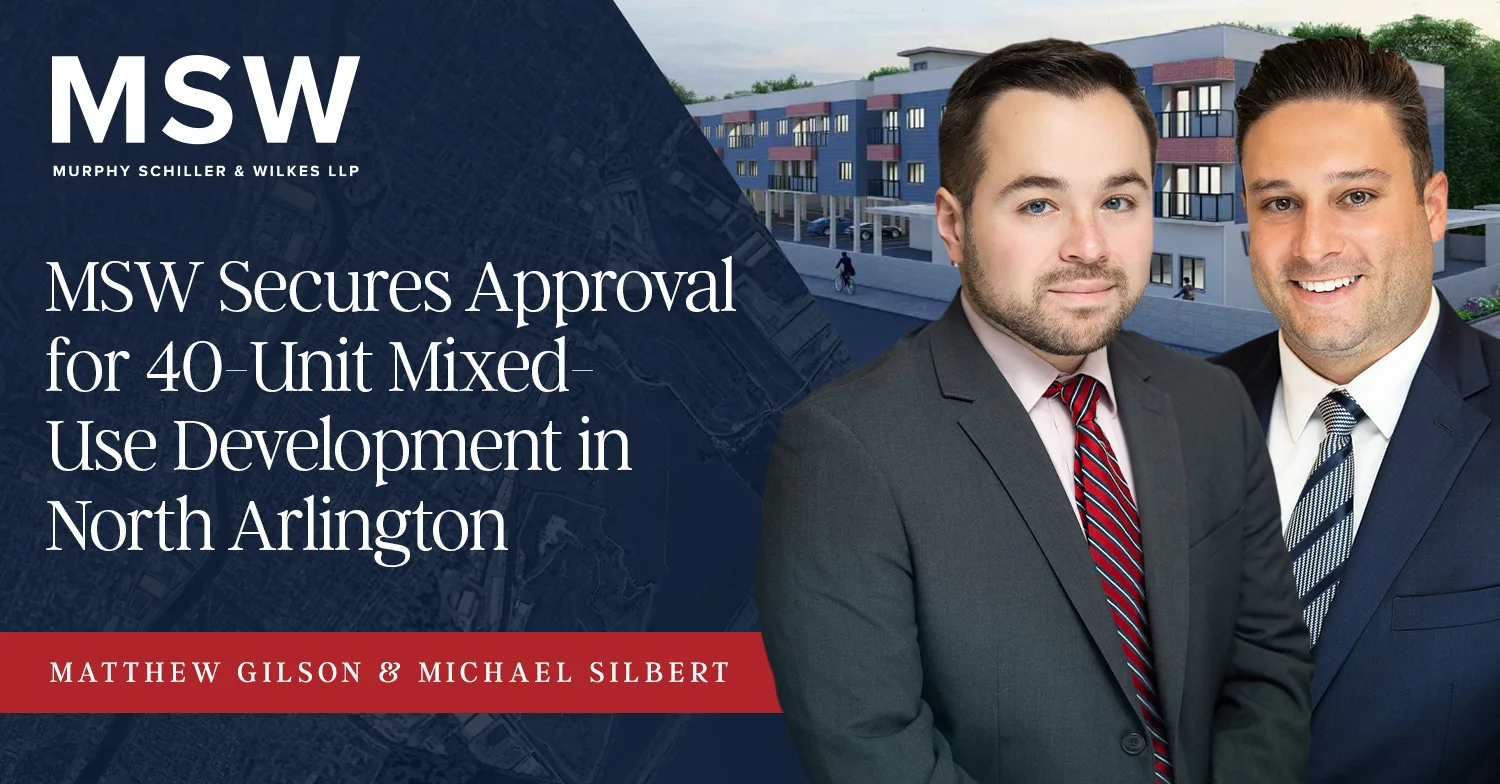
MSW Secures Approval for Mixed-Use Redevelopment Project in North Arlington

Murphy Schiller & Wilkes, LLP is proud to announce that we have secured site plan approval for a significant redevelopment project in North Arlington.

The project will transform an existing Veterans of Foreign Wars (VFW) property into a new three-story mixed-use building featuring a modern VFW facility on the ground floor, along with 40 age-restricted residential units on the upper floors, including affordable housing.

MSW was proud to handle all aspects of the redevelopment effort and represent our client throughout the Planning Board approval process. Congratulations to Matt Gilson, Esq., who served as lead attorney on the redevelopment application, and Michael Silbert, Esq., who successfully handled the Planning Board hearing, with the assistance of Stephanie McLeish. Their dedication and expertise, together with the efforts of the entire project team, helped move this important project one step closer to fruition.

We also extend our thanks to Yosef Portnoy, P.E., and the team at Civil Core Consulting, whose civil engineering and site design work played an important role in securing the approval.

We are excited to see this project move forward and help deliver a new home for the VFW while creating much-needed senior housing opportunities for the North Arlington community.

Another great project. Another great result for our client.

MSW Welcomes Daniel Kraft as Counsel in Transactional Real Estate Practice

MSW Welcomes Daniel Kraft as Counsel in Transactional Real Estate Practice

NEWARK, N.J. – Murphy Schiller & Wilkes LLP (MSW) is pleased to announce that Daniel Kraft has joined the firm as Counsel in its Transactional Real Estate Practice.

Daniel brings more than twenty-five years of experience representing lenders, borrowers, investors, developers, property owners, and businesses in sophisticated commercial real estate matters. His practice is concentrated in real estate finance, including acquisition, construction, and refinancing transactions, as well as commercial real estate acquisitions and dispositions, leasing, and development projects.

Throughout his career, Daniel has structured, negotiated, documented, and closed a broad range of commercial real estate transactions. He has extensive experience drafting and negotiating loan documentation, purchase and sale agreements, and commercial leases, while guiding clients through due diligence and advising on title, zoning, land use, survey, environmental, and other matters critical to successful transactions.

Prior to joining MSW, Daniel served as general counsel to real estate investment and development organizations, where he advised on financings, acquisitions, dispositions, leasing, development, construction, and operational matters. Earlier in his career, he served as underwriting counsel with a national title insurance company, handling complex title issues and high-value commercial real estate transactions across the United States.

“Daniel’s deep experience in commercial real estate finance and his broad transactional background make him an outstanding addition to our firm,” said Kellen F. Murphy, Managing Partner at MSW. “His practical approach, technical skill, and understanding of the business objectives that drive real estate transactions will be a tremendous asset to our clients.”

“I am excited to join MSW and work alongside such a talented team,” said Daniel Kraft. The firm’s commitment to client service and its growing transactional practice make it an ideal fit, and I look forward to helping clients navigate complex real estate transactions and achieve their business objectives.”

Daniel earned his J.D. from Rutgers Law School and his B.A. from Cornell University. He is admitted to practice law in New Jersey.

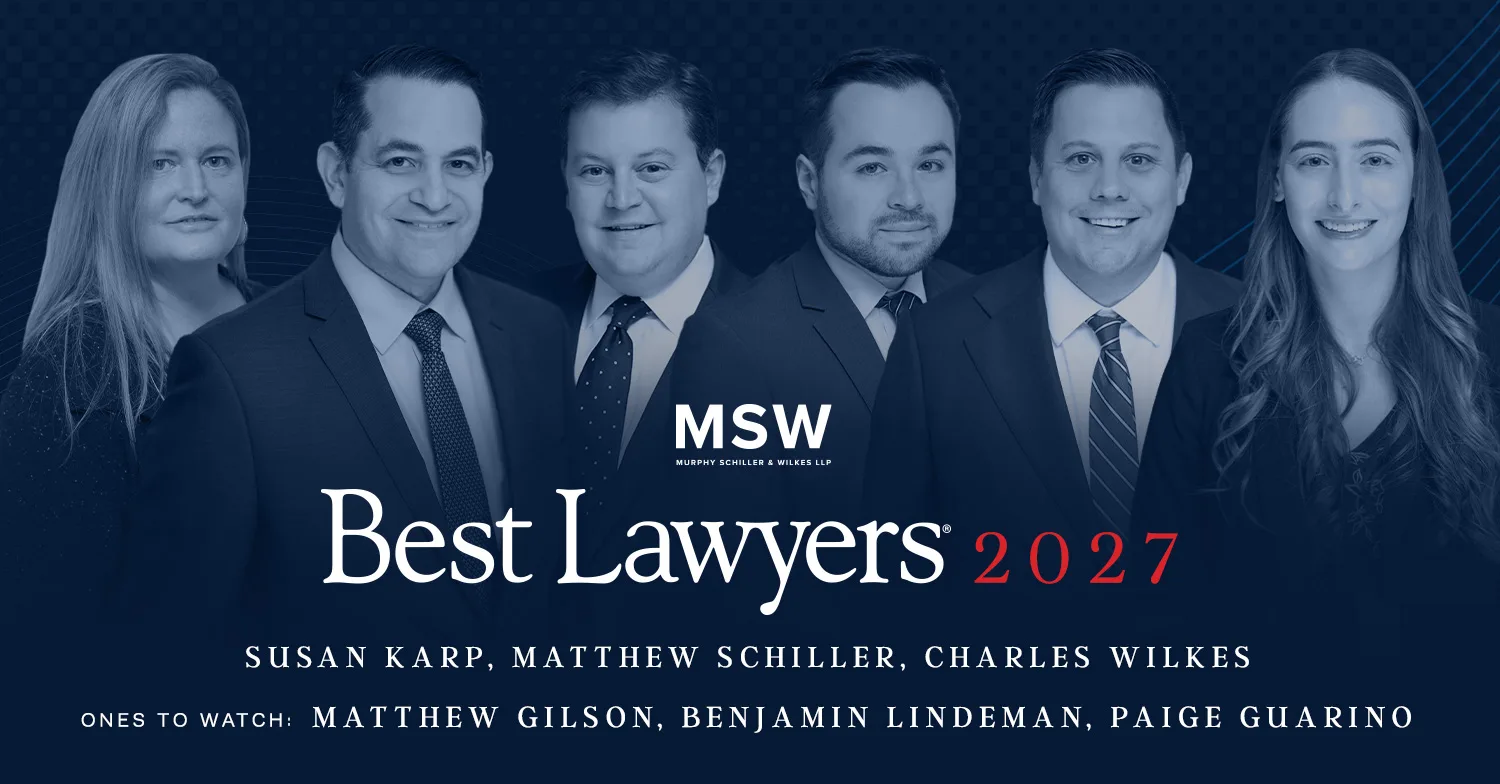
MSW Attorneys recognized as 2027 Best Lawyers / Ones to Watch in America

Murphy Schiller & Wilkes LLP (MSW) is proud to announce that six of its attorneys have been recognized in the 2027 editions of The Best Lawyers in America®️ and Best Lawyers: Ones to Watch®️ in America.

Susan C. Karp, Matthew J. Schiller and Charles J. Wilkes have once again been recognized by The Best Lawyers in America, while Matthew E. Gilson, Benjamin Lindeman and Paige Guarino have been named among Best Lawyers: Ones to Watch in America.

  • Susan C. Karp, Counsel – Recognized for her work in Environmental Law, advising clients on environmental compliance, regulatory matters, land development and remediation.
  • Matthew J. Schiller, Partner – Recognized for his work in Real Estate Law, representing clients in complex transactions, financings and development projects.
  • Charles J. Wilkes, Partner – Recognized for his work in Real Estate Law, with a focus on sophisticated real estate, land use and redevelopment matters.
  • Matthew E. Gilson, Partner – Named to Best Lawyers: Ones to Watch in America for his professional excellence and contributions to the legal profession.
  • Benjamin Lindeman – Named to Best Lawyers: Ones to Watch in America in recognition of his professional achievement and growing contributions to the firm and its clients.
  • Paige Guarino – Named to Best Lawyers: Ones to Watch in America in recognition of her professional excellence and commitment to client service.

First published in 1983, The Best Lawyers in America is one of the legal profession’s most respected peer-review publications. Its recognitions are based on evaluations by attorneys of their peers. Best Lawyers: Ones to Watch in America uses the same peer-review methodology to recognize outstanding attorneys earlier in their careers.

“We are proud to see Susan, Matt, Charles, Matthew, Benjamin and Paige recognized by their peers,” said the partners of Murphy Schiller & Wilkes LLP. “These honors reflect the talent, dedication and commitment to client service that define MSW.”

MSW congratulates all six attorneys on this well-deserved recognition and thanks the firm’s clients and colleagues for their continued trust.
For more information, visit BestLawyers.com.

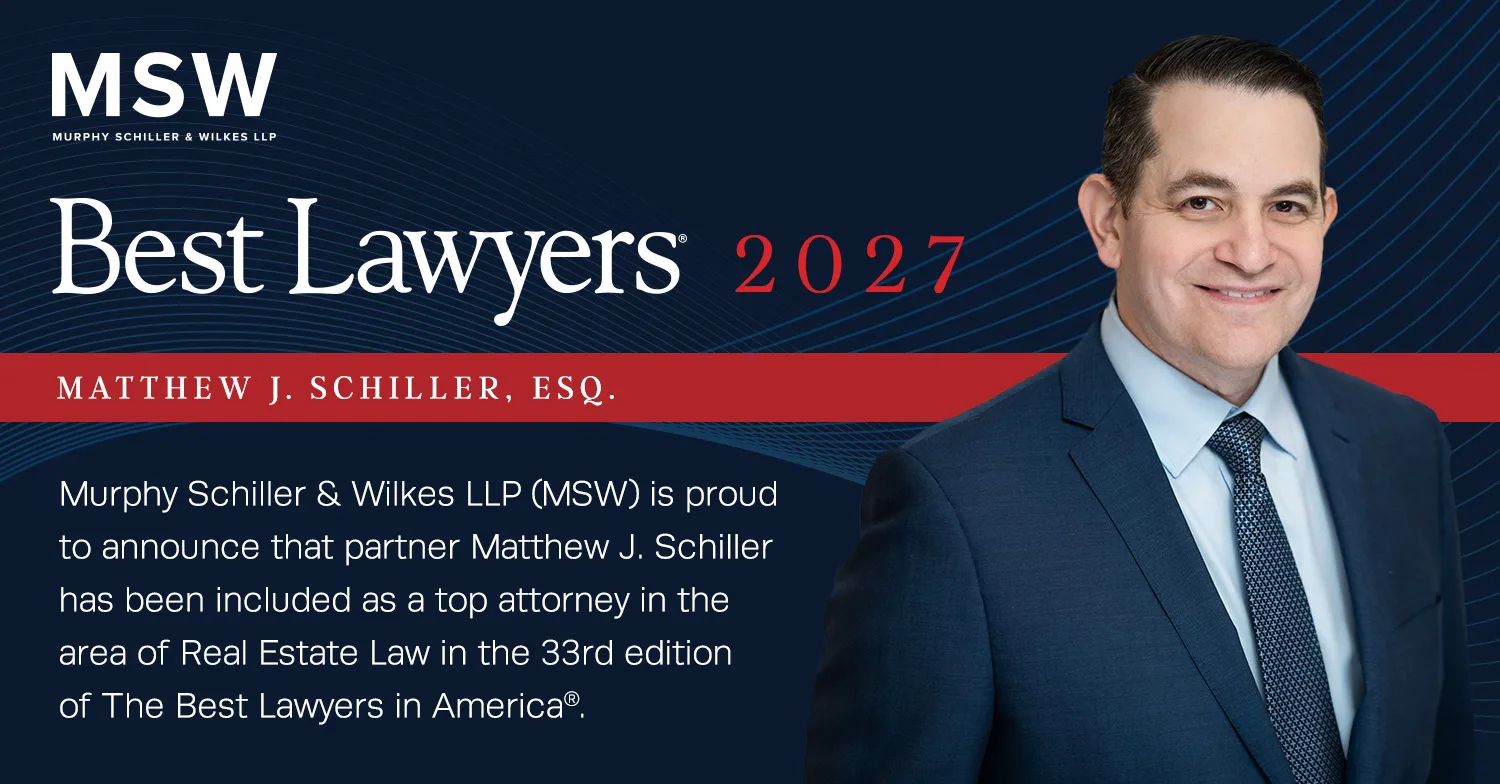
Matthew Schiller Recognized in the 2027 Edition of The Best Lawyers in America

Murphy Schiller & Wilkes LLP (MSW) is proud to announce that partner Matthew J. Schiller has been included as a top attorney in the area of Real Estate Law in the 32nd edition of The Best Lawyers in America.

The Best Lawyers in America was first published in 1983. Since then, the same tried and tested peer-review process has been used consistently for more than 40 years. The core mission of Best Lawyers is to highlight the top legal talent in America.

For more information, please click here: https://www.bestlawyers.com/america.

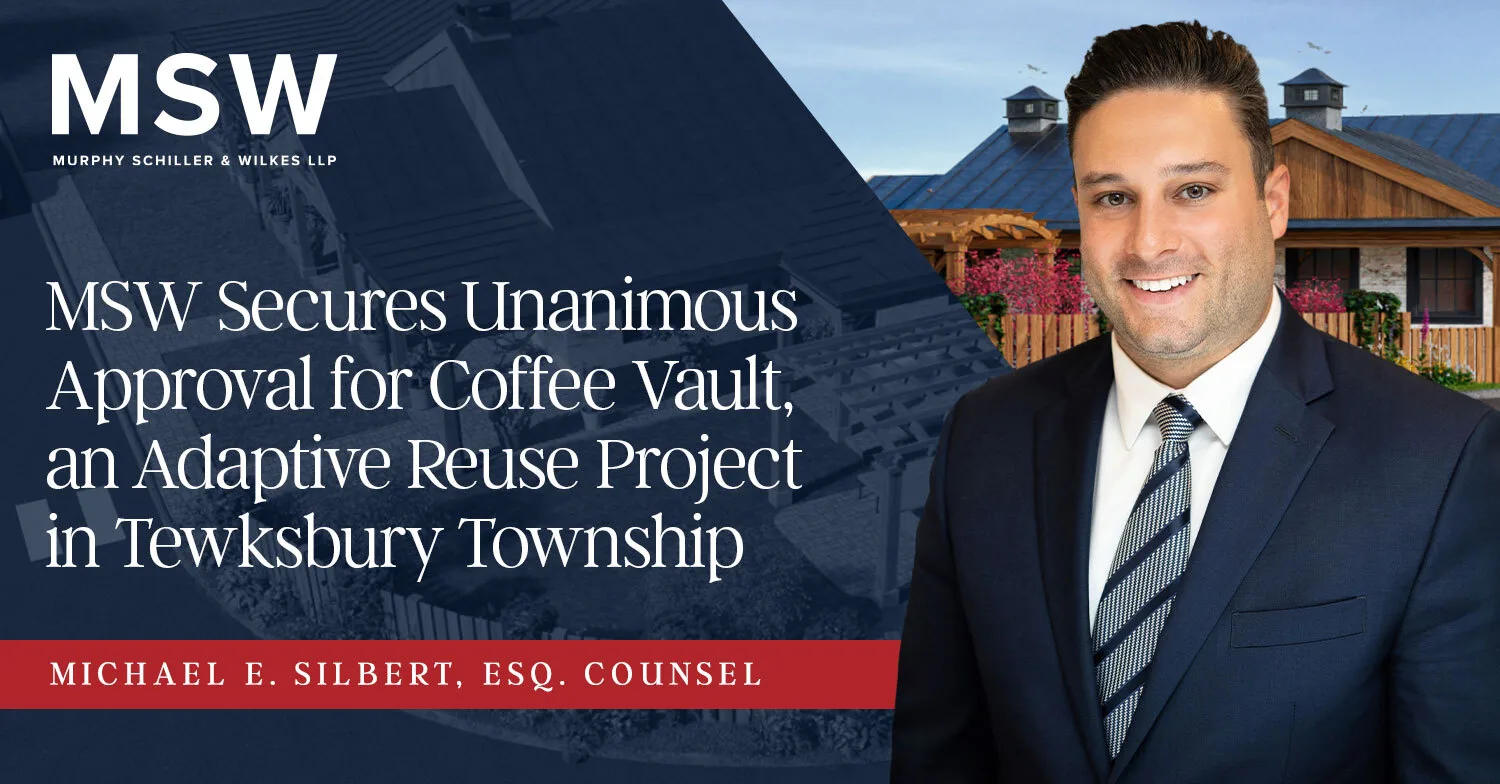
MSW Secures Major Site Plan Approval in Tewksbury

Murphy Schiller & Wilkes LLP is excited to announce that our Land Use team recently secured Preliminary and Final Major Site Plan Approval, together with D(1) Use Variance and bulk variance relief, before the Tewksbury Township Land Use Board for an exciting new project: Coffee Vault at 172 Oldwick Road.

Coffee Vault will breathe new life into a long-vacant former bank property at one of the more heavily traveled intersections in Hunterdon County.
The concept is a fantastic example of adaptive reuse done right. Coffee Vault will transform the former bank into a beautiful, historically and culturally sensitive destination coffee shop that will complement the surrounding businesses and add another reason for residents, commuters, and visitors to stop in Oldwick Village.

The architecture and site improvements will dramatically transform the appearance of the property, creating an attractive, inviting, and distinctly Oldwickesque destination while remaining sensitive to the distinctive character and aesthetic of Oldwick Village. The result will be a significant improvement to a property that has sat vacant for far too long.

Coffee Vault will roast its coffee on premises, inside the former bank’s actual vault, and yes, there will be a drive-through.

The site is located at the intersection of two heavily traveled County roads and presented a number of complicated planning, zoning, traffic, engineering, architectural, and community considerations. The application required an extensive and highly coordinated effort to address traffic and circulation, site design, zoning, land use compatibility, and the unique character of the surrounding community.

We are particularly proud that the application was handled from start to finish by Michael Silbert, Esq., Counsel at Murphy Schiller & Wilkes LLP. Michael did an excellent job navigating the sensitive nature of the application, balancing the interests of the applicant with the legitimate concerns of the surrounding community, and ensuring that the final proposal was something that could fit within and complement the character of Oldwick.

A huge congratulations to Wade Gordon, the principal behind Coffee Vault, whose vision and extraordinary commitment of time and financial resources have driven this project forward. Wade has a vision for what this property can become, and he has made a significant investment in turning that vision into reality. We think the community is going to be very excited to see it come together.

Special thanks to:

  • Corey Chase, P.E. of Dynamic Engineering, for handling the intricate and complicated traffic component of the application.
  • Matt Flynn, P.P., for providing the professional planning testimony and proofs supporting the requested land use relief.
  • George Folk, P.E., of David A. Stires Associates, for his work on the civil engineering component of the project.
  • Michael Elkins, R.A., from gk+a Architects, for bringing the architectural vision for Coffee Vault to life and developing a design that will make a striking improvement to the property.
  • Jahynis Cabral of Murphy Schiller & Wilkes LLP, for supporting our efforts throughout the application process.

We also want to extend our sincere appreciation to the Tewksbury Township Land Use Board, Township professionals, staff, and officials for working collaboratively with our team and the applicant throughout the past three years. Their time, thoughtful consideration, and willingness to work through the many complexities presented by this application were instrumental in getting the project unanimously approved. Without the Township’s cooperation and engagement throughout this process, this approval would not have been possible.

Projects like this are exactly why we love land use law. It’s not simply about obtaining an approval; it’s about understanding the community, working through the technical and regulatory challenges, and helping turn a vision into something tangible that can positively impact local businesses and the residents at large.

MSW Strengthens Land Use, Zoning & Redevelopment Practice with Addition of Jeffrey Lehrer and Aileen Brennan

NEWARK, N.J. – Murphy Schiller & Wilkes LLP (“MSW”) is pleased to announce that Jeffrey B. Lehrer has joined the firm as Of Counsel and Aileen Brennan has joined as Counsel in the firm’s Land Use, Zoning & Redevelopment Practice Group.

The addition of Lehrer and Brennan significantly expands MSW’s capabilities in land use and zoning law, redevelopment, affordable housing, eminent domain, and complex real estate development matters throughout New Jersey.

“Jeffrey and Aileen are highly respected practitioners whose experience, reputation, and deep understanding of New Jersey’s land use and redevelopment landscape make them tremendous additions to our firm,” said Chris Murphy, Partner at MSW. “Their combined experience advising developers, property owners, investors, municipalities, and other stakeholders on transformative development projects will further strengthen our ability to provide sophisticated, practical counsel to clients navigating increasingly complex development and redevelopment opportunities.”

Lehrer brings more than three decades of experience representing private developers, property owners, and business interests in connection with residential, commercial, mixed-use, and redevelopment projects throughout New Jersey. Widely recognized as a leader in land use law, his practice focuses on land use and zoning, redevelopment, real estate development, and affordable housing matters.

Throughout his distinguished career, Lehrer has served in numerous public-sector leadership roles, including Township Attorney for several New Jersey municipalities and Director of Law for the Township of Edison. He has also served as attorney to planning and zoning boards throughout the state and as special counsel on redevelopment and affordable housing matters. His extensive experience before planning boards, zoning boards of adjustment, governing bodies, redevelopment entities, and state agencies provides clients with a unique perspective on the governmental processes that shape development projects.

In recognition of his contributions to the profession, Lehrer received the prestigious William M. Cox Award from the New Jersey Institute of Local Government Attorneys in 2011, honoring excellence in land use law and service to local government and the legal profession.

Brennan’s practice focuses on redevelopment, land use, zoning, eminent domain, and related litigation and transactional matters. She represents developers, property owners, and investors through every stage of the development process, from project planning and entitlement approvals through implementation and litigation.
Brennan has extensive experience negotiating and drafting redevelopment agreements, PILOT agreements, redevelopment plans, ordinances, and related legislation. She regularly appears before municipal land use boards and has successfully represented clients in litigation involving redevelopment designations, redevelopment agreements, zoning ordinances, and development approvals.

Her representative matters include negotiating the rehabilitation of a historic landmark into affordable housing, handling condemnation proceedings associated with major development projects in Newark, securing and defending approvals for solar energy facilities, defending zoning ordinances supporting transformative redevelopment initiatives, and negotiating redevelopment and PILOT agreements along New Jersey’s waterfront communities.

“Aileen has built an outstanding reputation as a strategic and solutions-oriented advocate for developers and property owners,” Murphy added. “Her experience in both the transactional and litigation aspects of redevelopment and land use law complement Jeff’s decades of leadership in the field and creates exceptional depth within our practice group.”

The addition of Lehrer and Brennan further enhances MSW’s ability to advise developers, property owners, investors, and other stakeholders on the full spectrum of land use, zoning, redevelopment, affordable housing, eminent domain, and development-related matters throughout New Jersey. Their arrival adds significant depth to the firm’s Land Use, Zoning & Redevelopment Practice Group and reinforces MSW’s commitment to providing sophisticated, practical counsel on complex real estate development projects.