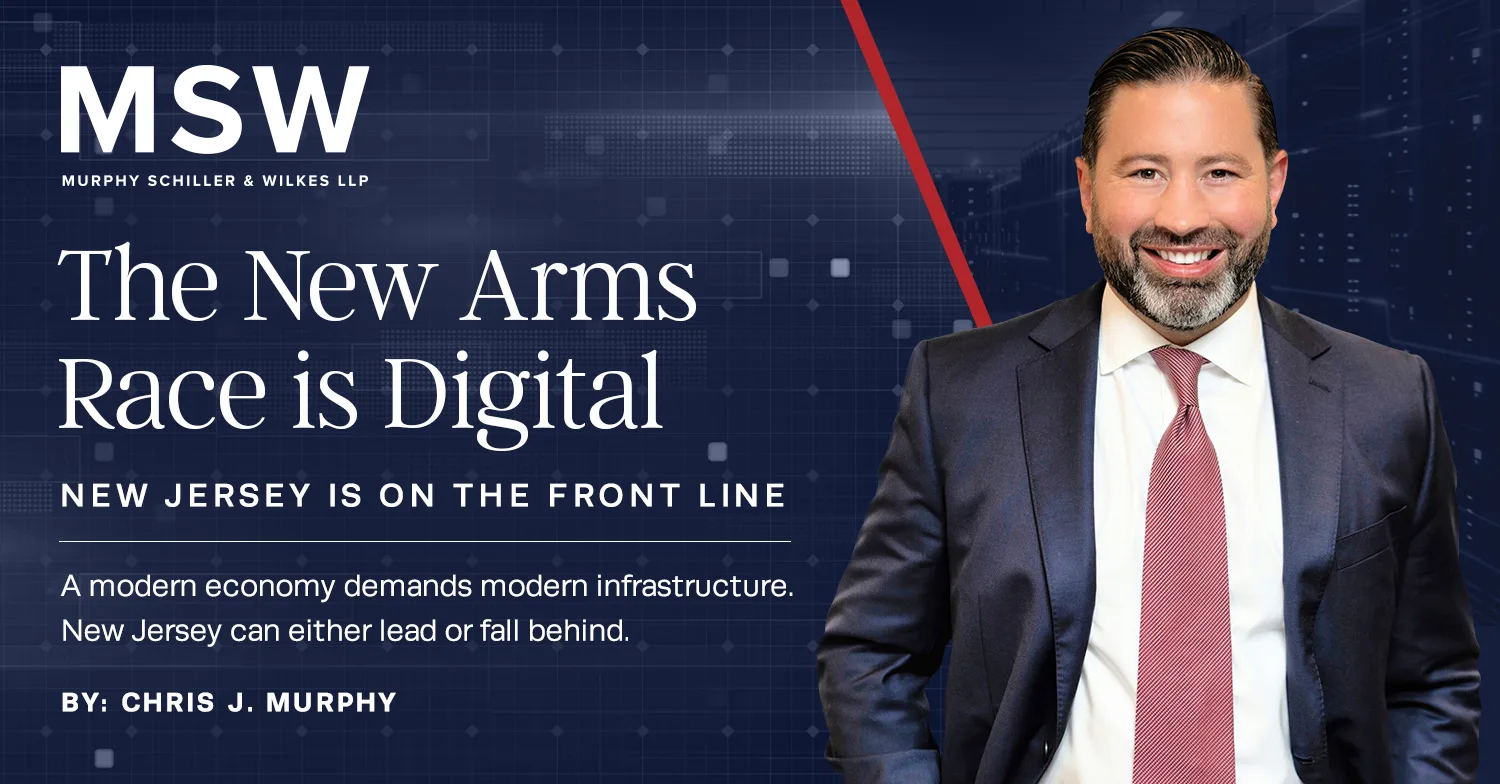
The New Arms Race Is Digital. New Jersey Is on the Front Line

By Chris Murphy
Partner, Murphy Schiller & Wilkes LLP

A modern economy demands modern infrastructure. New Jersey can either lead or fall behind.

The global race to build the infrastructure that powers artificial intelligence is well underway, and the United States cannot assume it will remain the world’s digital superpower by default. Nations across Europe, Asia, and the Middle East are investing heavily in data centers, the physical backbone of AI, cloud computing, and modern finance. These facilities are no longer niche components of the tech economy; they are strategic assets, as essential to national competitiveness as ports, highways, and energy grids.

New Jersey, perhaps unexpectedly, has emerged as one of the most important arenas in this competition. With its proximity to New York City, dense fiber connectivity, and deep industrial real estate base, the state is uniquely positioned to support the next generation of digital infrastructure. Developers who once focused exclusively on warehouses and logistics facilities are now exploring data center projects, recognizing that the demand for computing power is growing faster than any other segment of the built environment.

But the path forward is more complicated than simply repurposing industrial land. Many of New Jersey’s municipal zoning ordinances were drafted long before data centers existed as a distinct use. As a result, developers often encounter a patchwork of interpretations: some municipalities classify data centers as industrial uses, others as utilities, and still others as something that does not fit neatly into any existing category. This ambiguity can lead to delays, inconsistent treatment, and, in some cases, outright opposition.

That opposition is becoming more common nationwide. Communities that once viewed data centers as benign are now raising concerns about energy consumption, noise, water usage, and environmental impact. Some of these concerns reflect legitimate policy questions, while others stem from misunderstandings about how data centers operate. But in a state where local governments wield significant control over land use, perception matters. Developers who fail to engage early and transparently with municipal officials and residents risk finding themselves mired in political battles that could have been avoided.

Energy demand is the most consequential challenge of all. Modern data centers require extraordinary electrical capacity, and AI workloads only intensify those needs. Even the person who uploads a blurry, backlit selfie and asks an algorithm to “make me look amazing” (as if any of us naturally resemble the airbrushed masterpiece that comes back) is quietly contributing to a global surge in computing power that must come from somewhere. Securing adequate power is no longer a matter of routine utility coordination. It often requires multi‑year planning, substation upgrades, and collaboration across multiple agencies. New Jersey’s utilities are capable partners, but they cannot deliver capacity on short notice. Developers who underestimate the complexity of the grid may find their projects stalled before they begin.

None of this means New Jersey should retreat from data center development. Quite the opposite. If the United States intends to maintain its leadership in AI, it must expand its digital infrastructure in regions that already possess the connectivity, workforce, and industrial base to support it. New Jersey is one of those regions. But the state must modernize its regulatory frameworks to match the moment. Municipalities should update zoning ordinances to address data centers explicitly. Utilities and policymakers should coordinate long‑term planning to ensure that grid capacity keeps pace with demand. And developers must approach these projects with a level of transparency and community engagement that reflects the public’s growing interest in how digital infrastructure affects local life.

The stakes extend far beyond any single project or municipality. Data centers are the foundation of the technologies that will define the next generation of economic growth. If New Jersey embraces this opportunity with clarity and foresight, it can position itself as a national leader in the digital economy. If it hesitates, the investment and the innovation will go elsewhere.

Chris J. Murphy is a founding partner of Murphy Schiller & Wilkes LLP (MSW) and a member of the firm’s Executive Committee. He chairs both the Land Use, Zoning & Redevelopment Practice, and the Tax Credits & Incentives Practice, overseeing two of the firm’s core statewide platforms. In these roles, he has helped clients secure approvals for over 5M square feet of industrial warehouse development throughout New Jersey and over $1B in tax credits and incentives administered by the New Jersey Economic Development Authority (NJEDA).
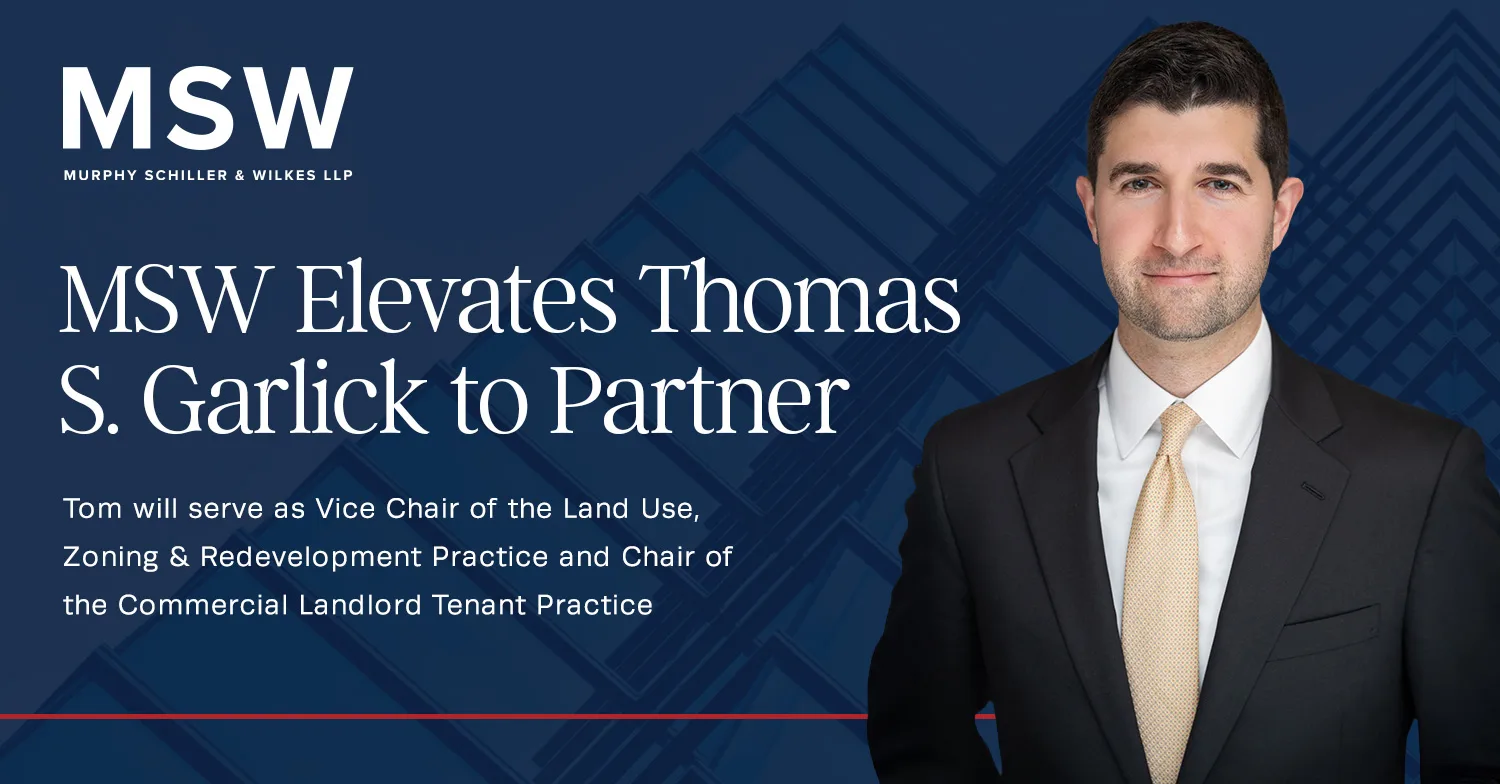
Murphy Schiller & Wilkes LLP Elevates Thomas S. Garlick to Partner

Newark, NJ — January 20, 2026 — Murphy Schiller & Wilkes LLP (MSW), a leading New Jersey commercial real estate and construction law firm, is pleased to announce the elevation of Thomas S. Garlick to Partner. In connection with his elevation, the firm also announces that Tom will serve as Vice Chair of the Land Use, Zoning & Redevelopment Practice and Chair of the Commercial Landlord‑Tenant Practice, reflecting his integral role in the continued growth of MSW’s statewide real estate platform.

“Tom’s elevation to Partner is a testament to his exceptional legal skill, steady leadership, and unwavering commitment to our clients,” said Chris Murphy, Founding Partner and Chair of the firm’s Land Use, Zoning and Redevelopment practice. “He has become a trusted advisor to developers, property owners, and institutional investors across New Jersey, and his ability to navigate complex land use and zoning matters has made him indispensable to our team.”

In his land use practice, Tom has earned a reputation for being the steady hand behind many of New Jersey’s most challenging development projects, guiding clients from early planning through final approvals with insight and precision. He represents developers, property owners, and institutional investors in all aspects of land use, zoning, and redevelopment, and regularly appears before planning boards, zoning boards, and governmental agencies throughout the state on matters involving residential and multifamily projects, commercial and mixed‑use developments, industrial warehouse developments, and large‑scale redevelopment initiatives. As Vice Chair of the Land Use, Zoning & Redevelopment Practice, Tom oversees workflow and matter management for MSW’s statewide land use practice, ensuring that projects move efficiently and strategically from intake through approval.

As Chair of MSW’s Commercial Landlord‑Tenant Practice, Tom leads a team that provides strategic counsel and aggressive advocacy to commercial landlords, property owners, and property managers throughout New Jersey. His practice focuses exclusively on the complex and often high‑stakes disputes that arise in the commercial leasing context, including lease enforcement actions, commercial evictions for non‑payment and holdover tenancies, breach of contract claims, property damage disputes, and other contested matters. Tom is an experienced litigator and negotiator who represents clients in state and federal courts, and he regularly advises on lease drafting, enforcement strategies, and risk mitigation to help clients protect their investments and avoid future conflicts. His deep understanding of New Jersey’s commercial landlord‑tenant laws, combined with his broader real estate development experience, allows him to deliver practical, results‑oriented solutions across asset classes ranging from industrial properties to shopping centers and office parks.

Before entering private practice, Tom served as judicial law clerk to the Honorable Joseph R. Rosa, Jr., J.S.C., at the Superior Court of New Jersey, Bergen Vicinage. He earned his Juris Doctor from St. John’s University School of Law and his Bachelor of Arts degree, cum laude, from Muhlenberg College.

“Tom embodies the values, work ethic, and client‑first mindset that define MSW,” said Matthew Schiller, Founding Partner. “We are proud to welcome him to the partnership and look forward to his continued leadership as we expand our footprint across New Jersey and beyond.”

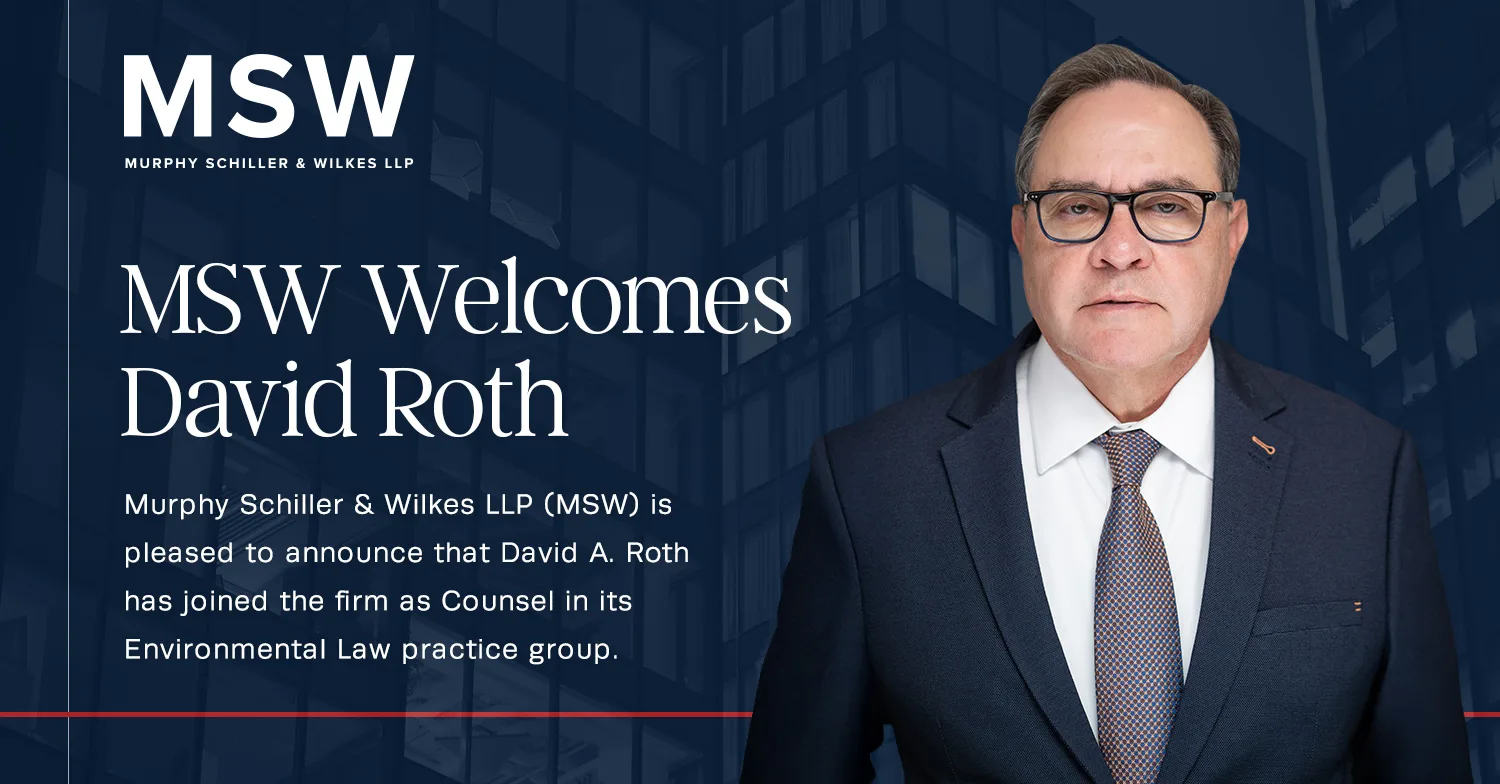
MSW Expands Environmental Law Capabilities with Addition of David A. Roth as Counsel

Newark, NJ — January 19, 2026 — Murphy Schiller & Wilkes LLP (MSW), a leading boutique law firm servicing the commercial real estate and construction industries, announced today that David A. Roth has joined the firm as Counsel in its Environmental Law practice group.

Roth brings more than 25 years of experience advising companies, developers, investors, and individuals on complex environmental, health, and safety matters. His practice spans federal and state regulatory compliance, enforcement defense, site remediation, brownfields redevelopment, and environmental aspects of real estate and corporate transactions.

“We are thrilled to welcome David to MSW,” said Kellen Murphy, Managing Partner of the firm. “Environmental issues increasingly shape the trajectory of real estate development and infrastructure investment across New Jersey and beyond. David’s depth of experience and practical, solutions‑oriented approach strengthen our ability to guide clients through these challenges with clarity and confidence.”

Roth advises clients on compliance and enforcement matters involving major environmental statutes, including New Jersey’s Industrial Site Recovery Act (ISRA) and Site Remediation Reform Act (SRRA), the Resource Conservation and Recovery Act (RCRA), the Clean Water Act, the Toxic Substances Control Act (TSCA), the Occupational Safety and Health Act (OSHA), and various Right‑to‑Know laws. He regularly works with environmental consultants and technical experts to develop cost‑effective strategies for site investigation and remediation under the New Jersey Department of Environmental Protection’s Technical Requirements for Site Remediation (TRSR), Administrative Requirements for the Remediation of Contaminated Sites (ARRCS), and the Licensed Site Remediation Professional (LSRP) program.

Roth also represents clients in the environmental components of business transactions, including acquisitions, dispositions, leasing, mergers and acquisitions, and financing. His work includes environmental due diligence, liability allocation, contract negotiation, and structuring post‑closing remediation and long‑term compliance obligations.

In addition, Roth has extensive experience representing owners, operators, generators, and other potentially responsible parties (PRPs) in litigation, cost allocation proceedings, and other disputes under the federal Comprehensive Environmental Response, Compensation, and Liability Act (CERCLA/Superfund), New Jersey’s Spill Compensation and Control Act (Spill Act), and analogous state superfund laws.

“MSW’s integrated platform and its leadership in real estate, construction, and redevelopment make it an ideal home for my practice,” Roth said. “I look forward to contributing to the firm’s continued growth and helping clients navigate the increasingly complex environmental landscape.”

Roth earned his J.D. from the University of Maryland School of Law and his B.S. from Rutgers University. He is admitted to practice in New Jersey and Maryland.

MSW’s Chris Murphy on the State of Commercial Real Estate and What’s Ahead for New Jersey Development

Murphy Schiller & Wilkes LLP (MSW) recently sat down with Invest: to discuss the evolving commercial real estate landscape and how the firm continues to meet the increasingly sophisticated needs of developers, investors, and owners across New Jersey and beyond. Chris Murphy, a founding partner of the firm and head of MSW’s Land Use, Zoning & Redevelopment and Tax Credits & Incentives practices, offered insights into market conditions, client expectations, and the firm’s strategic priorities for the years ahead.

A Market in Transition – And a Firm Built for It

The past several years have brought significant headwinds to the commercial real estate industry: higher interest rates, rising construction costs, and persistent market uncertainty. Yet MSW has continued to grow.

“As a boutique firm dedicated exclusively to commercial real estate and development matters, we’ve built a practice that is resilient in any market cycle,” Murphy said. “Clients today expect more from their legal advisors than ever before, and we have consistently risen to that challenge.”

With 30 attorneys and 42 total team members, MSW provides end‑to‑end legal services across acquisitions, sales, leasing, finance, environmental, land use and zoning, construction, and litigation. The firm’s integrated model—purpose‑built for the real estate and construction sectors—has become a defining advantage as deals grow more complex and clients seek a true one‑stop solution.

Development Momentum in New Jersey’s Urban Cores

Despite broader market volatility, development activity in New Jersey’s urban centers remains strong. Elevated residential and commercial rents, combined with proximity to New York City, continue to drive interest in cities like Hoboken, Jersey City, and Newark.

“We’ve seen a surge in client activity on this side of the river,” Murphy noted. “Municipalities are eager for thoughtful, well‑planned development, and we’re proud to have secured approvals for some of the most transformative projects in the state.”

MSW’s land use and redevelopment team has played a central role in advancing major residential, industrial, and mixed‑use projects across New Jersey’s densest corridors.

Evolving Client Expectations and Sector Trends

As the market cooled from the historically low interest‑rate environment of 2021–2022, clients became more selective, seeking advisors who can deliver strategic, value‑added guidance.

“Clients expect more from their attorneys, and we’ve been able to meet and exceed those expectations,” Murphy said.

Key trends include:

  • Industrial demand remains robust, fueled by e‑commerce and the need for modern logistics facilities.
  • Multifamily development continues to grow, particularly in transit‑oriented and urban locations.
  • Affordable housing requirements are shaping project feasibility, with many municipalities—including Newark—requiring 20% affordable components in new developments.

Developers who can structure financially viable projects in this environment are finding significant opportunities.

The Aspire Tax Credit Program: A Critical Tool for Project Feasibility

Murphy, who leads MSW’s Tax Credits & Incentives group, highlighted the transformative impact of the Aspire Tax Credit Program on multifamily development statewide.

“In today’s high‑interest‑rate environment, many projects simply would not be feasible without Aspire,” he explained. “Our team has secured over $300 million in tax credits for multifamily projects across New Jersey.”

Virtually every major urban project is now evaluating Aspire as part of its capital stack, and MSW continues to guide clients through the evolving monetization process.

Navigating New Environmental Regulations

New Jersey’s Environmental Justice Law and related regulatory changes are reshaping redevelopment, particularly in urban and historically overburdened communities.

“The intent is commendable, but the practical impact can be significant,” Murphy said. “We’ve seen projects become infeasible due to the added regulatory burden, especially in the affordable housing sector.”

MSW is working closely with clients to navigate these complexities while helping shape solutions that balance environmental goals with the need for continued development.

Legal and Political Challenges in Industrial and Multifamily Development

From warehouse resistance at the municipal and state levels to ongoing debates over parking requirements in downtown areas, developers face an increasingly intricate approval landscape.

“Our role extends beyond legal navigation,” Murphy emphasized. “We’re deeply involved in managing public relations, community engagement, and stakeholder communication. That work must begin early.”

MSW’s collaborative approach with planning professionals and municipal leaders has been key to achieving balanced, workable outcomes.

Looking Ahead: Strategic Growth and Continued Focus

Over the next two to three years, MSW’s priorities remain clear:

  • Expand the firm’s national transactional practice
  • Recruit top talent to support thoughtful, organic growth
  • Continue investing in technology and innovation
  • Remain laser‑focused on commercial real estate and construction law

“We have no plans to diversify into other industries,” Murphy said. “We know what we do exceptionally well, and we’re committed to elevating that work every day.”

To read the full interview, please click here.

Chris J. Murphy is a founding partner of Murphy Schiller & Wilkes LLP (MSW) and a member of the firm’s Executive Committee. He chairs both the Land Use, Zoning & Redevelopment Practice, and the Tax Credits & Incentives Practice, overseeing two of the firm’s core statewide platforms. In these roles, he has helped clients secure approvals for over 5M square feet of industrial warehouse development throughout New Jersey and over $1B in tax credits and incentives administered by the New Jersey Economic Development Authority (NJEDA).

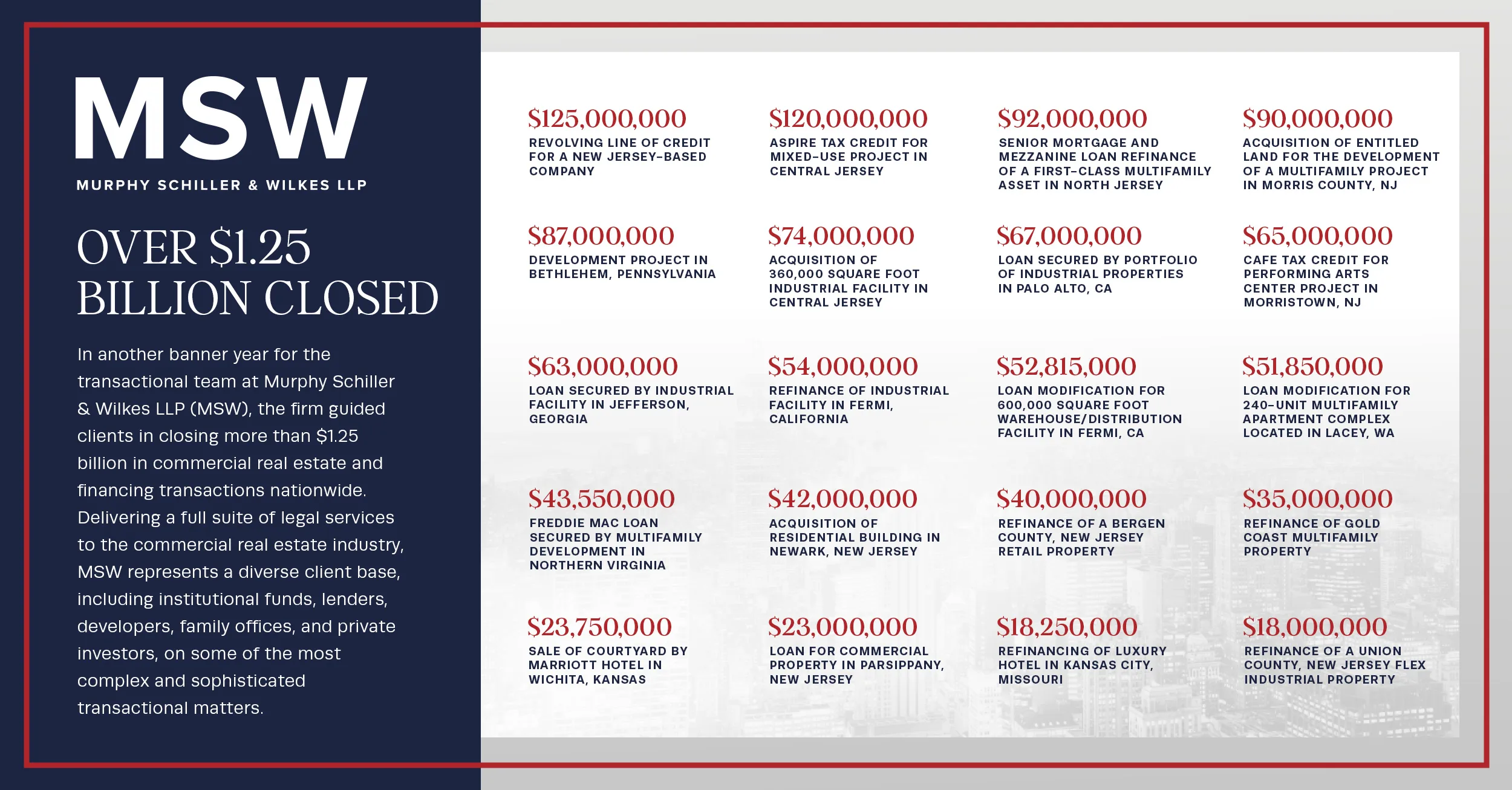
Year End Transaction Highlights 2025

In another banner year for the transactional team at Murphy Schiller & Wilkes LLP (MSW), the firm guided clients in closing more than $1.25 billion in commercial real estate and financing transactions nationwide. Delivering a full suite of legal services to the commercial real estate industry, MSW represents a diverse client base, including institutional funds, lenders, developers, family offices, and private investors, on some of the most complex and sophisticated transactional matters.

In 2025, the firm represented the following:

  • National bank in connection with the modification of a $125,000,000 revolving line of credit for a New Jersey-based company.
  • Developer in connection with $120,000,000 Aspire tax credit for mixed-use project in Central Jersey.
  • Developer in connection with a $92,000,000 senior mortgage and mezzanine loan refinance of a first-class multifamily asset in North Jersey.
  • Developer in connection with $90,000,000 acquisition of entitled land for the development of a 200-unit multifamily project in Morris County, New Jersey.
  • Developer in connection with the joint venture and the land acquisition for $87,000,000 development project in Bethlehem, Pennsylvania.
  • National real estate development firm in connection with $74,000,000 acquisition of 360,000 square foot industrial facility in Central New Jersey.
  • National REIT in connection with modification of $67,000,000 loan secured by portfolio of industrial properties in Palo Alto, CA.
  • Nonprofit Performing Arts Center in connection with $65,000,000 CAFE tax credit for project in Morristown, New Jersey.
  • National REIT in connection with modification of $63,000,000 loan secured by industrial facility in Jefferson, Georgia.
  • National REIT in connection with $54,000,000 refinance of industrial facility in Fermi, California.
  • Lender in connection with $52,815,000 loan modification for 600,000 square foot warehouse/distribution facility in Fermi, California.
  • Lender in connection with $51,850,000 loan modification for 240-unit multifamily apartment complex located in Lacey, Washington.
  • Private equity borrower in connection with $43,550,000 Freddie Mac loan secured by multifamily development in Northern Virginia.
  • National real estate fund in connection with $42,000,000 acquisition of residential building in Newark, New Jersey.
  • National bank in connection with a $40,000,000 refinance of a Bergen County, New Jersey retail property.
  • Ownership in connection with a $35,000,000 refinance of Gold Coast multifamily property.
  • Seller in connection with the $23,750,000 sale of Courtyard by Marriott hotel in Wichita, Kansas.
  • Private equity firm in connection with negotiation of participation agreement in connection with $23,000,000 loan for commercial property in Parsippany, NJ.
  • New Jersey bank in connection with a $19,000,000 acquisition financing of a catering facility in New Jersey.
  • Borrower in connection with $18,250,000 refinancing of luxury hotel in Kansas City, Missouri.
  • New Jersey bank in connection with a $18,000,000 refinance of a Union County, New Jersey flex industrial property.
  • New Jersey bank in connection with a $18,000,000 term loan to energy industry contractor.
  • Developer in connection with $15,000,000 sale of apartment building portfolio in Hoboken, New Jersey.
  • National bank in connection with $14,380,000 construction financing for the expansion of a manufacturing facility in Middlesex County, New Jersey.
  • National bank in connection with a $14,210,000 refinance of a multifamily property in Lafayette, Louisiana.
  • Developer in connection with $14,100,000 purchase and financing of office building in Cedar Knolls, New Jersey.
  • Developer in connection with $14,100,000 purchase and financing of 117,492 SF multi-tenant office building and 14 acres of vacant land in Morris County, New Jersey.
  • National bank in connection with a $13,490,000 refinance of multifamily property in Hudson County, New Jersey.
  • Developer in connection with a $13,000,000 acquisition of development site in Middlesex County, New Jersey.
  • Lender in connection with $10,850,000 loan in connection with purchase money financing of shopping center in Syracuse, New York.
  • National bank in connection with a $10,100,000 refinance of a multifamily property in Hudson County, New Jersey.
  • New Jersey developer in connection with a $10,000,000 second mortgage loan for improvements to industrial property in Mercer County, New Jersey.
  • Developer in connection with a $10,000,000 revolving line of credit secured by industrial property in Mercer County, New Jersey.
  • Business owner in connection with the $8,300,000 purchase and financing of industrial property in Union County, New Jersey.
  • Purchaser in connection with $8,250,000 acquisition of industrial property in Saddle Brook, New Jersey.
  • New Jersey bank in connection with a $4,400,000 acquisition financing of two net leased properties in Tampa, Florida.

MSW Partners Matthew J. Schiller and Charles J. Wilkes Named to ROI-NJ’s 2025 Real Estate Influencers List

Newark, NJ – December 26, 2025 – Murphy Schiller & Wilkes LLP (MSW), a premier boutique law firm specializing in commercial real estate and construction law, is proud to announce that partners Matthew J. Schiller and Charles J. Wilkes have been named to the 2025 ROI-NJ Real Estate Influencers list, an annual recognition celebrating more than 200 professionals shaping New Jersey’s real estate landscape.

This year’s list highlights leaders whose innovation, market influence, and commitment to community advancement are driving the evolution of one of the nation’s most dynamic real estate markets. In addition to Matthew and Charles, MSW’s managing partner Kellen Murphy and partner Chris Murphy were also recognized, underscoring the firm’s broad and growing impact across the industry.

Matthew J. Schiller, co-founder of MSW and chair of the firm’s Commercial Leasing, Distressed Real Estate, and Opportunity Zone practice groups, is widely regarded for his sophisticated counsel on complex leasing matters, distressed asset strategies, and tax-advantaged development opportunities. Matthew’s ability to guide clients through high-stakes transactions and shifting market conditions has positioned him as a trusted advisor to developers, investors, and institutional stakeholders throughout the country.

Charles J. Wilkes, co-founder of MSW and chair of the firm’s Real Estate Finance and Commercial Lending practice groups, is recognized for his deep expertise in structuring and negotiating complex financing arrangements. Charles represents lenders, borrowers, and capital providers in transactions spanning construction financing, permanent loans, mezzanine debt, and portfolio-level restructurings. His practical, solutions-oriented approach has supported some of the region’s most significant real estate development projects.

“Matt and Charlie exemplify the leadership, innovation, and client-focused excellence that define MSW,” said Kellen Murphy, the firm’s managing partner. “Their recognition reflects the strength of our team and the impact our attorneys continue to have on New Jersey’s real estate and construction sectors. We are proud to see their contributions acknowledged among such an accomplished group of industry leaders.”

The inclusion of four MSW partners on the 2025 ROI-NJ Real Estate Influencers list highlights the firm’s continued growth and its expanding role in shaping the future of commercial real estate across the state.

Real full article here.

Murphy Schiller & Wilkes LLP Welcomes Camilla Martinez as Marketing Coordinator

Newark, NJ – January 2, 2026 – Murphy Schiller & Wilkes LLP (MSW), a boutique law firm specializing in commercial real estate and construction law, is pleased to announce that Camilla Martinez has joined the firm as Marketing Coordinator.

Camilla brings a strong background in marketing strategy, communications, and organizational leadership. She has held roles in healthcare, technology, and nonprofit organizations, where she managed interns, coordinated outreach initiatives, and designed branded materials to enhance visibility and engagement. A Vice President of the Kean Association of Marketing, Camilla has demonstrated leadership in event promotion and strategic planning, while earning her B.S. in Marketing at Kean University.

Certified in Google Analytics, Canva Marketing, and AI-Powered Marketing, Camilla leverages data-driven insights and creative design to support firmwide initiatives. At MSW, she will oversee marketing projects, digital communications, and event promotion, contributing to the firm’s continued growth and national recognition.

“We are thrilled to welcome Camilla to MSW,” said founding partner Chris J. Murphy. “Her energy, creativity, and proven ability to execute strategic marketing initiatives will be instrumental as we expand our reach and strengthen our brand.”