
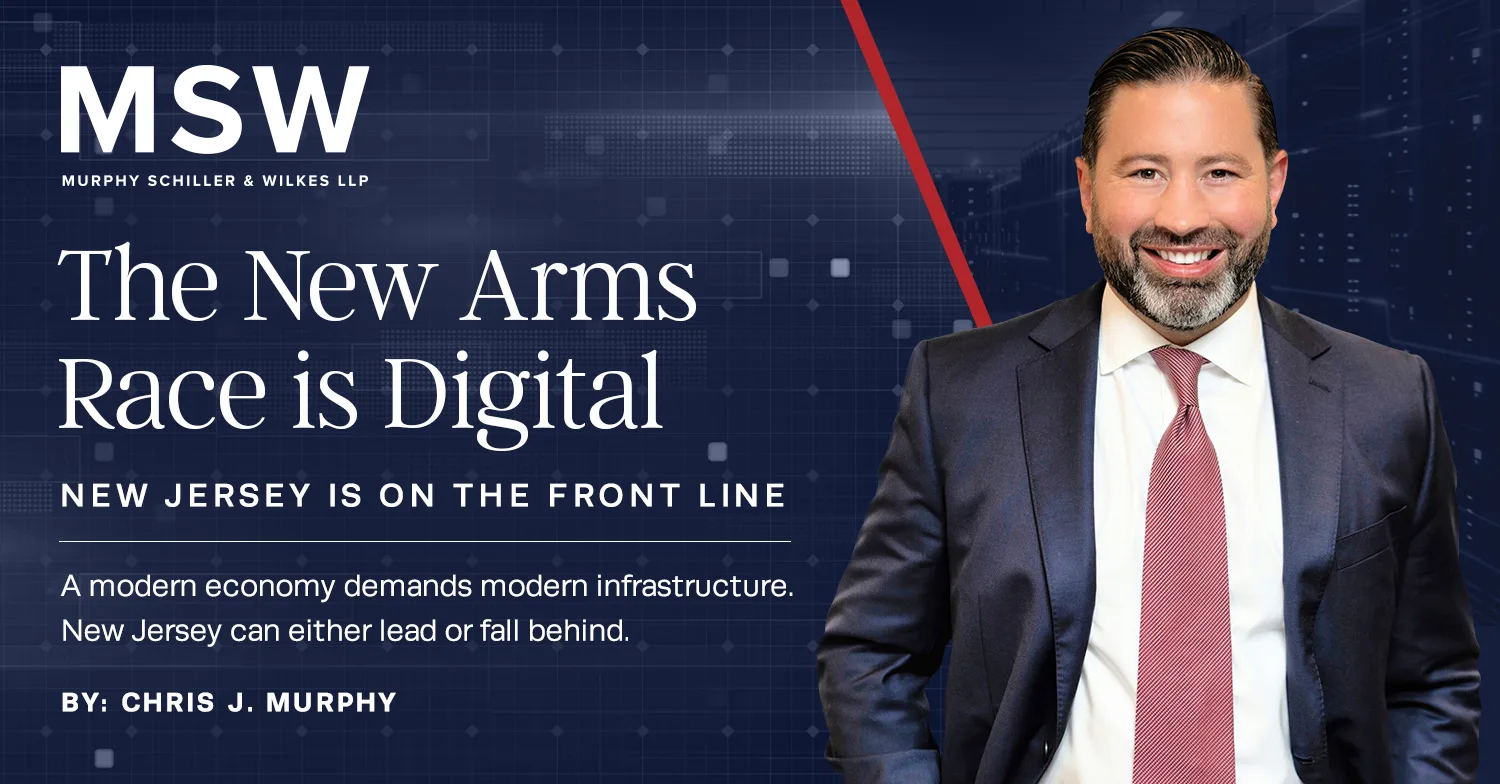
By Chris Murphy
Partner, Murphy Schiller & Wilkes LLP
A modern economy demands modern infrastructure. New Jersey can either lead or fall behind.
The global race to build the infrastructure that powers artificial intelligence is well underway, and the United States cannot assume it will remain the world’s digital superpower by default. Nations across Europe, Asia, and the Middle East are investing heavily in data centers, the physical backbone of AI, cloud computing, and modern finance. These facilities are no longer niche components of the tech economy; they are strategic assets, as essential to national competitiveness as ports, highways, and energy grids.
New Jersey, perhaps unexpectedly, has emerged as one of the most important arenas in this competition. With its proximity to New York City, dense fiber connectivity, and deep industrial real estate base, the state is uniquely positioned to support the next generation of digital infrastructure. Developers who once focused exclusively on warehouses and logistics facilities are now exploring data center projects, recognizing that the demand for computing power is growing faster than any other segment of the built environment.
But the path forward is more complicated than simply repurposing industrial land. Many of New Jersey’s municipal zoning ordinances were drafted long before data centers existed as a distinct use. As a result, developers often encounter a patchwork of interpretations: some municipalities classify data centers as industrial uses, others as utilities, and still others as something that does not fit neatly into any existing category. This ambiguity can lead to delays, inconsistent treatment, and, in some cases, outright opposition.
That opposition is becoming more common nationwide. Communities that once viewed data centers as benign are now raising concerns about energy consumption, noise, water usage, and environmental impact. Some of these concerns reflect legitimate policy questions, while others stem from misunderstandings about how data centers operate. But in a state where local governments wield significant control over land use, perception matters. Developers who fail to engage early and transparently with municipal officials and residents risk finding themselves mired in political battles that could have been avoided.
Energy demand is the most consequential challenge of all. Modern data centers require extraordinary electrical capacity, and AI workloads only intensify those needs. Even the person who uploads a blurry, backlit selfie and asks an algorithm to “make me look amazing” (as if any of us naturally resemble the airbrushed masterpiece that comes back) is quietly contributing to a global surge in computing power that must come from somewhere. Securing adequate power is no longer a matter of routine utility coordination. It often requires multi‑year planning, substation upgrades, and collaboration across multiple agencies. New Jersey’s utilities are capable partners, but they cannot deliver capacity on short notice. Developers who underestimate the complexity of the grid may find their projects stalled before they begin.
None of this means New Jersey should retreat from data center development. Quite the opposite. If the United States intends to maintain its leadership in AI, it must expand its digital infrastructure in regions that already possess the connectivity, workforce, and industrial base to support it. New Jersey is one of those regions. But the state must modernize its regulatory frameworks to match the moment. Municipalities should update zoning ordinances to address data centers explicitly. Utilities and policymakers should coordinate long‑term planning to ensure that grid capacity keeps pace with demand. And developers must approach these projects with a level of transparency and community engagement that reflects the public’s growing interest in how digital infrastructure affects local life.
The stakes extend far beyond any single project or municipality. Data centers are the foundation of the technologies that will define the next generation of economic growth. If New Jersey embraces this opportunity with clarity and foresight, it can position itself as a national leader in the digital economy. If it hesitates, the investment and the innovation will go elsewhere.
Chris J. Murphy is a founding partner of Murphy Schiller & Wilkes LLP (MSW) and a member of the firm’s Executive Committee. He chairs both the Land Use, Zoning & Redevelopment Practice, and the Tax Credits & Incentives Practice, overseeing two of the firm’s core statewide platforms. In these roles, he has helped clients secure approvals for over 5M square feet of industrial warehouse development throughout New Jersey and over $1B in tax credits and incentives administered by the New Jersey Economic Development Authority (NJEDA).
Murphy Schiller & Wilkes LLP (MSW) is a boutique law firm servicing the commercial real estate and construction industries. Headquartered in Newark, New Jersey, the firm represents a wide range of clients, including institutional, publicly traded real estate companies, international and regional lenders, national contractors and subcontractors, and family offices. The firm has been ranked as a top law firm by both Chambers & Partners and U.S. News & World Report.