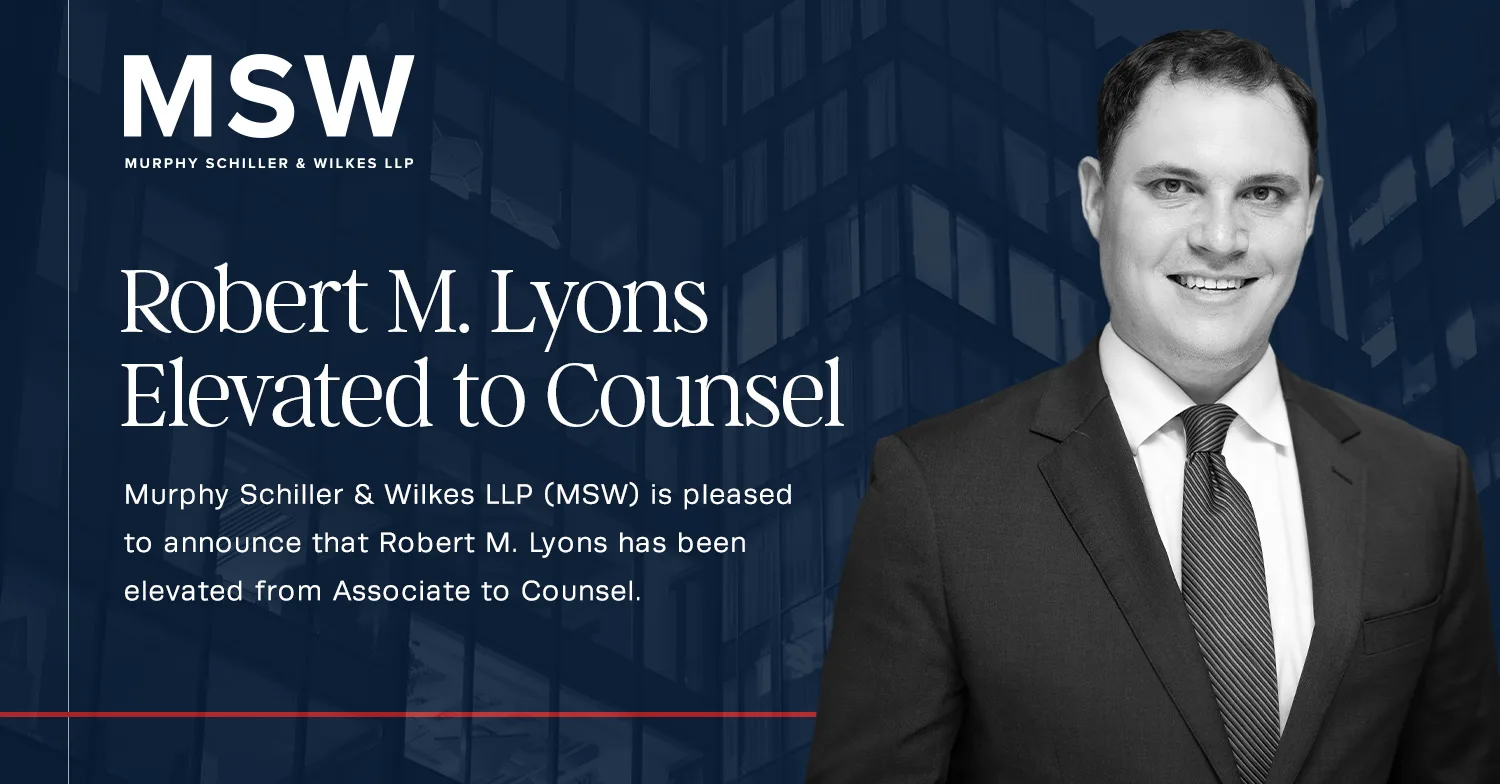
Murphy Schiller & Wilkes LLP Elevates Robert M. Lyons to Counsel

Newark, N.J. — April 1, 2026 — Murphy Schiller & Wilkes LLP (MSW) is pleased to announce that, effective April 1, 2026, Robert M. Lyons has been elevated from associate to counsel.

Robert is a member of the firm’s Construction Law and Litigation practice groups, where he represents developers, owners, contractors, subcontractors, construction managers, architects, engineers, and surveyors in a broad range of disputes arising from complex commercial real estate and construction projects. His practice includes representation in matters involving contract disputes, delay and impact claims, defective construction, design negligence, and related shareholder disputes in both state and federal courts.

Prior to joining MSW, Mr. Lyons practiced at a national litigation firm in New York City. He earned his Juris Doctor from Fordham University School of Law and his undergraduate degrees from Providence College, where he received a B.A. in Economics and a B.S. in Finance, cum laude. He is admitted to practice in New Jersey and New York, as well as the U.S. District Court for the District of New Jersey.

“Robert’s elevation to counsel reflects his exceptional legal acumen, commitment to our clients, and meaningful contributions to the continued growth of the firm,” said Anthony Capasso, Chair of the firm’s Construction Law and Litigation practice groups. “He has established himself as a trusted adviser to our clients in the construction and real estate industries, and we are proud to recognize his achievements.”

Robert’s promotion underscores MSW’s ongoing commitment to developing talent from within and investing in attorneys who exemplify the firm’s values of excellence, responsiveness, and practical problem-solving.

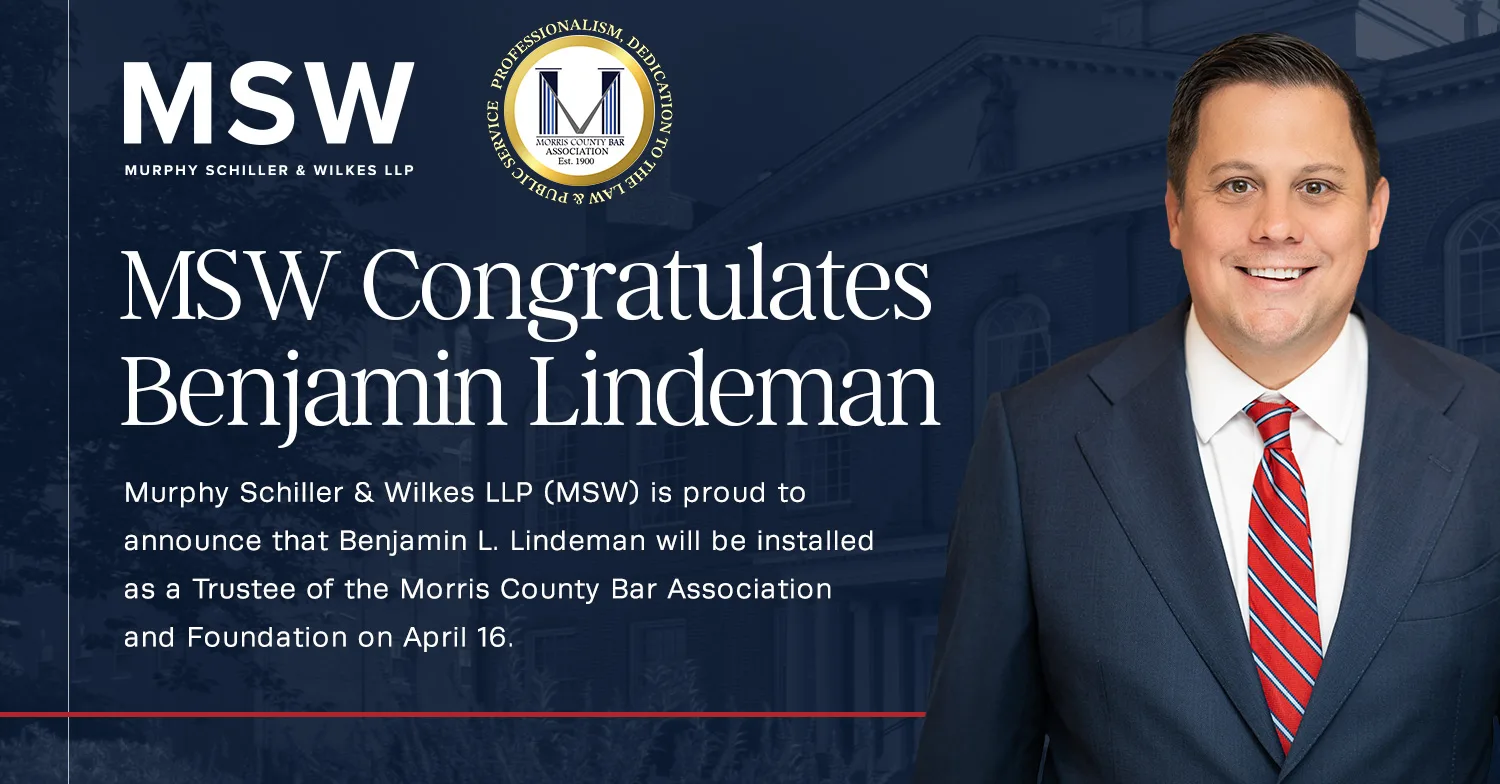
Murphy Schiller & Wilkes LLP Congratulates Benjamin L. Lindeman on Trustee Appointment

Murphy Schiller & Wilkes LLP (MSW) is proud to announce that Benjamin L. Lindeman will be installed as a Trustee of the Morris County Bar Association and Foundation on April 16.

This appointment reflects Ben’s ongoing commitment to the legal profession and to serving the broader community. The Morris County Bar Association plays a vital role in supporting attorneys, advancing professional standards, and promoting access to justice throughout the region. As a Trustee, Ben will help guide the organization’s initiatives and contribute to its continued impact.

Please join us in congratulating Ben on this well-deserved achievement.

MSW Attorneys selected as 2026 Super Lawyers / Rising Stars

Murphy Schiller & Wilkes LLP (MSW) is pleased to announce that 12 attorneys have been selected as part of the 2026 Super Lawyer / Rising Stars lists:

MSW Profile: https://profiles.superlawyers.com/new-jersey/newark/lawfirm/murphy-schiller-and-wilkes-llp/05adfc59-ee73-4370-be99-7b22daa9f08b.html

Super Lawyers selects attorneys using a patented multiphase selection process. Peer nominations and evaluations are combined with independent research. Each candidate is evaluated on 12 indicators of peer recognition and professional achievement. Selections are made on an annual, state-by-state basis.

For more information on the selection process, click HERE.

MSW Featured in Real Estate NJ’s Law Firm Spotlight Series

Murphy Schiller & Wilkes LLP (MSW) is proud to share that the firm was recently featured in Real Estate NJ’s Law Firm Spotlight Series, which highlights law firms making an impact in New Jersey’s commercial real estate sector.

Our profile, appearing on pages 2–3 of the publication’s newest flipbook edition and featured in the March print edition, showcases MSW’s comprehensive real estate, land use, tax credit, construction, and litigation practices, along with the firm’s continued growth and reputation for providing strategic, business‑focused legal counsel. The spotlight offers insight into our team’s work advising developers, investors, lenders, contractors, and other key stakeholders across the state.

Read the feature here: RE-NJ (Our spotlight appears on pages 2–3.)

At MSW, we take pride in helping clients navigate the full life cycle of complex real estate matters, including acquisitions and sales, financing, redevelopment, incentives, land use approvals, and public‑private partnerships. Our team continues to expand in response to the evolving needs of New Jersey’s real estate industry, and we are honored to be recognized in this publication.

We appreciate the opportunity to share more about our work with Real Estate NJ’s readership and remain committed to supporting transformative projects that strengthen communities and drive economic growth throughout the state.

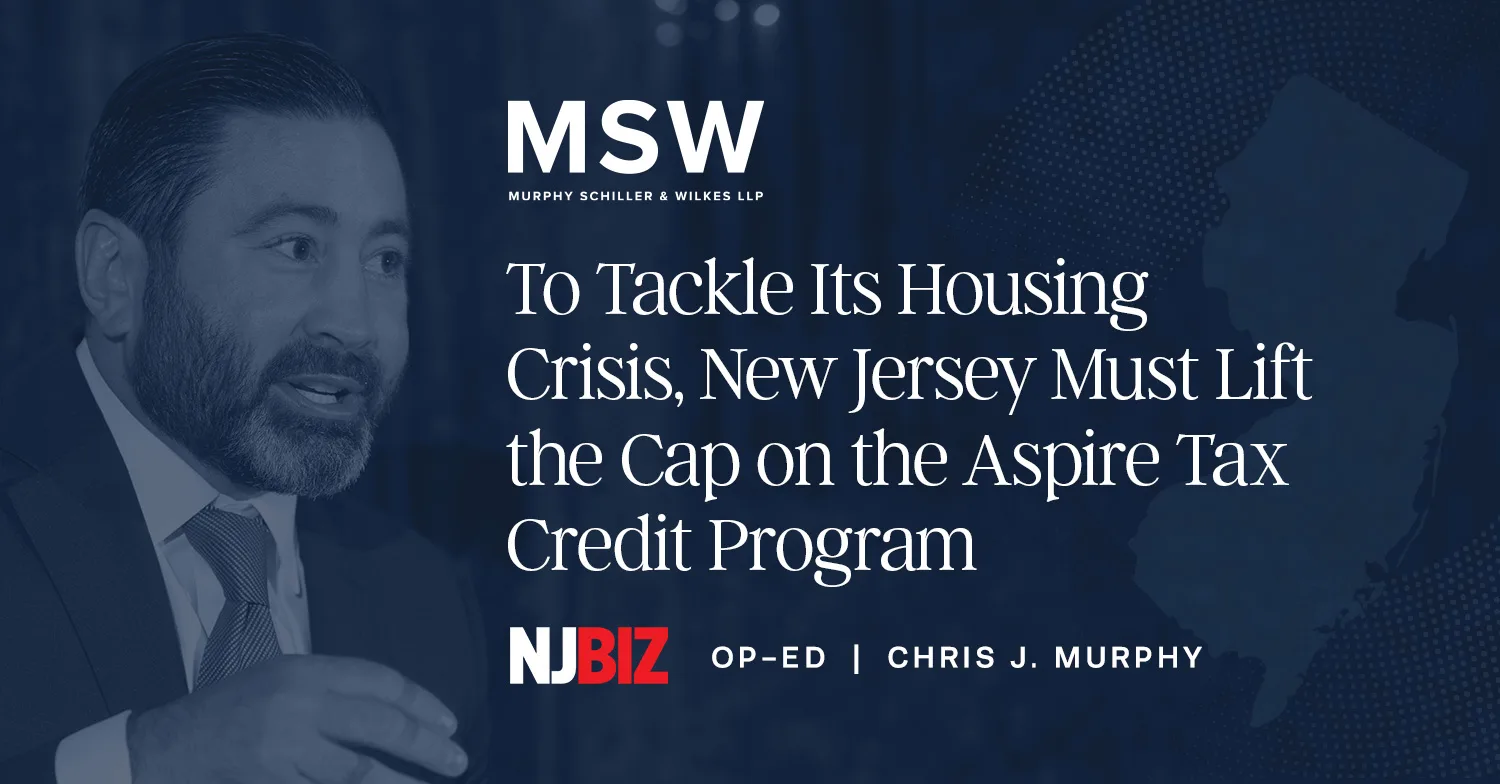
MSW – NJBIZ Op-Ed: Cap on Aspire tax credits threatens NJ development

To Tackle Its Housing Crisis, New Jersey Must Lift the Cap on the Aspire Tax Credit Program

By Chris J. Murphy
Partner, Murphy Schiller & Wilkes LLP

For the first time since the Legislature created the Aspire Tax Credit Program in 2020, New Jersey’s development community can finally model, finance, and close Aspire supported projects with real confidence. It has taken years for the market to understand the mechanics of the program. It has taken years for lenders and investors to become comfortable with the tax credits. It has taken years for the NJEDA to refine its processes. But today, Aspire is doing exactly what it was intended to do. It is making complex, high-cost projects financially feasible in both urban and suburban markets.

And just as the program becomes workable, the State is limiting it in a way that threatens the entire development pipeline.

The Legislature recently increased the amount of credits permitted under Aspire. That increase was necessary, but it was not sufficient. Aspire is not subject to annual appropriations. It is a tax credit program, not a budget line item. The problem is not a lack of state dollars. The problem is the artificial ceiling the Legislature has placed on the total amount of credits that can be awarded. Previous state tax credit programs operated without a cap and were allowed to meet market demand. Aspire, in contrast, is being constrained at the exact moment when the market needs it most.

The economics of development across New Jersey are unforgiving. Construction costs have reached historic levels. Interest rates have dramatically increased the carrying costs of projects. Municipalities continue to impose affordability requirements that further compress returns. Environmental, infrastructure, and regulatory burdens grow heavier each year. The result is simple. Projects do not pencil. Without Aspire, many will not move forward.

This is not ideology. It is arithmetic. Anyone who is actually building in Newark, Paterson, New Brunswick, East Orange, Jersey City, or any other urban center understands this reality. The same is true in suburban communities where Aspire is now one of the only tools capable of supporting mixed income and affordable housing development. These projects face the same cost pressures and the same financing gaps and Aspire is often the only mechanism that can close those gaps.

Aspire was created to fill the space between what a project costs and what it can support. After years of uncertainty, the program is finally functioning. Developers can model it. Lenders can underwrite it. Investors can monetize it. Municipalities can plan around it. For the first time, there is predictability, which is the single most important ingredient in any development ecosystem.

But predictability means nothing if the program is capped at a level that bears no relationship to market conditions.

If the State does not either remove the cap entirely or authorize a significantly larger amount of credits, the consequences will be immediate and severe. Projects in design will be shelved. Lenders will walk away. Capital will move to other states where construction and labor costs are lower and incentives are not artificially constrained. Municipalities that have been counting on new ratables will be left with vacant lots and stalled visions. Housing production, including desperately needed affordable housing in both urban and suburban communities, will slow to a crawl.

This is especially troubling because Aspire directly advances the State’s own policy goals. Every Aspire project must include at least twenty percent on site affordable housing. Every Aspire project must pay prevailing wages during construction and for ongoing building services. Every Aspire project must incorporate green building design standards. These requirements ensure that Aspire delivers not only economic development, but also affordability, labor protections, and environmental responsibility. It is a win for residents, a win for workers, a win for municipalities, and a win for the State.

New Jersey cannot claim to be serious about economic development while simultaneously restricting the only tool capable of making development feasible. Urban revitalization and suburban housing production require more than speeches, press releases, and ceremonial groundbreakings. They require a program that is allowed to operate at the scale the market demands. At the moment, the State is offering the opposite.

The Legislature has two responsible options. It can remove the cap altogether, or it can authorize a significantly larger amount of credits that reflects the true cost of development in this market. Anything less is political theater. Aspire is not a luxury. It is not a giveaway. It is the backbone of development in New Jersey. Without it, the State’s communities will stagnate while other regions surge ahead.

New Jersey has the talent, the demand, the developers, and the municipalities ready to build. What it lacks is the political will to allow Aspire to operate at the level required to make that possible. If the State wants any chance of attracting private capital to its communities, it must stop restricting the program that makes investment feasible. The market has done its part. Now Trenton needs to do the same.

Chris J. Murphy is a founding partner of Murphy Schiller and Wilkes LLP (MSW) and a member of the firm’s Executive Committee. He chairs both the Tax Credits and Incentives Practice and the Land Use, Zoning and Redevelopment Practice, overseeing two of the firm’s core statewide platforms. In these roles, he has helped clients secure approvals for more than one billion dollars in tax credits and incentives administered by the New Jersey Economic Development Authority and thousands of multifamily residential units throughout New Jersey.

Read the full article HERE.

Murphy Schiller & Wilkes LLP Recognized in Best Lawyers 2026 “Best Law Firms” Rankings

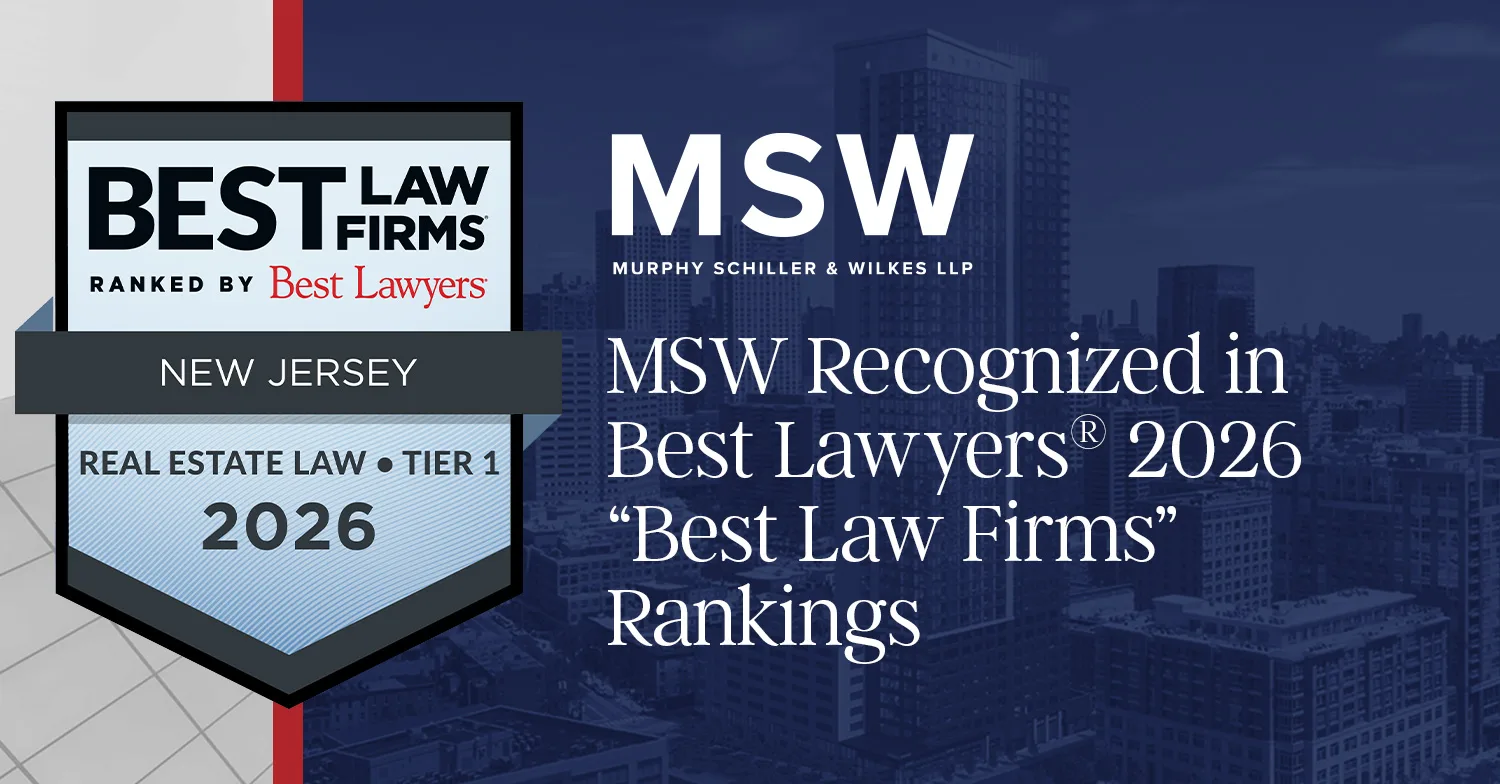
Murphy Schiller & Wilkes LLP (MSW) is proud to announce its inclusion in the Best Lawyers®️ 2026 “Best Law Firms” rankings, earning top recognition for excellence in both Real Estate Law and Environmental Law.

MSW achieved a Tier 1 ranking in Real Estate Law (Regional – New Jersey). This honor reflects the firm’s depth of experience in real estate development, land use, redevelopment, financing, and complex transactions, as well as our continued commitment to providing strategic, solutions‑driven counsel to clients throughout New Jersey and the region.

The firm also earned a Tier 3 ranking in Environmental Law (Regional – New Jersey). This recognition underscores MSW’s expanding capabilities in navigating New Jersey’s dynamic environmental regulatory framework, including permitting, compliance, environmental litigation, and brownfield redevelopment.

The Best Law Firms rankings, now in their 16th year, evaluate thousands of firms nationwide through a rigorous process that includes client feedback, peer reviews, and detailed firm submissions. The 2026 rankings recognize top regional firms, highlighting practices that demonstrate exceptional professional achievement and industry leadership.

MSW is grateful to our clients, partners, and colleagues whose trust and collaboration make this recognition possible. We remain dedicated to delivering the high‑quality, forward‑thinking legal counsel that defines our practice.

To view MSW’s full rankings, please visit: https://www.bestlawfirms.com/firms/murphy-schiller-wilkes-llp/91422/US

When the Gloves Come Off: Navigating Land Use & Zoning Litigation in New Jersey

By Chris J. Murphy and Lisa E. Lomelo

New Jersey land use is not for the faint of heart. Anyone who has ever sat through a land use board hearing that stretched on for months knows the truth … this is hand‑to‑hand combat. It’s a world where nearly conforming projects can still face stiff resistance, where politics and planning collide, and where even the most carefully designed development can find itself subject to challenge.

It is essential that developers understand the role that litigation can play in both securing and defending their development rights. That’s where having the right team makes all the difference.

Why Litigation Happens (Even When It Shouldn’t)

Most developers don’t walk into a project expecting to litigate. They invest in planning, engineering, community outreach, and compliance. They hire experienced counsel. They follow the rules. And in many cases, that’s enough.

But New Jersey’s land use framework is uniquely complex. Governing bodies have almost unlimited power to control zoning in the municipality and local land use boards have extreme discretion. Local opposition can be fierce. Even nearly conforming applications can be derailed by shifting political winds, misapplied legal standards, or procedural missteps. Sometimes, a denial is simply the result of a board refusing to accept what the law requires.

A developer must be prepared both to defend challenges from those who may simply not want the project to go forward or to bring an action against a land use board that failed to follow the law.

Consider these scenarios:

  • A planning board unlawfully denies a development application due to off-site concerns such as traffic.
  • A zoning board grants a use variance but with unreasonable conditions that make the development unlikely to ever be built.
  • A board denies approval for one of the few uses that would render the site viable for development.
  • An objector presents with counsel and expert testimony with the sole goal of preventing development.

Presenting a well-designed project may not be enough. Unfortunately, land use boards make decisions that they know violate the MLUL, often because they believe they will not be challenged.

Prerogative Writ Actions: The Developer’s Counterpunch

A prerogative writ action is the mechanism to challenge a land use decision in New Jersey Superior Court. It allows a court to review whether the board acted within its jurisdiction and authority and the board’s decision-making process.

These cases often turn on questions like:

  • Did the board have proper jurisdiction to hear the development application?
  • Did the board act within its legal authority?
  • Did the board apply the correct legal standards?
  • Did the board rely on the evidence presented to it?
  • Did it ignore uncontroverted expert testimony?

When the answer to any of these is “no,” the court can, and often does, step in.

Why It Matter for Developers

Litigation is never the first choice, but it is often a reality. Either as an essential tool to enforce a developer’s rights or because of an objector’s desire to derail a project, a developer may find itself in litigation. It is essential that the development application be presented before the land use in a manner that allows a successful outcome before both that board and a court.

Without it, municipalities can act with impunity. Politics or unfounded community opposition can influence a board to make unlawful decisions. Having a strong team that understands the process and will vigorously defend a developer’s rights at all stages is essential.

For developers, the ability to overturn a wrongful denial or to excise an illegal condition of the approval is essential. It sends a message to municipalities that the applicant is serious and well‑represented.

And perhaps most importantly, litigation can turn a “no” into a “yes.”

The MSW Approach: Precision, Strategy, and Staying Power

Prerogative writ litigation is not about theatrics. It’s about building a meticulous record, identifying legal vulnerabilities, and presenting a compelling narrative grounded in the MLUL. Our team approaches these cases with the same intensity we bring to complex approvals:

  • We know the boards. We understand how decisions are made and how they should be made.
  • We know the law. Our land use and zoning practice is built on decades of experience navigating the MLUL and its judicial interpretations.
  • We know the battlefield. New Jersey’s land use environment is adversarial by nature. We treat it accordingly.

Because we handle both approvals and litigation, we see the full lifecycle of development. That perspective allows us to anticipate issues before they arise and respond decisively when they do.

Litigation as a Strategic Tool—Not a Last Resort

Developers often think of litigation as a failure. In reality, it’s a strategic option – one that can unlock stalled projects, correct municipal overreach, and protect significant investments. A strong team that understands how to build a record and will not flinch at the threat of litigation can often prevent frivolous legal actions before they begin.

In a state where land is scarce, politics are local, and development pressure is high, prerogative writ actions are part of the landscape. The key is approaching them with clarity, confidence, and a team that knows how to win.

In New Jersey, Land Use Is a Contact Sport

The MLUL provides a framework, but the real action happens in the trenches, at hearings, in boardrooms, and, when necessary, in court. Developers who understand this, and who surround themselves with experienced counsel, are the ones who succeed.

At MSW, we don’t shy away from the fight. We prepare for it. And when a denial crosses the line, we’re ready to push back.

For more information on the MSW Land Use Litigation practice, please contact:

Chris J. Murphy, Partner
Chair, Land Use, Zoning and Redevelopment
Phone: (973) 705-7421
Email: cmurphy@murphyllp.com

Lisa E. Lomelo, Counsel
Land Use, Zoning and Redevelopment
Phone: (973) 750-4770
Email: llomelo@murphyllp.com