Practice Group Series – Planning & Development Services

Planning and Development Services

MSW’s Planning and Development Services team helps clients get shovels in the ground. Through the development of comprehensive strategies throughout the pre-approval and post-approval process, our team helps clients expediate their development schedules, saving time and money in the process.

At Murphy Schiller & Wilkes LLP (MSW), our Planning and Development Services team is dedicated to helping clients transform plans into reality. From pre-approval to post-approval, we craft and execute strategies that streamline the development process, reducing delays, saving costs, and ultimately getting shovels in the ground faster.

We understand that securing land use approvals is just one piece of the puzzle—getting a project underway is an entirely separate challenge. To address this, our Planning and Development Services group provides targeted, client-focused solutions in three key areas:

1. Entitlement Planning

Navigating the entitlements process efficiently is critical for any development project. Our team works closely with municipal planning and engineering professionals to ensure that project designs meet local standards, streamlining approvals. This proactive, pre-application engagement minimizes delays during the resolution compliance and permitting stages, helping clients move their projects forward more quickly.

2. Resolution Compliance

In many of New Jersey’s largest municipalities, resolution compliance often becomes a bottleneck, causing costly delays. Our team’s deep understanding of local processes and relationships with key stakeholders allows us to take the lead in managing compliance submissions and final signoffs. By ensuring that documents are reviewed promptly by the right officials, we help significantly reduce the time required to navigate this complex stage.

3. Permitting

Once resolution compliance is secured, we guide clients through the building permit process with precision. Thanks to long-standing relationships with construction officials and review agents, we help expedite permit approvals, ensuring that construction can commence without unnecessary delays.

At MSW, we don’t just assist with development—we deliver solutions that keep projects on schedule and on budget. Let our Planning and Development Services team help you turn your vision into reality.

Practice Group Leaders:

Christopher Watson
Director of Planning and Development Services
Phone: (973) 705-7421
Email: cwatson@murphyllp.com

Chris J. Murphy, Partner
Chair, Tax Credits & Incentives
Phone: (973) 705-7442
Email: cmurphy@murphyllp.com
New Jersey Incentives Update (January 2025)

On January 23, 2025, Governor Phil Murphy signed recently passed legislation (S1323/A2076) that significantly changes the Aspire Tax Credit Program. Aspire is the state’s main developer-focused incentive program, designed to spur residential and commercial development through the provision of tax credits. The amendments make meaningful changes to the Aspire program, altering which projects qualify, the size of the potential tax credit and several key aspects that have major financial implications.

On the same day, the New Jersey Economic Development Authority (NJEDA) held a Special Telephonic Board Meeting, during which they approved the first Aspire project in Jersey City. The Board granted an award of $64,226,368 to support a six-story, 210-unit housing project, with 35% of the units designated as affordable housing. This development is part of the larger Bayfront project in Jersey City’s West Side.

During this Special Meeting, the NJEDA also approved a new incentive program that seeks to enhance cultural arts activities across the state. The Cultural Arts Facilities Expansion (CAFE) program. CAFE is a gap financing tax credit program providing awards of up to 100% of eligible capital and operating costs (not to exceed $75M) for projects with a minimum project size of $5M. Qualifying institutions must be engaged in cultural, educational, or artistic enrichment in the state.

More information on the CAFE program to follow on the MSW Blog when the rules are made public.

Aspire

On December 19, 2024, the New Jersey State Senate and Assembly passed legislation (S1323/A2076), known as the “Aspire Amendment,” which Governor Phil Murphy signed into law on January 23, 2025. This legislation introduces significant changes to the Aspire Tax Credit Program, the state’s primary developer-focused incentive designed to promote residential and commercial development.

Major changes were made to the program, including:

  • Expanded eligible areas
  • New municipalities qualifying as GRMs
  • Reduced thresholds for Transformative projects
  • New Special Mission Non-profit Projects designation

We covered these changes in our article last month: Aspire Tax Credit Update – NJ Legislature Approves Amendments

To date, the NJEDA has awarded over $2,600,000,000 in tax credits to 25 development projects in municipalities across New Jersey, including Jersey City, Woodbridge, Morristown, Newark, Hoboken, Union City, Bayonne, Trenton, and Camden. The program has been used to finance several large-scale projects, including the following:

  • 386-unit mixed-use project in Hoboken, NJ.
  • 58-acre, 1,567,385 square feet film studio in Bayonne, NJ.
  • 101-unit senior affordable housing development in Union City, NJ.
  • $356,000,000 mixed-use development in Newark, NJ, including 350 residential units, a new 53,000 square foot arts-education and community facility, 12,600 square feet of commercial space, and improvements to a 100,000 square foot performing arts center.

The Aspire Tax Credit Program provides tax credits covering between 50-85% of eligible project costs (not to exceed between $60M-$120M) for qualifying projects in eligible locations. Aspire can be used for both residential and commercial developments, and for projects as small as 25,000 – 50,000 square feet for commercial and $5,000,000 – $17,500,000 for residential, depending on location.

Cultural Arts Facilities Expansion (CAFE) program

At a Special Meeting on January 23rd, 2025, the New Jersey Economic Development Authority (NJEDA) approved the new Cultural Arts Facilities Expansion (CAFE) program. This $1.2B gap financing program is designed to support cultural arts institutions constructing or rehabilitating theaters, museums, galleries, libraries and performing arts centers across New Jersey.

CAFE will award tax credits up to 100% of eligible capital and operating costs (not to exceed $75M) for projects with a minimum project size of $5M. Qualifying institutions must be engaged in cultural, educational, or artistic enrichment in the state. The EDA anticipates the first application window opening this spring. If you know of an institution that could benefit from this program, do not hesitate to reach out.

More information on the CAFE program to follow on the MSW Blog when the rules are made public.

For more information, please contact:

Brendan Pytka
Director of Tax Credits & Incentives
Phone: (862) 418-3702
Email: bpytka@murphyllp.com

Chris J. Murphy, Partner
Chair, Tax Credits & Incentives
Phone: (973) 705-7421
Email: cmurphy@murphyllp.com

MSW Obtains Swift Dismissal of Construction Lien Claim and Award of Fees

The Murphy Schiller & Wilkes LLP (MSW) Construction and Litigation team recently succeeded in discharging a construction lien by court order and precluded a lienor from filing any further lien claims. MSW, led by Brant Forrest, partner and co-chair of the MSW Construction and Litigation Groups, represented a general contractor on a large-scale residential project. A subcontractor improperly recorded a construction lien claim against a project.

Pursuant to N.J.S.A. 2A:44A-14, MSW served a notice on the subcontractor demanding the subcontractor commence an action to foreclose on the construction lien within 30 days or otherwise forfeit any lien rights. After the subcontractor failed to commence any action, MSW filed an Order to Show Cause seeking immediate discharge of the construction lien and an award of attorneys’ fees. The court agreed with the arguments presented by MSW in that the subcontractor failed to take timely action after receiving the notice under N.J.S.A. 2A:44A-14, and ordered the discharge of the construction lien. In addition, the court deemed the subcontractor forfeited its lien rights and awarded attorneys’ fees to the general contractor.

For more information, please contact us:

R. Brant Forrest
Phone: (973) 320-7591
Email: bforrest@murphyllp.com

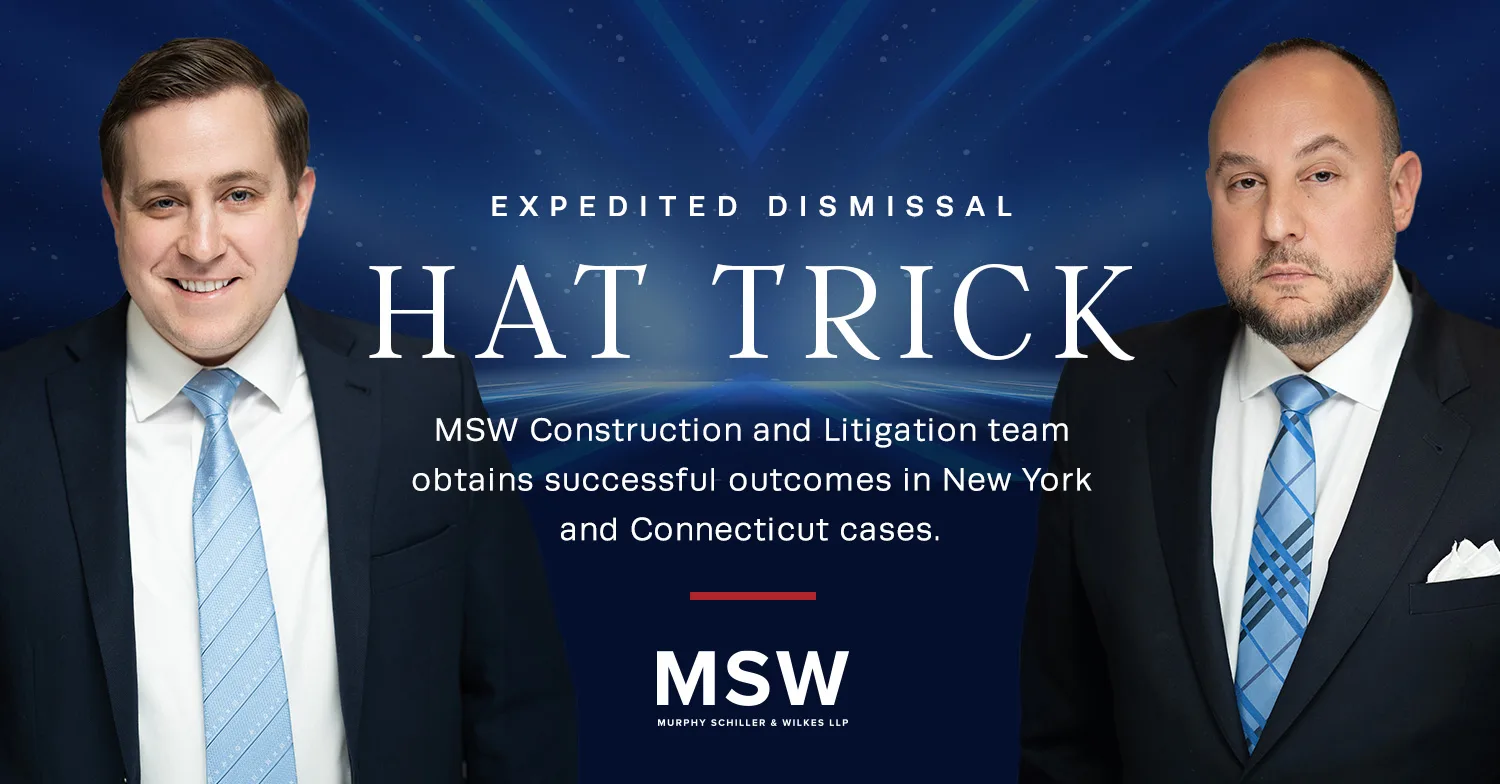
Expedited Dismissal “Hat Trick” for the MSW Litigation Team

Expedited Dismissal “Hat Trick” for the MSW Litigation Team

The MSW Construction and Litigation team recently obtained pre-answer dismissal in two separate matters on behalf of its professional, and pre-discovery voluntary discontinuance in one matter where discovery had only just begun.

“…with Liberty and Justice for All”

New York County, NY – MSW filed a pre-answer motion for dismissal of a New York Labor Law claim arising out of an alleged fall on an equipment access ramp in connection with the renovation of Ms. Liberty.

Specifically, MSW represented an engineer in the design of an access ramp for use by certain vehicles used for repairs and masonry work at the Statute of Liberty. During construction work, a worker allegedly slipped and fell on the ramp. He subsequently sued the engineer (and other construction defendants) under New York Labor Law Sections 200, 240(1), 241(6). MSW filed a pre-answer motion to dismiss. The court held that the engineer’s role was limited to providing construction design, which cannot form the basis of liability under Labor Law Sections 240(1) and 241(6) unless that engineer controlled or directed plaintiff’s work. Additionally, the court held that Labor Law Section 200 could not impose liability against the engineer because the engineer did not control, supervise the work, nor had the authority to direct the construction procedures or safety measures.

“Take me out of the Ballgame…”

Hartford, CT – MSW filed a pre-answer motion on behalf of an engineer who performed limited services in connection with the design of a professional baseball stadium. The engineer was joined after the case was remanded post-trial and faced claims of indemnification, professional negligence, and negligent misrepresentation. The court held that the third-party plaintiff failed to allege facts sufficient to satisfy the required elements of a common law indemnification claim, thereby requiring dismissal of the common law indemnification claim. As for the professional negligence and negligent misrepresentation claims, the court held that the pleadings were devoid of factual allegations to support these claims and did not allege any pecuniary harm. The court noted that these claims are common law indemnification claims based on a breach of a duty owed to the underlying plaintiffs, not direct claims for a breach of duty owed to the third-party plaintiff.

“You Can’t See Me”

Ulster County, NY – MSW represented a structural engineer in litigation relating to a failing foundation at a residential property in New York. The structural engineer was sued for allegedly failing to properly inspect a foundation and provide a sufficient opinion about the structural integrity of the structure. The litigation team identified and obtained sworn statements from multiple non-party witnesses that corroborated the structural engineer’s version of events, and rebutted not merely plaintiff’s theory of the case, but also her recollection that she was there during the operative inspection. Under the heavy weight of an impending falsus in uno charge, Plaintiffs voluntarily discontinued the lawsuit.

Navigating New Horizons: Mastering Affordable Housing Tax Credits and Zoning Reforms in New Jersey

As New Jersey faces a critical juncture in urban development, the roles of zoning reforms and affordable housing tax credits have never been more essential. This article delves into these transformative forces, aiming to equip executives, bankers, policymakers, and developers with the insights needed to navigate these changes not just efficiently, but with unprecedented profitability and societal impact.

Consider the transformative Springfield Avenue Marketplace in Newark. This initiative utilized Low-Income Housing Tax Credits (LIHTC) alongside progressive zoning to revitalize a declining neighborhood into a bustling community center. It boasts 24,000 square feet of commercial space, alongside 152 affordable units, supported by a coalition of city planners, developers, and financiers. This collaboration not only fueled economic growth but also catalyzed further developments, showcasing a blueprint for sustainable urban renewal.

List of Challenges: Industry professionals routinely encounter formidable challenges:

  • Regulatory Navigation: The ever-evolving landscape of federal and state regulations demands constant vigilance.
  • Financing: Integrating incentives into a capital stack and accounting for the various rules presents a significant barrier.
  • Community Buy-in: Local opposition can significantly stall developments.
  • Cost Management: Adhering to budgets in fluctuating market conditions is continually challenging.

Solutions and Opportunities: Addressing these challenges requires innovative thinking:

  • Enhanced Public-Private Partnerships: Foster partnerships that not only share risks but also integrate community services to gain public support.
  • Innovative Financing Models: Explore all possible incentives to fund affordable units and maintain returns.
  • Proactive Community Engagement: Implement comprehensive stakeholder engagement plans early in the development process to mitigate resistance and enhance community benefits.
  • Advanced Project Management Techniques: Utilize state-of-the-art construction management software and eco-friendly building practices to reduce costs and environmental impact.

To incentivize affordable housing, government agencies and municipalities in the State of New Jersey administer a range of funding sources available to developments that provide affordable housing:

  • Aspire: The Aspire program from the New Jersey Economic Development Agency (“NJEDA”) has provided over $1,400,000,000 in tax credits to 20 residential projects that include affordable housing.
  • LIHTC: the New Jersey Housing and Mortgage Finance Agency (“NJHMFA”) allocates tax credits through their 4 Percent and 9 Percent programs to incentivize residential developments up to 100% affordable.
  • HOME Investment Partnerships Program (“HOME”): a locally administered federal program that provides grant funding for the rehabilitation and creation of affordable housing.
  • Other programs: the NJEDA administers a multitude of targeted incentive programs that provide additional funds for specific types of development, including the Brownfields Incentive Program and the Historic Property Reinvestment Program.

The future of affordable housing depends on proactive industry leadership. Engage and learn more about affordable housing by joining my collaborative think tank on sustainable development. Your expertise can spearhead the change needed to ensure affordable housing not only exists but thrives in New Jersey.

Tackling affordable housing under New Jersey’s new regulatory frameworks offers strategic benefits. By mastering tax credits and zoning reforms, you can lead successful projects that foster community development and economic growth. Embrace your role as a thought leader—your actions today will shape the sustainable cities of tomorrow.

For more information, please contact us:

Roosevelt J. Donat, Esq.
Special Counsel
Land Use, Zoning and Redevelopment
Phone: (973) 705-7414
Email: rdonat@murphyllp.com

Brendan Pytka
Director of Tax Credits & Incentives
Phone: (862) 418-3702
Email: bpytka@murphyllp.com

MSW Year End Highlights 2024

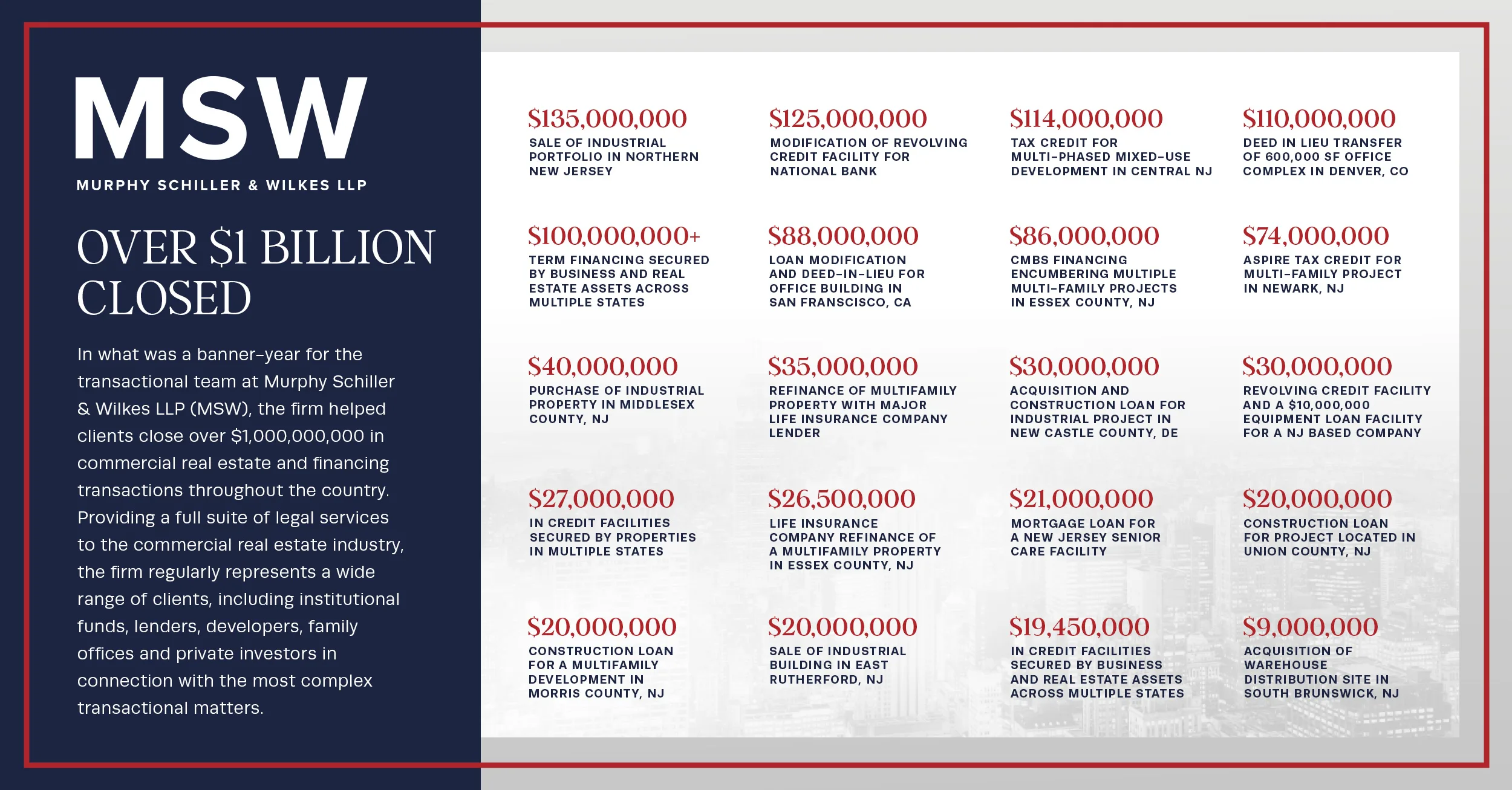
In what was a banner-year for the transactional team at Murphy Schiller & Wilkes LLP (MSW), the firm helped clients close over $1,000,000,000 in commercial real estate and financing transactions throughout the country. Providing a full suite of legal services to the commercial real estate industry, the firm regularly represents a wide range of clients, including institutional funds, lenders, developers, family offices and private investors in connection with the most complex transactional matters.

In 2024, the firm represented the following:

  • Borrower in connection with Deed in Lieu transfer of 600,000 SF office complex in downtown Denver, CO in connection with $110,000,000 loan.
  • Seller in connection with $135,000,000 sale of industrial portfolio in northern New Jersey.
  • National bank in connection with modification of $125,000,000 revolving credit facility.
  • Developer in connection with a $114,000,000 tax credit award under the Aspire Tax Credit Program for a multi-phased mixed-use development in central New Jersey.
  • National cannabis company on $100,000,000+ term financing secured by business and real estate assets across multiple states.
  • Borrower in connection with loan modification of $88,000,000 loan and deed-in-lieu transaction for office building in San Francisco, California.
  • Borrower in connection with the defeasance of a $30,300,000 loan and new CMBS financing in the amount of $86,000,000 encumbering multiple multi-housing family projects located in Essex County, NJ.
  • Developer in connection with $74,000,000 Aspire tax credit for multi-family project in Newark, NJ.
  • Developer in connection with $40,000,000 purchase of industrial property in Middlesex County, New Jersey.
  • Developer in connection with $35,000,000 refinance of multifamily property with major life insurance company lender.
  • Developer in connection with $30,000,000 acquisition and construction loan for industrial project in New Castle County, Delaware.
  • New Jersey bank in connection with a $30,000,000 revolving credit facility and a $10,000,000 equipment loan facility for a New Jersey based company.
  • International bank in connection with amendment and restatement of $27,000,000 in credit facilities secured by properties in multiple states.
  • Borrower in connection with a $26,500,000 life insurance company refinance of a multifamily property in Essex County, New Jersey.
  • Community bank in connection with a participation in a $21,000,000 mortgage loan for a New Jersey senior care facility.
  • Borrower in connection with $20,000,000 construction loan for property located in Union County, New Jersey.
  • Lender in connection with a $20,000,000 construction loan for a multifamily development in Morris County, New Jersey.
  • Developer in connection with $20,000,000 sale of industrial building in East Rutherford, New Jersey.
  • International lender in connection with the modification of $19,450,000 in credit facilities secured by business and real estate assets across multiple states.
  • Purchaser in connection with $9,000,000 acquisition of warehouse distribution site in South Brunswick, NJ.

New Jersey Incentives Update (December 2024)

On December 19th, 2024, New Jersey Economic Development Authority (“NJEDA”) held its monthly Board meeting in Trenton, NJ. Along with other items, the NJEDA approved three new Aspire awards in Camden, Fort Monmouth, and Trenton, totaling over $400,000,000 in tax credits.

The NJEDA also approved an award through the Atlantic City Revitalization Grant Program, in addition to updating and reopening the program, which provides grant funding of up to 50% of eligible soft and hard costs for qualifying projects in Atlantic City.

Additionally, on Thursday, December 19th, 2024, the New Jersey State Senate and Assembly passed legislation (S1323/A2076) that will significantly change the Aspire Tax Credit Program. The law is anticipated to be signed by Governor Murphy in the coming weeks.

See below for more details on these updates and the associated programs.

Aspire Approvals

The NJEDA Board approved three new Aspire projects at their December 19th meeting. These new projects were located in Camden, Fort Monmouth and Trenton and totaled over $400,000,000 in new tax credits.

A residential project in Camden was awarded approximately $17,720,000 in Aspire tax credits for a project including:

  • 30 affordable housing units
  • 26,283 square foot health center
  • $36,000,000 in total development costs
  • 4,481-square-foot commercial space

Netflix’s new flagship East Coast production facility, located in Fort Monmouth, NJ, was awarded $387,000,000 tax credits. This Transformative project, slated to open in 2028, will comprise:

  • Over 1,000,000 square feet studio campus over a 292-acre parcel
  • 12 soundstages, backlot areas, an office building, and other production support facilities

A 100% affordable rehabilitation project in Trenton, NJ, was awarded $22,769,231 in tax credits, consisting of 110 rental units affordable at 60% of Area Median Income (“AMI”) spread across eight 3-story buildings.

To date, the NJEDA has awarded over $2,500,000,000 in tax credits to 25 development projects in municipalities across New Jersey, including Woodbridge, Morristown, Newark, Hoboken, Union City, Bayonne, Trenton, and Camden. The Aspire Tax Credit Program provides tax credits covering between 50-85% of eligible project costs (not to exceed between $60M-$120M) for qualifying projects in eligible locations. Aspire can be used for both residential and commercial developments, and for projects as small as 25,000 – 50,000 square feet for commercial and $5,000,000 – $17,500,000 for residential, depending on location.

Aspire Amendments

On December 19th, 2024, the New Jersey State Senate and Assembly passed legislation (S1323/A2076) updating Aspire which will have significant implications for the program. The amendments alter which projects qualify, the size of the potential tax credit and several key aspects that have financial implications for a project that uses the Aspire program.

Major changes to the program include:

  • Additional cities now qualify as Government Restricted Municipalities (GRMs)
  • New Special Mission Non-profit Projects (SMNP) designation
  • Lower thresholds to qualify as a mixed-use Transformative project
  • Reduced Eligibility Periods for certain projects

Have a look at earlier post ( Aspire Tax Credit Update – NJ Legislature Approves Amendments ) for more detailed information.

Atlantic City Revitalization Program

This program was initially funded with $19,650,000 and began accepting rolling applications on January 31, 2024. The program was created to provide grant funding to for-profit and non-profit developers to help fund projects that contribute to Atlantic City’s revitalization. It funded up to 50% of eligible soft and hard costs for qualifying projects, with a required grant size of $1,000,000 to $10,000,000.

Every project must focus on addressing at least one local impact priority, including:

  • Addressing downtown vitality efforts
  • Job and office space creation
  • Food insecurity
  • Clean and safe initiatives
  • Small business support

At the December 19th meeting, the NJEDA Board approved a grant of $4,200,000, in addition the rollover and reallocation of previously unused and withdrawn funding in order to reopen the application window. After this approval, $3,900,000 will remain in available funding. The Board approved changes to the rules of the program, including the requirement that future programs be rehabilitation only, among others. The program closed applications earlier this year, and a date has not yet been set for the next application window.

For more information, please contact:

Brendan Pytka
Director of Tax Credits & Incentives
Phone: (862) 418-3702
Email: bpytka@murphyllp.com

Chris J. Murphy, Partner
Chair, Tax Credits & Incentives
Phone: (973) 705-7421
Email: cmurphy@murphyllp.com

Aspire Tax Credit Update – NJ Legislature Approves Amendments

On Thursday, December 19, 2024, the New Jersey State Senate and Assembly passed legislation (S1323/A2076) (“Aspire Amendment”) that will significantly change the Aspire Tax Credit Program (“Aspire”), the state’s main developer-focused incentive program, designed to spur residential and commercial development through the provision of tax credits. Established under the Economic Recovery Act of 2020, Aspire has quickly become an important tool for real estate developers, with the New Jersey Economic Development Authority (“NJEDA” or “Authority”) having approved over $2,000,000,000 in tax credits for 25 development projects in municipalities across the state.

The purpose of the memorandum is to provide a detailed overview of the Aspire Amendment, which is anticipated to be signed by Governor Murphy in the coming weeks. The updates to the Aspire program have significant implications for which projects qualify, the size of the potential tax credit and several key aspects that have financial implications for a project that uses the Aspire program.

Below is an overview of the key programmatic changes contained in the Aspire Amendment:

1. Government Restricted Municipalities

The Aspire program has different eligibility thresholds, potential awards, and regulations for projects that are located in municipalities designated as Government Restricted Municipalities (“GRM”). Under the previous statute, only Atlantic City, Patterson and Trenton qualified as GRMs. The Aspire Amendment expands the definition of a GRM, which results in the inclusion of New Brunswick, Camden and East Orange.

Qualifying projects in these newly designated municipalities are now eligible for awards of up to 80% of eligible costs (not to exceed $120M), with reduced thresholds for qualifying for Transformative Projects.

For projects located in municipalities that were previously designated as GRMs (Atlantic City, Paterson and Trenton), the maximum potential award has been increased to 85% of eligible costs (not to exceed $120M).

Further, the Aspire Amendment now allows projects located in a GRM to include the cost of land in their Eligible Costs (up to 20% of Eligible Costs), and also reduces the maximum Eligibility Period to 5 years.

2. Special Mission Non-profit Projects

The Aspire Amendment creates a new potential designation for projects located in a GRM or an Enhanced Area. Those requirements include, among others, projects that:

  • Serve a special mission, as determined by the Authority;
  • Include no more than 100 units of 100% supportive housing for tenants requiring special needs or social services; and
  • Include no more than 25,000 square feet of commercial space for the provision of social service programs.

Projects that qualify as Special Mission Non-profit Projects (“SMNPs”) are exempt from the requirements for the Net Benefits Test, affordable housing, market study, and the Community Benefits Agreement.

These projects are eligible for an award up to 85% of eligible costs (not to exceed $120M).

3. Transformative Projects

In order to qualify as a Transformative Project, the primary benefit being an increased maximum potential tax award of $400M, a project must meet certain thresholds, including a minimum size (number of units and square footage requirements). The amendment reduces the amount of commercial square footage required to qualify as a mixed-use residential development, as follows:

  • 200 new residential units in a GRM;
  • 300 new residential units in an Enhanced Area;
  • 400 new residential units in all other eligible areas; and
  • 30,000 square feet of commercial space (reduced from the previous threshold of 50,000).

4. Eligibility Period

The Eligibility Period dictates the period of time under which the developer is required to adhere to certain program requirements, as well as when they will receive their award of tax credits. This has implications for the value of those tax credits and the ability to monetize them.

The Aspire Amendment reduces the maximum Eligibility Period from 15 to 10 years for most projects, and to 5 years for projects located in a GRM or for Special Mission Non-profit Projects. It further allows the NJEDA to approve an Eligibility Period shorter than the prescribed limits.

5. Certification and Reduction in Tax Credit Award

Pursuant to the previous Aspire statute, the NJEDA reserved the right to verify the need for the tax credit up until project completion and conclusion of the certification process. That process could include a project cost audit and confirmation of the financing sources, among other requirements. If the resulting financial analysis showed a return greater than that included in the project’s Board approval, the NJEDA reserved the right to reduce the size of the approved tax credit award.

The Aspire Amendment removes the ability of the NJEDA to decrease the size of the award in the event of excess returns prior to certification but creates a mechanism by which the developer will be required to fund a profit share. The implementation of this profit share will be contingent on the established Eligibility Period and whether the developer has chosen to redeem their tax credits with the New Jersey Department of Treasury.

6. Department of Treasury Purchase of Tax Credits

Under the Aspire program prior to the amendment, developers were allowed to either use the tax credits against their own tax liability or sell them on the market to another entity for the same purposes. The Aspire Amendment allows the developer, if a year has passed since the tax credit has been issued, to sell those credits to the Department of the Treasury for $0.85 per dollar.

If a tax credit is sold to the Treasury after the sixth year of the Eligibility Period, any required payment of excess returns would increase to 50%.

7. Additional updates

The Aspire Amendment further updates several key aspects of the Aspire program:

  • Incentive Area. The NJEDA has expanded the Aspire eligible areas.
  • Commercial Projects. Amended to include warehouse distribution and fulfillment centers as long as they have at least $10M in qualifying environmental remediation costs.
  • Commercial vacancy. Commercial projects must reach 60% occupancy by the 4th year or must forfeit tax credits for that tax period and until the deficiency has been remedied.
  • Sale of an Aspire project. The new rules allow the developer to sell the building during the eligibility, “subject to such rules and regulations as may be adopted by the Authority.”
  • Phase projects. To qualify as phased, the project must have $50M in Eligible Project Costs, updated from Total Project Costs.
  • Prevailing wages. The amendments clarify that the prevailing wage requirements for building services do not apply to residential tenants.
  • Previously approved projects. The Aspire Amendment clarifies which regulations apply to projects previously approved for an Aspire award.
  • Community Benefits Agreement (“CBA”). Updated requirements concerning community engagement and reporting requirements in the CBA approval process.

For more information on the Aspire Amendment, please contact us:

Chris J. Murphy, Esq.
Chair, Tax Credits & Incentives
Phone: (973) 705-7421
Email: cmurphy@murphyllp.com

Brendan Pytka
Director of Tax Credits & Incentives
Phone: (862) 418-3702
Email: bpytka@murphyllp.com

Aspire Tax Credits – A Primer on Monetization

The Aspire Tax Credit Program (Aspire), administered by the New Jersey Economic Development Authority (NJEDA), is the state’s main developer-focused incentive program, designed to spur residential and commercial development through the provision of tax credits. Established under the Economic Recovery Act of 2020, the program has quickly become an important tool for real estate developers, with the NJEDA having approved over $2,000,000,000 in tax credits for 22 development projects in municipalities across state.

Despite the success of the program, there are common misconceptions in the real estate community regarding how the program functions in financing development projects. In this post we look to address some of the basics of turning a tax credit award into funding for a development project.

What is an Aspire award?

An Aspire award is the granting of the right to offset either Corporate Business Tax (CBT) or Insurance Premium Tax (IPT) liability in the State of New Jersey, and comes in the form of a Tax Credit Certificate.

When do developers receive their award?

After a development has attained its Certificate of Occupancy, the developer undergoes a process where the NJEDA confirms compliance with the rules of the program. This includes adherence to the prevailing wage guidelines, affordability requirements, the EDA’s Green Building Standards, and the terms of a developer’s Incentive Award Agreement. The NJEDA will certify the project’s eligible costs and establish the size of the award.

The tax credit certificates are then awarded in equal annual installments for the project’s eligibility period, which is generally a 10-year period (i.e., a $100,000,000 award is paid over ten years in $10,000,000 installments).

How do developers use Aspire to fund their development?

Developers who receive an Aspire award can either use the tax credit to offset their own tax liability, or sell them to another entity. Generally, real estate holding companies and/or single-purpose entities do not incur CBT or IPT liability, so the sale of the tax credit is necessary to monetize an Aspire award. A developer can find a buyer annually as they receive the tax credit certificates, and retain the funding as cash flow. Alternatively, they can enter an agreement to sell all of the future tax credits, either for an upfront payment or by agreeing to sell all future tax credits at a stipulated price. Lastly, a developer could find a lender to provide upfront funding for the project in the form of a bridge loan that will be serviced by the future sale of those tax credits.

At what price do Aspire tax credits sell for?

The sales price will depend on the developer’s negotiations with a potential buyer or lender, but must exceed the minimum price of $0.85 per dollar ($0.75 if utilizing Low-Income Housing Tax Credits).

Although none of the approved Aspire projects have yet to complete construction and sell their tax credits, the NJEDA awards the same type of tax credits (CBT/IPT) through their other incentive programs. The Grow New Jersey Assistance Program (GROW NJ), the Economic Redevelopment and Growth Grant (ERG), and the Emerge programs all award the same type of tax credit, the majority of which are sold.

Additionally, the NJEDA periodically sells the same tax credits through an auction process. A 2023 auction of CBT/IPT tax credits yielded an average price of $0.91 per dollar, and another round of auction sales is awaiting EDA approval.

Lastly, the New Jersey State Legislature is currently contemplating legislation that would require the Department of the Treasury to purchase any unused tax credits for a payment of $0.90 per dollar of tax credits. We are actively tracking this legislation and will provide further updates.

The sale of tax credits involves risk, and the price will fluctuate based on the particulars of a project and market demand, but the monetization of Corporate Business Tax and Insurance Premium Tax certificates is an established process. With $2,000,000,000 in tax credits already awarded through the Aspire program and progressing towards potential monetization, the market will likely become further standardized and structured in the coming year.

For more information, please contact:

Brendan Pytka
Director of Tax Credits & Incentives
Phone: (862) 418-3702
Email: bpytka@murphyllp.com

Chris J. Murphy, Partner
Chair, Tax Credits & Incentives
Phone: (973) 705-7421
Email: cmurphy@murphyllp.com