MSW Recognized by Chambers USA as a Top Law Firm

Murphy Schiller & Wilkes LLP (MSW) is proud to announce that the firm has been selected as a top law firm in the areas of Real Estate and Construction in the Chambers USA 2025 Rankings. Chambers USA ranks the top 3% of lawyers and law firms across the United States.

A ranking in Chambers shows that a firm has stood out in the most rigorous, independent and in-depth research process of any legal directory on the market, and has emerged as one of the best in the field.

In addition to the firm receiving recognition, firm partners Matthew J. Schiller and Charles J. Wilkes were ranked as top attorneys in the area of real estate, while partners Anthony Capasso and Brant Forrest were ranked as top attorneys in the area of construction.

For more information, please visit Chambers and Partners at chambers.com.

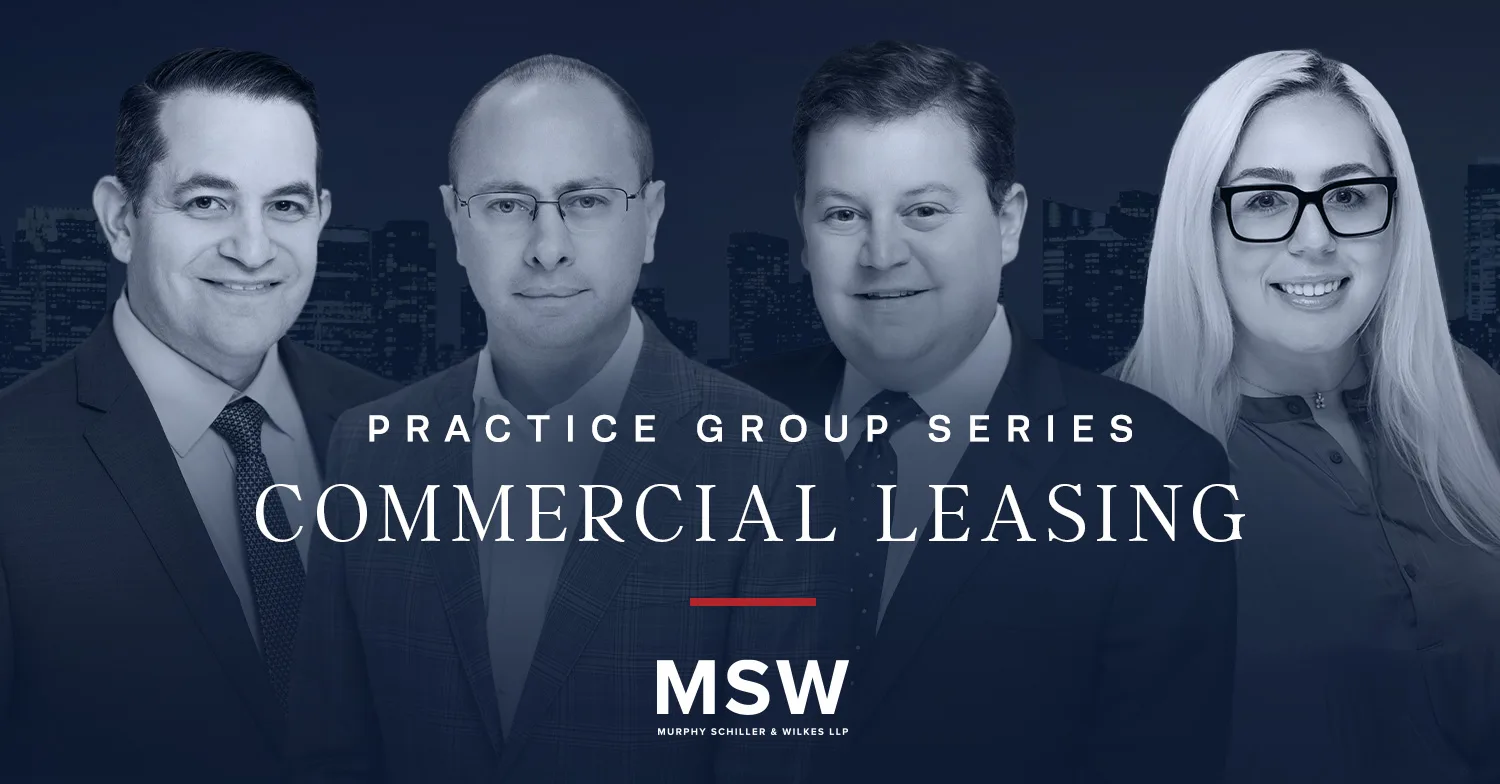
Practice Group Series – Commercial Leasing

Our lawyers have handled high profile commercial leases, including corporate headquarters and major industrial facilities.

MSW’s lawyers structure and negotiate leases on behalf of landlords and tenants for all kinds of commercial property, including office buildings, industrial and warehouse facilities, shopping centers, restaurants and breweries, cannabis dispensaries, health care facilities, marinas, sports arenas, and other sites throughout the country.

As a full-service real estate practice group, we are experienced in all varieties of leasing arrangements, including large and small office leases, and retail and restaurant leases, subleases, ground leases, sale-leaseback transactions, and build-to-suit leases. We also structure and implement commercial leasing programs for office building and shopping center owners and have experience addressing “green” and “WELL” building issues. Further, utilizing the firm’s extensive incentive advisory experience, the firm’s leasing attorneys regularly advise clients on potential real estate and economic development incentives that may be available to them as a tenant or landlord.

Practice Group Leaders:

Kellen Murphy
Partner
Phone: (973) 705-7420
Email: kmurphy@murphyllp.com

Matthew J. Schiller
Partner
Phone: (973) 705-7431
Email: mschiller@murphyllp.com

Charles J. Wilkes
Partner
Phone: (973) 705-7422
Email: cwilkes@murphyllp.com

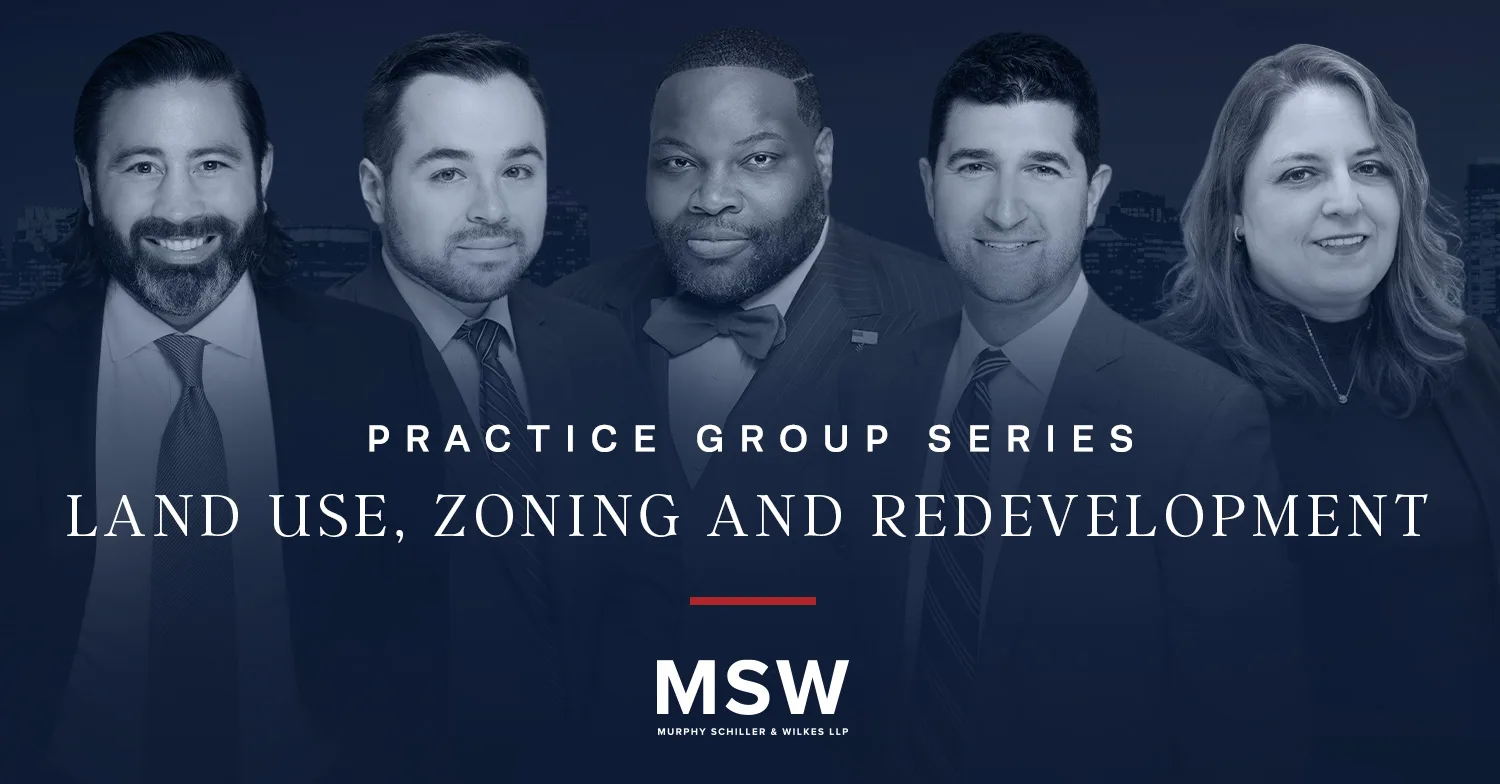
Practice Group Series – Land Use, Zoning and Redevelopment

MSW serves as land use and zoning counsel to developers, property owners, and businesses throughout New Jersey.

The firm’s land use attorneys and professionals work closely with clients and project teams to establish a proper legal and regulatory framework for a project’s design and construction, and help clients navigate the ever-complex land use process to ensure that they receive all of the necessary government approvals and permits required to develop a project. The firm’s attorneys regularly appear before local land use boards and other governmental bodies in connection with planning, zoning, and other land use approvals.

In addition, the firm’s attorneys regularly perform land use and zoning due diligence to determine a project’s feasibility and work closely with the firm’s transactional practice groups to structure land use related provisions in purchase and sale agreements and commercial leases.

MSW also represents developers in the negotiation of redevelopment agreements, and in the procurement of tax abatements and exemptions and other public incentives needed to make a development project economically viable. Our team regularly helps our private sector clients identify public-private partnerships and provides strategic counsel throughout every phase of the development process.

Practice Group Leader:

Chris Murphy
Chair, Land Use, Zoning and Redevelopment
Phone: (973) 705-7421
Email: cmurphy@murphyllp.com

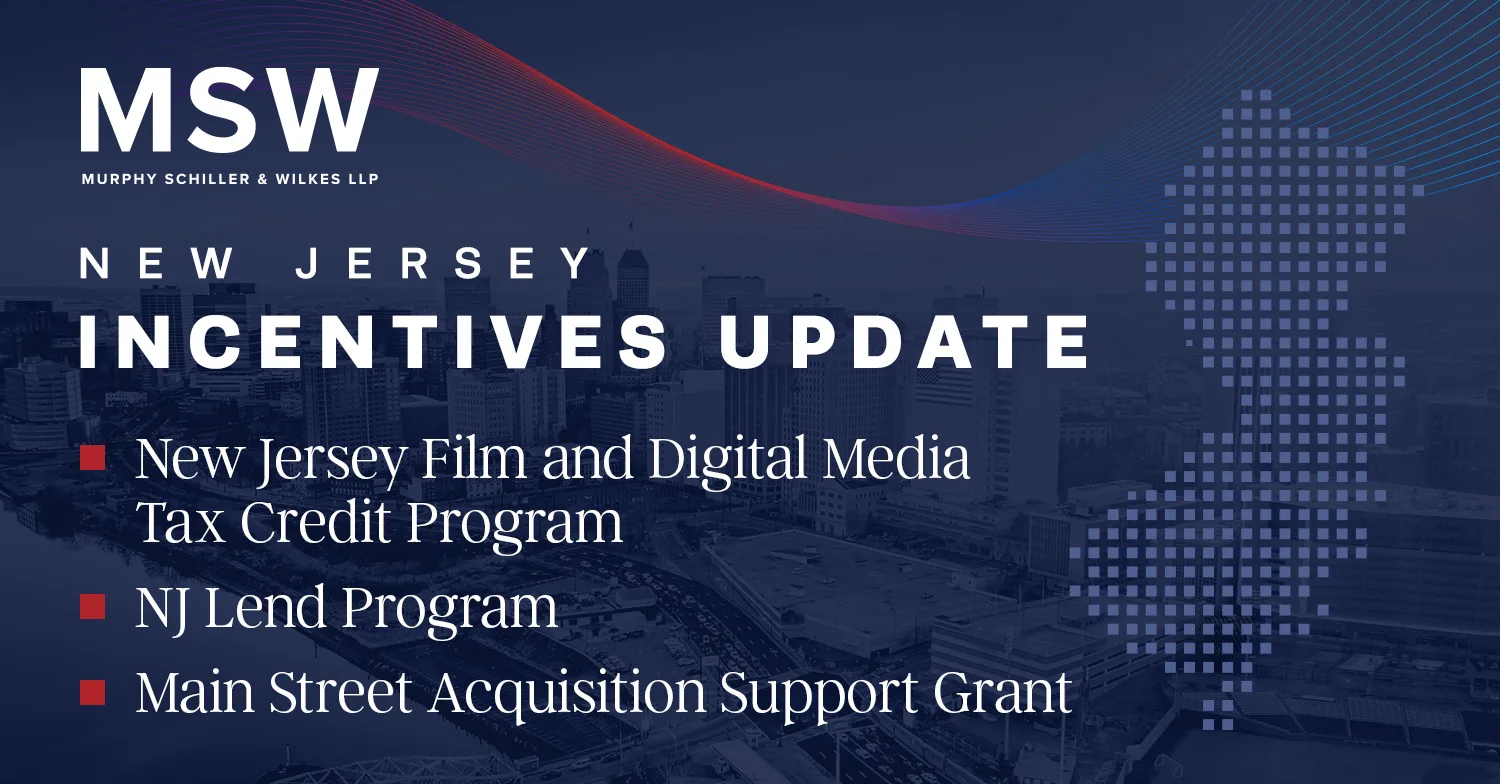
MSW New Jersey Incentives Update (April 2025)

On Wednesday April 9th, the New Jersey Economic Development Authority (NJEDA) held its monthly Board meeting in Trenton, NJ. At this meeting, the NJEDA approved an incentive award under the New Jersey Film and Digital Media Tax Credit Program. This program offers transferable tax credits up to 40% of eligible costs for film and digital media productions conducted in New Jersey. The EDA has approved over $144M in tax credits to 36 projects in their FY2025.

The NJEDA Board also approved the creation of NJ Lend, a three-year fixed asset financing pilot program that expands NJEDA loan programs. Additionally, the Main Street Acquisition Support Grant pilot application window remains open for applications.

New Jersey Film and Digital Media Tax Credit Program

The New Jersey Film & Digital Media Tax Credit Program, administered by the New Jersey Economic Development Authority (NJEDA), offers tax credits of up to 40% of eligible expenses incurred in New Jersey for qualifying production companies. Eligible productions include feature films, television series, digital media content, and documentary feature films and documentary television shows. Productions must meet minimum in-state spending requirements as defined by the program rules, among other requirements.

At the April 9 meeting, the NJEDA Board approved a Film Tax Credit award of $12,335,600 to Apple Studios for the production of “Echo Valley”, a dramatic thriller starring Julianne Moore and Sydney Sweeney. Stockton, a borough in Hunterdon County, will be the principal location, with an estimated completion in September 2025.

In FY2025, the EDA has awarded over $144M in tax credits to 36 projects under the Film Tax Credit program, with a remaining allocation over $250M. During the same time, the Digital Media Tax Credit program has awarded over $27M in tax credits to 12 projects. It has a remaining allocation of over $32M.

NJ Lend

At the April 9th Board meeting, NJEDA approved the NJ LEND (New Jersey Loan Expansion and Network Development) program, a three-year $30M pilot initiative to assist New Jersey’s small and medium-sized businesses. The program enhances the EDA’s existing Premier Lender and Direct Loan programs by increasing the maximum loan amounts available for fixed assets to up to $5M and for working capital up to $1M. The EDA will accept online applications on a rolling until all funds are committed or the three-year program period expires.

Key qualifying criteria:

  • For-profit or non-profit with a New Jersey operating location
  • No more than 750 New Jersey employees
  • For-profits: at least 2 years in business, 50% of guarantors with 700+ FICO, all 10%+ owners provide unlimited guarantees, 1.10x debt service coverage
  • Non-profits: at least 3 years in business, 1.0x debt service coverage, no personal guarantees
  • Must create/retain 1 full-time job per $65,000 in loan exposure within 2 years
  • Must secure financing with fixed assets
  • Home-based businesses not buying commercial property are ineligible
  • Additional qualifying criteria

Main Street Acquisition Support Grant

The Main Street Acquisition Support Grant is a pilot program under New Jersey’s Main Street Recovery Fund that provides grants of up to $50,000 to eligible small businesses to reimburse closing costs associated with purchasing commercial property in New Jersey for business operations.

Applicant must meet certain criteria in order to qualify, including:

  • Meet the SBA definition of a small business
  • Property purchase (closing) must occur after the program’s application is made available to the public (October 1, 2024)
  • Application must be submitted no later than one year from the date of closing
  • The purchased property must be located in New Jersey and used for business operations
  • The applicant must occupy at least 1,000 square feet of the purchased property
  • Only new purchases of commercial property are eligible; refinances and purchases of vacant land are not eligible
  • The grant is only available after the real estate closing has occurred; pre-closing applications are not accepted
  • Additional qualifying criteria

The grant is awarded post-closing, based on actual closing costs, and is subject to a five-year compliance period, with prorated repayment required if the property is sold or vacated early. The EDA will continue to accept applications until the total funding is exhausted, up to a maximum of three years.

For more information, please contact:

Brendan Pytka
Director of Tax Credits & Incentives
Phone: (862) 418-3702
Email: bpytka@murphyllp.com

Chris J. Murphy, Partner
Chair, Tax Credits & Incentives
Phone: (973) 705-7421
Email: cmurphy@murphyllp.com

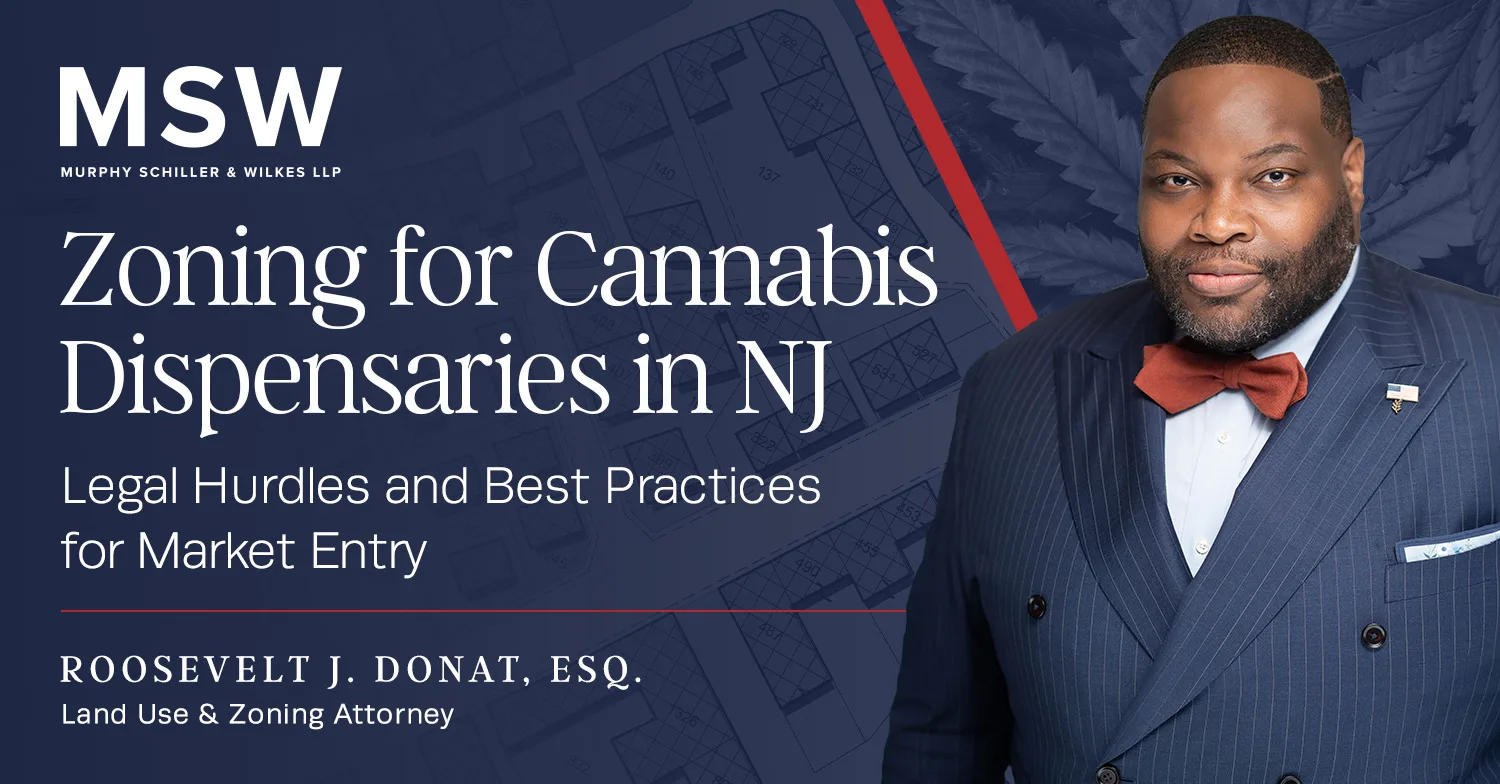
Zoning for Cannabis Dispensaries in New Jersey

Legal Hurdles and Best Practices for Market Entry

As cannabis legalization takes deeper root across the United States, New Jersey stands at the crossroads of opportunity and regulatory complexity. For all the momentum sparked by the Cannabis Regulatory Commission (CRC), it is not the state, but rather New Jersey’s 565 municipalities, that serve as the gatekeepers of cannabis retail expansion. Nowhere is this more apparent than in the realm of zoning.

Zoning is where legalization meets local control—and for attorneys, policymakers, investors, and operators alike, it is the battlefield that defines who gets to participate in the market and who does not.

This article explores the legal and strategic contours of New Jersey’s cannabis zoning landscape, highlighting key hurdles and offering proven best practices to help navigate it.

I. Home Rule, Local Power, and the Patchwork Problem

New Jersey’s home rule doctrine empowers municipalities to govern local land use. While the state legalized adult-use cannabis through the Cannabis Regulatory, Enforcement Assistance, and Marketplace Modernization Act (CREAMMA), it left final authority over dispensary zoning to the local level.

This has produced a fragmented policy environment where:

  • Some municipalities fully embrace cannabis retail
  • Others permit only cultivation or manufacturing
  • Many continue to opt out entirely, imposing bans or moratoria
  • Others pass ordinances that allow cannabis businesses in theory—but zone them out in practice

The result is a regulatory paradox: cannabis may be legal statewide, but functionally prohibited in large parts of the state due to municipal zoning laws. For those seeking to operate, this decentralization creates risk, delay, and opportunity—all at once.

Legal Foundation:

Under N.J.S.A. 24:6I-45(b), municipalities may “adopt an ordinance authorizing one or more classes of cannabis establishments… and may determine the number of establishments of each class that may operate in the municipality and the location, manner, and times of operation of each establishment.”

This statutory provision is the backbone of local zoning authority under CREAMMA—and a reminder that even with a state license in hand, local control remains decisive.

II. Legal Hurdles Operators Must Anticipate

Despite legalization, the pathway to a compliant dispensary site is rarely straightforward. Common zoning-related obstacles include:

  1. Opt-Out Jurisdictions
  2. Many towns opted out in 2021 during the initial CRC licensing window. While some have reversed course, many remain closed to retail cannabis. Operators must track ongoing municipal reversals and proposed ordinance amendments.

  3. Overly Restrictive Buffer Zones
  4. Some municipalities require dispensaries to be located 500 to 1,000 feet from schools, houses of worship, parks, or residential zones. In dense cities like Newark or Elizabeth, this can effectively eliminate all viable real estate.

  5. Zoning Code Ambiguity
  6. Municipalities that have not updated their zoning codes create uncertainty around whether cannabis is a permitted or conditional use. This creates room for inconsistent interpretations by planning and zoning boards.

  7. Unwritten Political Resistance
  8. In some jurisdictions, the law may permit cannabis uses—but the politics do not. Community opposition, elected official hesitance, and local stigma can lead to “silent bans” or procedural dead ends.

III. Strategic Legal Tools to Navigate Zoning Challenges

To navigate this complexity, applicants and counsel must understand and deploy local land use tools with precision:

  1. Cannabis Overlay Zones
  2. An increasingly popular solution, Cannabis Overlay Zones carve out specific areas where dispensaries are permitted by right or with minimal discretionary review. Overlay zones can offer predictability and help align cannabis retail with underutilized commercial corridors.

  3. Redevelopment Plans
  4. In areas designated “in need of redevelopment,” municipalities can bypass traditional zoning restrictions through a redevelopment plan. Embedding cannabis as an allowed use within a redevelopment framework can unlock opportunities that would otherwise be off-limits under general zoning law.

  5. Conditional Use Applications and Use Variances
  6. When cannabis is permitted as a conditional use, applicants must satisfy criteria such as hours of operation, security, or neighborhood compatibility. Where the use is prohibited, a use variance must be sought—a high bar requiring proof of hardship and a showing that the use will not substantially impair the zoning plan or neighborhood character.

  7. Municipal Resolutions of Support
  8. A critical component of any state application is a resolution of support or a zoning compliance certification from the host municipality. Securing this requires early engagement with local officials, clear alignment with municipal goals, and a credible commitment to community reinvestment.

    IV. Site Selection: The Real Estate Imperative

    In a limited-license state like New Jersey, site control is not a formality—it is a strategic advantage.

    The best sites are not just compliant. They are politically viable, logistically sound, and competitively positioned. Smart operators do more than lease space—they secure optionality, map zoning overlays, and assess a site’s hearing risk long before application submission.

    Key considerations include:

    • Zoning classification and use category
    • Distance from disqualifying uses
    • Traffic flow and parking availability
    • Community demographics and voting history
    • Political temperature of the municipal governing body

    V. Public Hearings and the Politics of Land Use

    Zoning is not just legal—it is performative and political. In New Jersey, approvals often hinge on community sentiment expressed at planning board or zoning board hearings.

    Best practices include:

    • Conducting stakeholder mapping before any filing
    • Hosting local information sessions to educate and engage
    • Demonstrating measurable community benefits (e.g., local hiring, grants to nonprofits, security investments)
    • Preparing expert testimony from planners, architects, and security consultants
    • Presenting a cohesive narrative that emphasizes economic development and public safety, not just compliance

    A successful application is not just technically complete — it is locally compelling.

    VI. Lessons from the Field

    Case 1: Jersey City – Overlay Zone Success

    A minority-led team secured a prime location in Jersey City’s designated cannabis overlay zone. By aligning their narrative with the city’s equity goals, partnering with a local nonprofit, and committing to hire within Ward F, they won zoning approval without opposition.

    Case 2: Bergen County – Variance Denial

    A group signed a lease in a commercial plaza assuming they could obtain a variance. Despite a polished presentation, the board denied their request, citing proximity to a residential zone and lack of community support. The project folded, and the investors lost over $250,000 in sunk costs.

    Takeaway: Technical compliance alone is insufficient—community engagement and political literacy are decisive.

    Case 3: Collingswood – Political Indecision Undermines First-Mover Advantage

    In the wake of COVID-19 and amid litigation stemming from New Jersey’s 2019 award of medical cannabis licenses—many of which were slated for conversion following the state’s 2020 legalization of adult-use cannabis – a business group acquired a commercial property in Collingswood, NJ, anticipating a first-mover advantage in a what was marketed as a progressive, transit-accessible municipality.

    Following promising discussions with borough leadership, the group invested over $1.2 million in property acquisition, design planning, and carrying costs while awaiting the local zoning framework to be finalized. However, despite early optimism, the project stalled as political indecision and shifting internal dynamics caused Collingswood to delay formal adoption of cannabis zoning rules.

    Over two years of uncertainty, missed council opportunities, and a lack of definitive municipal direction exhausted the capital reserves earmarked for zoning approvals and project execution. Ultimately, the business group was forced to sell the building, walking away from a promising project derailed not by legal noncompliance—but by bureaucratic stagnation and local ambivalence.

    Takeaway: A perceived first-mover advantage means little in the face of municipal hesitation. In post-COVID markets still defining their cannabis identity, success depends not just on timing—but on the ability to withstand prolonged political drift and regulatory ambiguity.

    VII. What’s Next: Trends and Policy Recommendations

    As the New Jersey cannabis market matures, zoning policies will continue to evolve. Key developments to monitor:

    1. 1. Municipal Reversals and Regulatory Re-Engagement
    2. Municipalities that originally opted out are now re-entering the market to capture tax revenue and redevelopment momentum. Keep tabs on agendas, planning board discussions, and economic development authorities.

    3. Equity-Based Zoning Incentives
    4. Expect to see municipalities reward social equity applicants with zoning incentives, reduced application timelines, and scoring advantages for community benefit agreements (CBAs).

    5. Regional Planning Models
    6. Counties may adopt regional frameworks to standardize zoning across municipalities, preventing hyper-fragmentation and encouraging coordinated growth.

    7. Increased Litigation
    8. Expect legal challenges to zoning decisions based on arbitrary denial, due process violations, and equal protection concerns—especially where local politics interfere with otherwise qualified applications.

    VIII. Conclusion: Zoning Is the New Battleground

    In New Jersey’s cannabis ecosystem, zoning is not an afterthought—it is the front line.

    It is where real estate meets regulation.
    Where law meets politics.
    Where vision meets resistance.

    Those who understand zoning—who treat land use as both legal terrain and political theater—will shape the contours of this industry, not merely survive it.

    For attorneys, it is where you prove your client’s project has both the right to proceed and the wisdom to win.

    For policymakers, it is where social equity and economic strategy either align—or collapse.

    And for operators and investors, it is the difference between a million-dollar license and a sunk cost.

    Zoning is not just where the battle is fought. It is where the future of cannabis in New Jersey will be decided.

    For further insights on this topic—or for legal guidance on cannabis-related land use and zoning matters in New Jersey—please contact:

    Roosevelt J. Donat | Special Counsel
    Murphy Schiller & Wilkes LLP
    One Gateway Center, Suite 400, Newark, NJ 07102
    5 Penn Plaza, 19th Floor, #19113, New York, NY 10001
    Email: rdonat@murphyllp.com

Practice Group Series – Commercial Landlord-Tenant Law

Murphy Schiller & Wilkes LLP (MSW) provides strategic counsel and aggressive advocacy to commercial landlords, and property owners and managers throughout New Jersey. Our Commercial Landlord-Tenant Law practice group focuses exclusively on the complex and often high-stakes disputes that arise in the commercial leasing context—delivering results-oriented legal solutions tailored to the unique needs of our clients.

As a leading commercial real estate law firm in New Jersey, our attorneys bring deep knowledge of the state’s commercial landlord-tenant law to each matter. We regularly represent clients in lease enforcement actions, commercial evictions, including non-payment and holdover proceedings, lease disputes, property damage claims, and breach of contract cases. When our clients are seeking to protect their investments while navigating a challenging lease dispute, we provide clear, practical guidance grounded in a thorough understanding of the law and the market realities our clients face.

We are experienced litigators and negotiators, capable of resolving disputes through settlement or, when necessary, through assertive litigation in state and federal courts. Our team also advises clients on lease drafting and risk mitigation strategies to help avoid future conflicts and protect our clients’ long-term financial goals.

From industrial properties to shopping centers and office parks, MSW is a trusted partner for resolving commercial landlord-tenant disputes with efficiency and precision.

Practice Group Leaders:

Sean Callahan
Partner
Phone: (973) 705-7412
Email: scallahan@murphyllp.com

Thomas S. Garlick
Partner
Phone: (973) 567-7194
Email: tgarlick@murphyllp.com

MSW – Q1 2025 Transaction Highlights

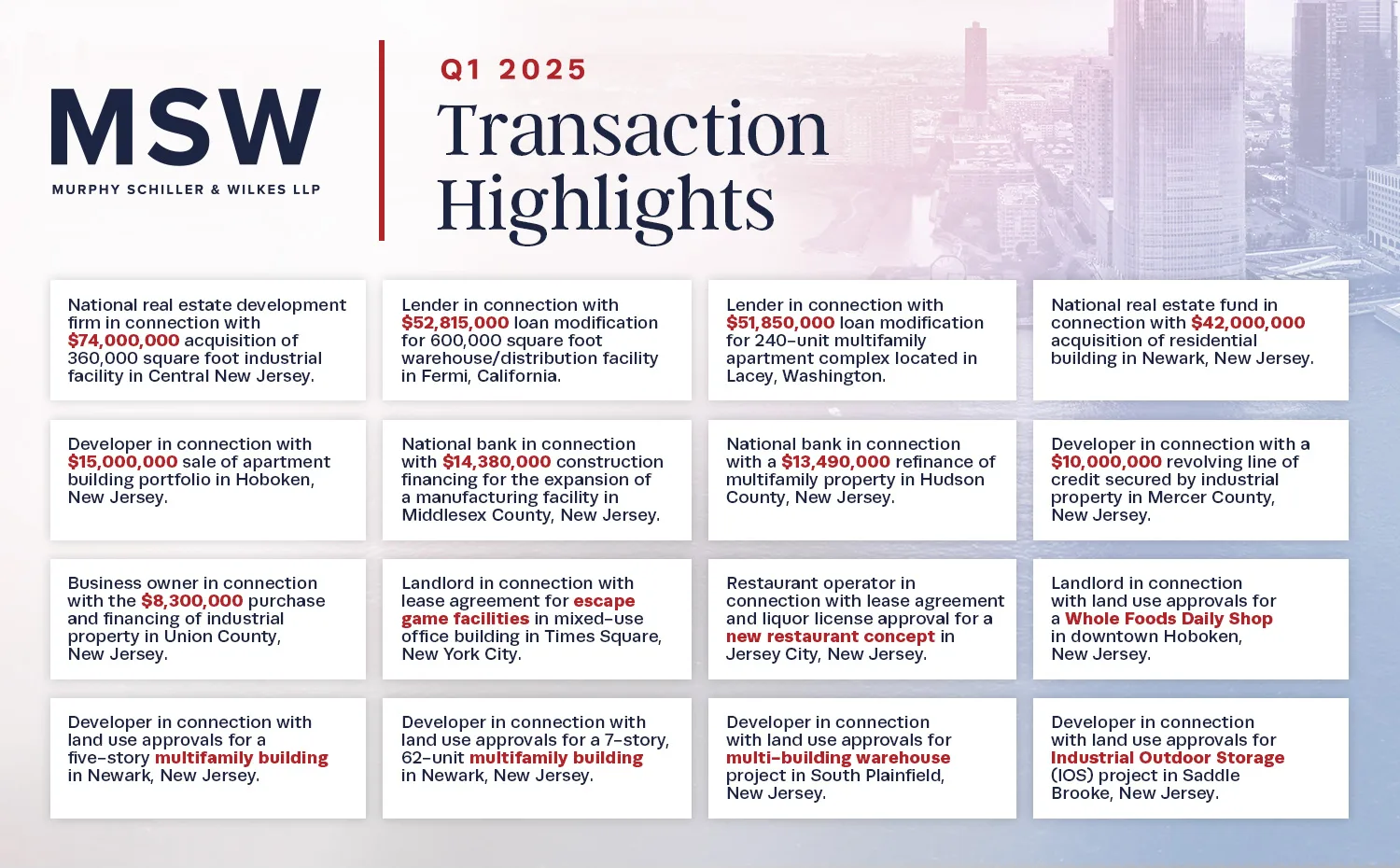
The first quarter of 2025 started off strong for the attorneys at Murphy Schiller & Wilkes LLP (MSW). The firm acted as lead counsel in connection with the acquisition and sale of properties in all asset classes, helped our clients negotiate significant lease transactions, represented both lenders and borrowers in connection with financing CRE deals, both locally and nationally, and secured noteworthy approvals for major industrial, multi-family, and retail projects throughout New Jersey.

In Q1 2025, the firm represented the following:

  • National real estate development firm in connection with $74,000,000 acquisition of 360,000 square foot industrial facility in Central New Jersey.
  • Lender in connection with $52,815,000 loan modification for 600,000 square foot warehouse/distribution facility in Fermi, California.
  • Lender in connection with $51,850,000 loan modification for 240-unit multifamily apartment complex located in Lacey, Washington.
  • National real estate fund in connection with $42,000,000 acquisition of residential building in Newark, New Jersey.
  • Developer in connection with $15,000,000 sale of apartment building portfolio in Hoboken, New Jersey.
  • National bank in connection with $14,380,000 construction financing for the expansion of a manufacturing facility in Middlesex County, New Jersey.
  • National bank in connection with a $13,490,000 refinance of multifamily property in Hudson County, New Jersey.
  • Developer in connection with a $10,000,000 revolving line of credit secured by industrial property in Mercer County, New Jersey.
  • Business owner in connection with the $8,300,000 purchase and financing of industrial property in Union County, New Jersey.
  • Landlord in connection with lease agreement for escape game facilities in mixed-use office building in Times Square, New York City.
  • Restaurant operator in connection with lease agreement and liquor license approval for a new restaurant concept in downtown Jersey City, New Jersey.
  • Landlord in connection with land use approvals for a Whole Foods Daily Shop in downtown Hoboken, New Jersey.
  • Developer in connection with land use approvals for a five-story multifamily building in Newark, New Jersey.
  • Developer in connection with land use approvals for a 7-story, 62-unit multifamily building in Newark, New Jersey.
  • Developer in connection with land use approvals for multi-building warehouse project in South Plainfield, New Jersey. 
  • Developer in connection with land use approvals for Industrial Outdoor Storage (IOS) project in Saddle Brooke, New Jersey.

Practice Group Series – Banking and Commercial Finance

Our team regularly counsels clients on the structuring, negotiation and documentation of both secured and unsecured credit accommodations.

MSW represents lenders and borrowers alike in commercial and industrial finance transactions. On the lender side, MSW represents international financial institutions, community banks and private lenders, including agent banks in syndicated credit transactions. On the borrower side, our clients include family-owned businesses, mid-market companies, developers, and entrepreneurs.

MSW’s work in this area encompasses revolving credit and term loan facilities, syndicated facilities, participations, letters of credit, asset-based financings, loan modifications and tax-exempt transactions. MSW represents lenders in the negotiation and documentation of complex intercreditor agreements, participation agreements and loan purchase agreements. The firm’s attorneys also act as local opinion counsel to borrowers and lenders in New Jersey and New York in connection with major credit facilities.

Practice Group Leader:

Charles Wilkes
Partner
Phone: (973) 705-7422
Email: cwilkes@murphyllp.com

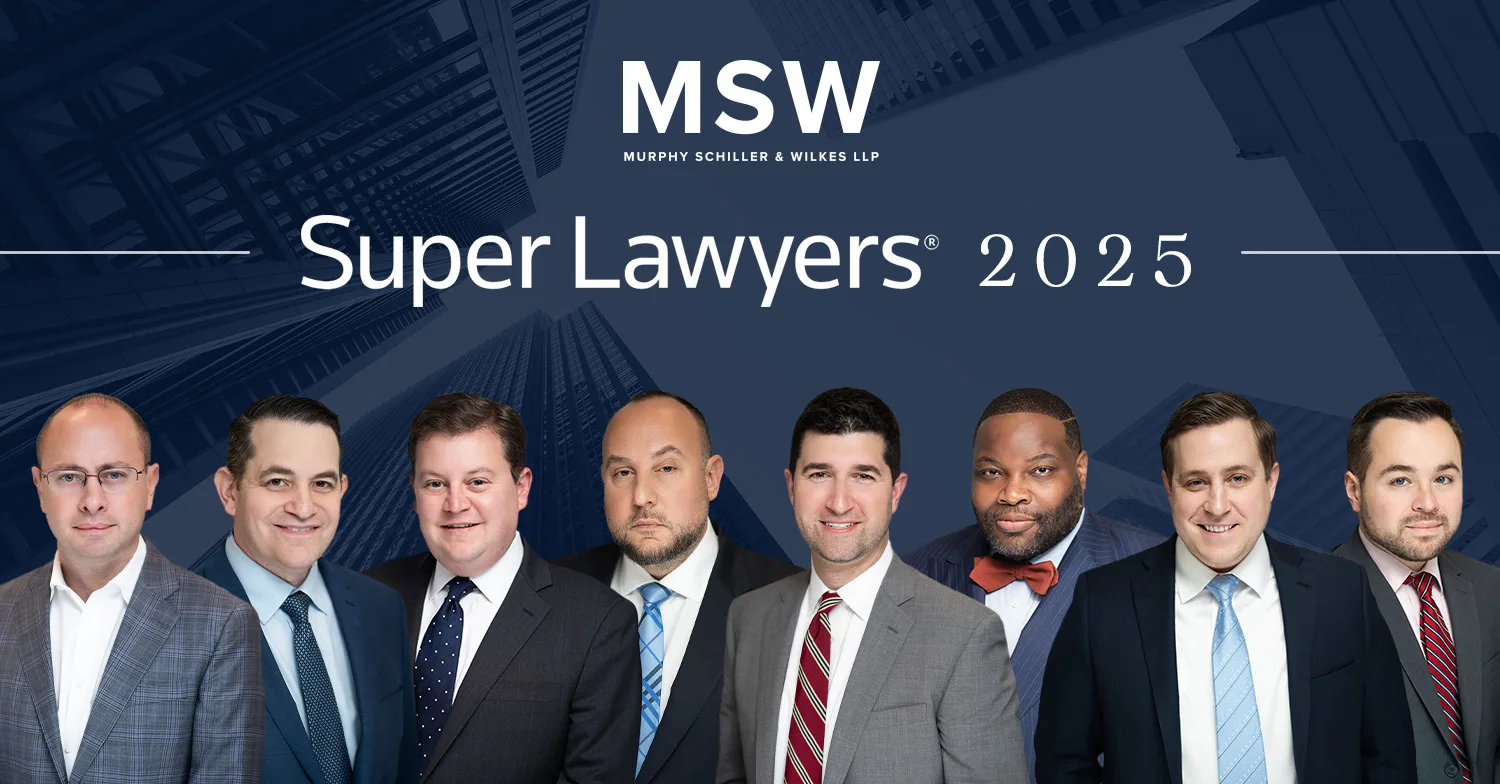
MSW Attorneys selected as 2025 Super Lawyers / Rising Stars

Murphy Schiller & Wilkes LLP (MSW) is pleased to announce that the following attorneys have been selected as part of the 2025 Super Lawyer / Rising Stars lists:

  • Kellen F. Murphy – Super Lawyer in Real Estate
  • Matthew J. Schiller – Super Lawyer in Real Estate
  • Charles J. Wilkes – Super Lawyer in Real Estate
  • Anthony Capasso – Super Lawyer in Construction Litigation
  • Thomas S. Garlick – Rising Star in Land Use & Zoning
  • Roosevelt J. Donat – Rising Star in Real Estate
  • R. Brant Forrest – Rising Star in Construction Litigation
  • Matthew E. Gilson – Rising Star in Land Use & Zoning

Super Lawyers selects attorneys using a patented multiphase selection process. Peer nominations and evaluations are combined with independent research. Each candidate is evaluated on 12 indicators of peer recognition and professional achievement. Selections are made on an annual, state-by-state basis.

For more information on the selection process, click HERE.