MSW Land Use Team Secures Planning Board Approval for Industrial Development in Monroe Township

On Thursday, March 25th, the Monroe Township Planning Board granted preliminary and final site plan approval, along with certain variance relief, for the construction of a 44,400 square foot industrial building in the LI Light Impact Industrial zoning district.

Chris J. Murphy, Esq. led the firm’s successful efforts on behalf of the development team, which included John Manilio of man|TERRA Design LLC, Doug Polyniak of Dolan & Dean Consulting Engineers, LLC, Roberto Martinez of REDCOM Design & Construction LLC, and John McDonough of John McDonough Associates, LLC. MSW associate Hannah Bartges and land use paralegal Marika Igras also played a critical role in the process.

MSW Land Use Team Secures Planning Board Approval for Multi-Family Development in Plainfield

On Thursday, March 4th, the Plainfield Planning Board granted amended site plan approval for the construction of a five story mixed-use building on Park Avenue. The building will consist of fourteen (14) apartments on floors two through five, and 2,455 square feet of retain space on the first floor, along with amenities including a 1,573 square foot rooftop terrace, a bike storage area, and an exercise room.

Roosevelt J. Donat, Esq. led the firm’s successful efforts on behalf of the development team, which included Brian Taylor of Taylor Architecture & Design and Rick Adelsohn of Frank H. Lehr Associates. MSW associate Hannah Bartges and land use paralegal Marika Igras also played a critical role in the process.

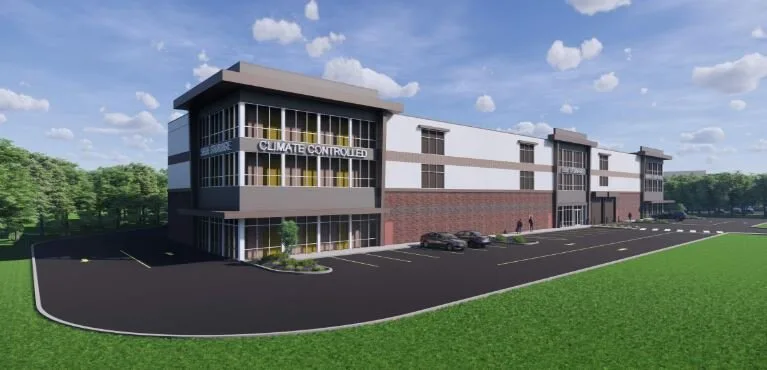
MSW Land Use Team Secures Planning Board Approval for Self-Storage Development in Toms River

On Wednesday, March 3rd, the Toms River Planning Board approved plans to permit the construction of a 120,582 square foot self-storage facility in the Industrial (I) zoning district. The Board granted Preliminary and Final Major Site Plan approval, along variance and waiver relief.

Chris J. Murphy, Esq. led the firm’s successful efforts on behalf of the development team, which included Douglas Grysko of Dynamic Engineering, Louis Vandeloecht of GMA Architects, John McCormack of Dynamic Traffic, and Creigh Rahenkamp of Creigh Rahenkamp & Associates.

MSW Land Use Team Secures Approvals for Cigar Establishment and Jersey Shore Properties

On Wednesday, February 24th, the Murphy Schiller & Wilkes (MSW) Land Use Team secured approvals for two exciting projects.

First, the Somerville Planning Board granted preliminary and final site plan approval in connection with the establishment of a retail cigar store on East Main Street. The applicant, Jersey Cigars LLC (which operates as Sticks Cigars) successfully operates Sticks Cigars in Rahway, NJ and will be bringing a similar concept to the Somerville location.

Chris J. Murphy, Esq. led the successful effort of behalf of the development team, which included architect Patrick Lesbirel of Brick City Reconstruction.

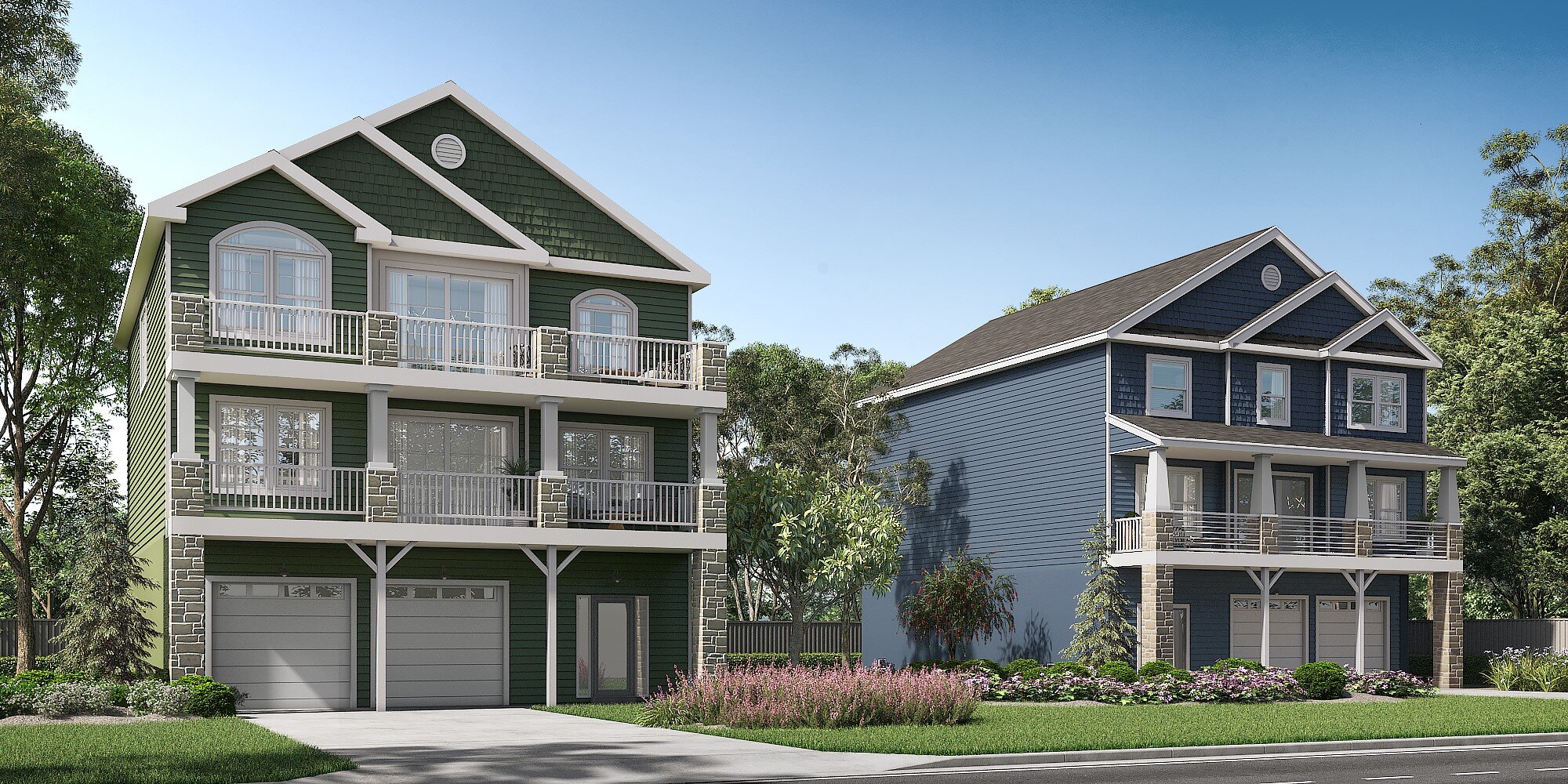
The same night, Roosevelt J. Donat, Esq. represented a client in connection with approvals for the subdivision and construction of two (2) single family homes in Union Beach, NJ. He was joined by architect Enkela Malellari from Brick City Reconstruction.

For more information on the Land Use, Zoning, and Redevelopment practice group at MSW, please feel free to reach out to Chris J. Murphy, Esq. at (973) 705-7421 or cmurphy@murphyllp.com.

MSW EXPANDS LITIGATION AND LAND USE PRACTICE GROUPS WITH ADDITION OF NEW ATTORNEYS

Newark, NJ, February 22, 2021 – Murphy Schiller & Wilkes LLP (MSW) is pleased to announce that Christopher A. Khatami and Hannah C. Bartges have joined the firm.

Christopher A. Khatami has joined the firm as Counsel and will concentrate his practice on real estate litigation. Prior to joining the firm, Chris worked at a New Jersey-based litigation boutique, where he represented both private and public sector clients in connection with complex litigation matters in both state and federal courts.

He received his law degree from Seton Hall University School of Law, and his undergraduate degree from Fordham University, where he was a Dean’s List student, Arabic Language Fellowship recipient, and Fulbright Scholar nominee.

Hannah C. Bartges has joined the firm as an Associate and will concentrate her practice on land use and environmental matters. Prior to joining the firm, Hannah worked as an associate in a top New Jersey-based law firm, gaining invaluable experience representing a wide range of clients, from Fortune 500 companies to family-owned businesses. Prior to entering private practice, she was an Assistant Corporation Counsel in Jersey City’s Law Department where she handled complex issues concerning federal, state, and municipal laws, including the Comprehensive Environmental Response, Compensation, and Liability Act (CERCLA) and New Jersey’s Spill Act. Following law school, Hannah served as a judicial law clerk to the Honorable John M. Deitch, J.S.C., of the New Jersey Superior Court.

Hannah received her law degree, magna cum laude, with a Certificate in Environmental Law from the Elisabeth Haub School of Law at Pace University, where she was Acquisitions Editor of the Pace Environmental Law Review. She received her undergraduate degree, magna cum laude, from Florida State University.

“We are incredibly excited to have Chris and Hannah join our growing team. Our ability to continue to attract top-level talent is a testament to our vision of building a first-rate boutique law firm focused solely on commercial real estate and development,” says Kellen F. Murphy, the firm’s managing partner.

MSW Public Policy Alert: Pending legislation would significantly impact redevelopment efforts throughout New Jersey

New legislation pending in the New Jersey State Assembly (A1571/A1576), and Senate (S1956), seeks to amend the “New Jersey Prevailing Wage Act.” P.L.1963, c.150 (C.34:11-56.25 et seq.) to impose prevailing wage requirements on private redevelopment projects awarded tax abatements or exemptions (also referred to as PILOTs). Specifically, the legislation requires a contractor to include a provision in their contract that holds the contractor liable for paying a worker “a rate of wages less than the prevailing wage.” PILOTs have been a successful tax incentive tool utilized by private developers and municipalities to incentivize the redevelopment of distressed properties throughout the State.

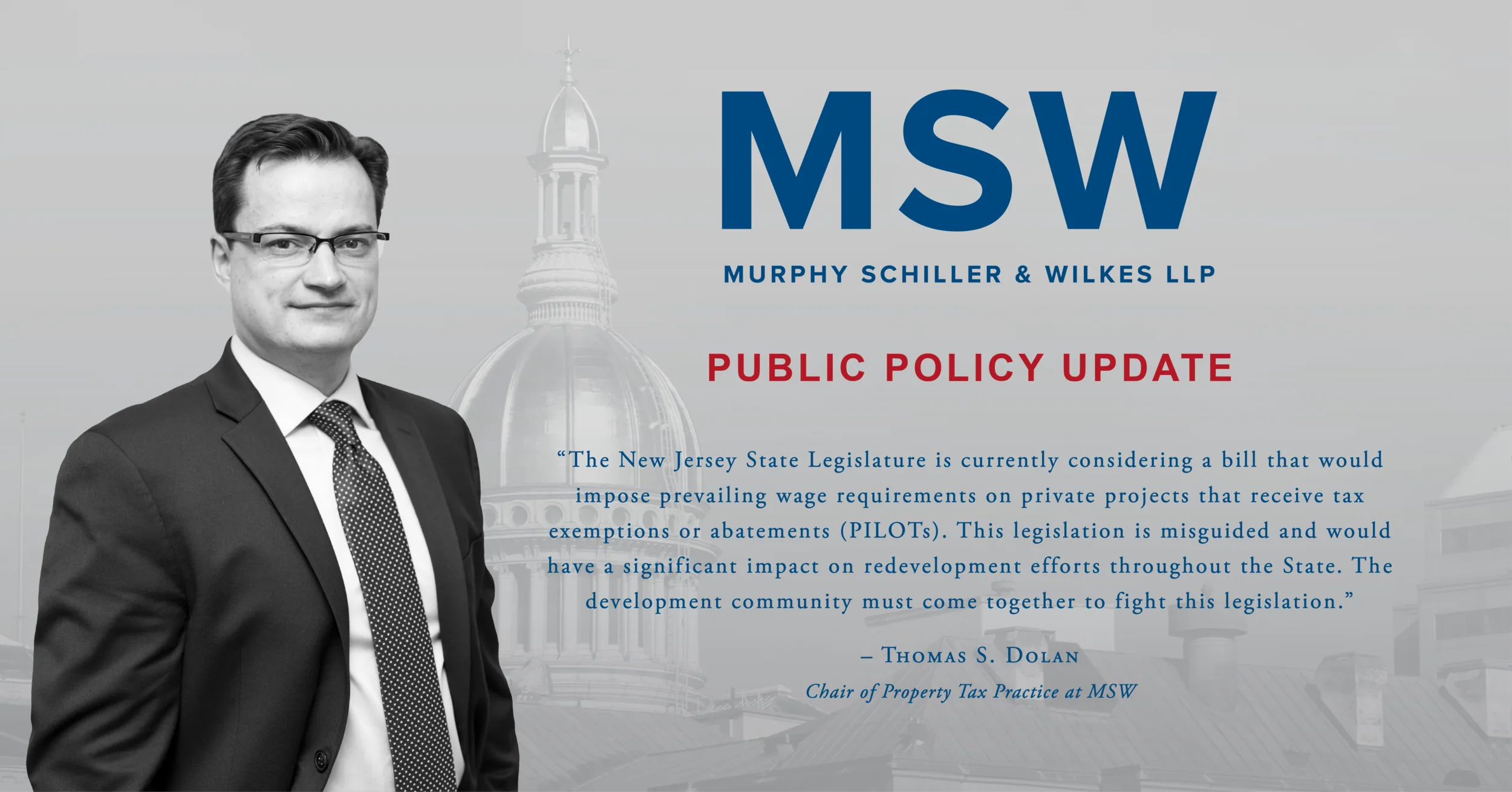
“This pending legislation threatens the use of this vital property tax incentive program by significantly increasing the costs to develop distressed properties. As a result, it will have a significant impact on redevelopment efforts throughout the State. The development community must come together to fight this legislation.” – Thomas S. Dolan, Chair of Property Tax Practice at MSW.

Important 2021 New Jersey Property Tax Appeal Deadlines

COVID-19 has severely impacted commercial property values by decimating rental income and increasing vacancies for income producing properties across the State. Most commercial properties will be over assessed and eligible for a tax appeal in 2021, as many municipalities have not adjusted property tax assessments to account for the severe economic downturn. Further, many municipalities continue to pursue appeals to increase assessments, even during this time.

The time to consider a tax appeal is now. The critical tax appeal deadlines are quickly approaching, and commercial property owners need to be prepared to file tax appeals for 2021 to get much needed property tax relief in order to mitigate against declines in revenue. The Property Tax Appeal group at Murphy Schiller & Wilkes LLP have already begun obtaining taxpayers property tax relief for 2021 and are currently providing free consultation to property owners considering an appeal this year. Failure to meet the important tax appeal filing deadlines may completely bar your right to file a property tax appeal this year. Below is an overview of the strict filing deadlines and process.

Notice of Assessment – February 1, 2021

The first step in the appeal process is to carefully review your Notice of Assessment. Taxpayers typically receive the Notice of Assessment by the first week of February. The Notice of Assessment will contain important information regarding your assessment. It lists the 2021 assessment for your property, the prior year’s assessment, and the prior year’s taxes. However, it does not include the taxes due for 2021 based on the new tax assessment. Importantly, you will not know the taxes you owe for 2021 until the third quarter of 2021, after the deadline to appeal. The decision to appeal is based solely on the assessment and its relationship to market value, not on the amount of taxes due.

Appeal Deadline – April 1, 2021

After receiving your Notice of Assessment, there is a very small window of time to consider whether to file an appeal. Unless the municipality has undergone a municipal-wide revaluation or reassessment, the strict deadline for taxpayers to file an appeal directly to the New Jersey Tax Court is the later of April 1, 2021, or 45 days from the date the bulk mailing of the Notice of Assessments is completed. This is also the deadline to file an appeal to the County Board of Taxation in every county except Monmouth County. Filing deadlines are strictly enforced. Failure to meet the filing deadline may completely bar your right to appeal your assessment for 2021 regardless of the unfairness of your assessment and tax burden.

Revaluation Deadline – May 1, 2021

The deadline to file an appeal in the New Jersey Tax Court and the County Board of Taxation for municipalities that have undergone a municipal-wide revaluation or reassessment is the later of May 1, 2021, or 45 days from the date the bulk mailing of the Notice of Assessments is completed. Notable municipal-wide reassessments this year were performed in Hackensack and Paterson.

Where to file

If the assessment is over $1,000,000, the taxpayer may file an appeal in either the Tax Court of New Jersey or the County Board of Taxation of the county where the property is located. If the assessment is $1,000,000 or less, the taxpayer must file with the County Board of Taxation.

Deciding whether to appeal

Deciding whether to file a property tax appeal requires careful analysis and consideration of your tax assessment, as adjusted by the applicable county equalization ratio, and its fairness in relationship to the true market value of the property. Importantly, in New Jersey, a municipality has the right to file a counterclaim to seek to increase your assessment if it determines you are under assessed. Therefore, failure to properly evaluate your case prior to filing may prove costly. It is vital to use experienced legal counsel to review your assessment to determine the risks and benefits prior to filing an appeal in order to understand the tax relief available and to avoid an unwanted tax increase. As market and property conditions fluctuate every year, it is vital to reexamine your property on an annual basis for eligibility for a tax appeal.

Consultation

To determine whether your property may be eligible for an appeal, the experienced team at Murphy Schiller & Wilkes LLP is ready to provide a complimentary evaluation of your property. If we determine that an appeal will be beneficial, we will recommend a strategy to reduce your tax burden and can file and pursue your appeal. As a dedicated commercial real estate firm, our team has invaluable insight into the real estate market and has successfully litigated the value of virtually all property types. Our team also has considerable experience advising on tax exemptions, or other tax incentive programs, that may be available to reduce the property tax burden outside of the appeal process. Our experience and deep broad-based knowledge allow us to consider all options that may be available to potentially reduce your tax burden.

For additional information concerning our property tax appeal services, or to request an evaluation of your property, please contact:
THOMAS S. DOLAN
Partner – Property Tax Practice Leader
(973) 705-7412
tdolan@murphyllp.com

MSW Land Use Team Secures Planning Board Approval for Restaurant in Randolph Township

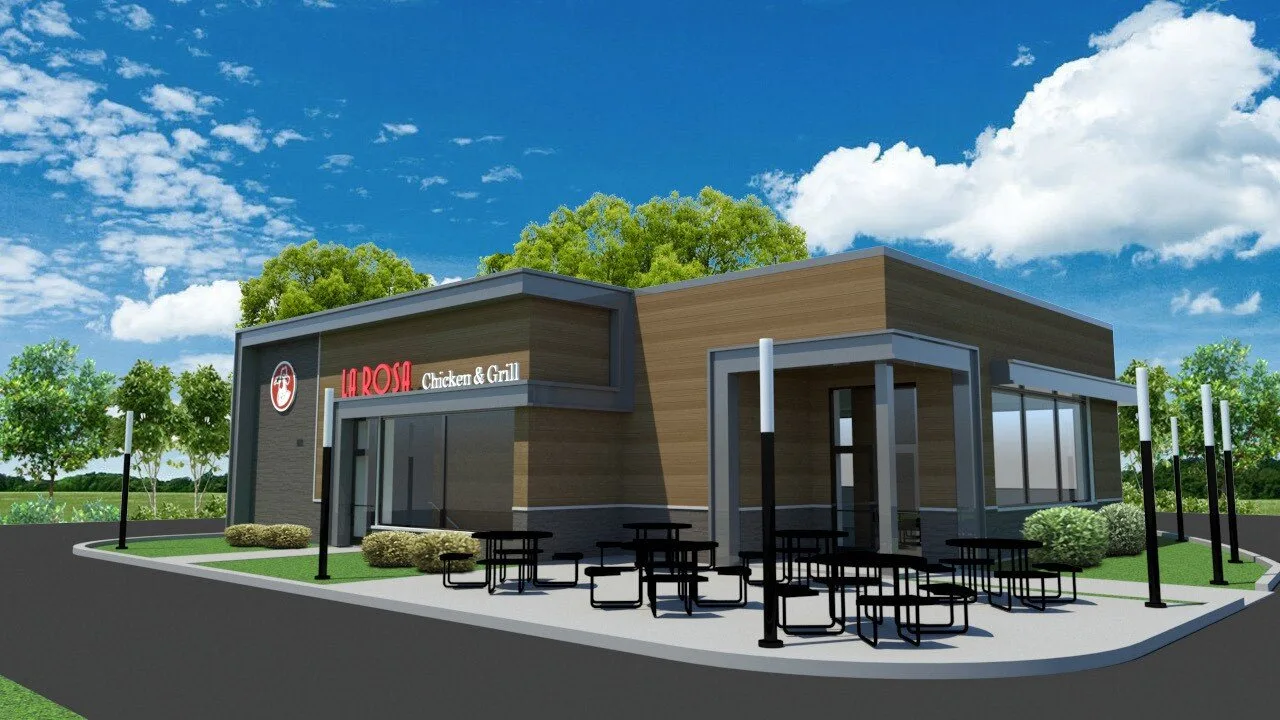
On Monday, January 25th, the Randolph Township Planning Board approved plans to permit the construction of a La Rosa Chicken & Grill restaurant in the Township’s B2 zoning district. The Board granted preliminary and final site plan approval, along with multiple variances and waivers.

Kellen F. Murphy, Esq. led the firm’s successful efforts on behalf of the development team, which included Patrick Lesbirel from Brick City Reconstruction and Michael Dipple from L2A Land Design, LLC.

IRS Extends COVID-19 Relief for Qualified Opportunity Funds and OZ Investors

On January 19, 2021, the IRS issued Notice 2021-10, which further extends relief previously granted to taxpayers, Qualified Opportunity Funds (QOFs), and Qualified Opportunity Zone Businesses (QOZBs) under the Opportunity Zone Program due to the COVID-19 pandemic under Notice 2020-39 (issued on June 4, 2020) and Notice 2020-23 (issued on April 9, 2020).

The Opportunity Zone Program provides certain tax incentives to encourage the reinvestment of capital gains derived from any source (e.g., sale of stock, sale of business assets, sale of real estate) as long-term equity investments into real estate projects and new businesses located in designated “opportunity zones.” Such investments must generally occur within a 180-day period in order to be eligible for the tax benefits afforded under the Opportunity Zone Program.

Pursuant to Notice 2021-10, if the 180-day investment period would have otherwise expired between April 1, 2020 and March 31, 2021, the deadline to re-invest the capital gains into a QOF has been extended to March 31, 2021. Thus, taxpayers who have incurred capital gains between October 4, 2019 and October 2, 2020 now have until March 31, 2021 to invest all or a portion of their capital gains into one or more QOFs in accordance with the requirements of the Opportunity Zone Program.

Additional relief afforded under Notice 2021-10 includes:

  • The automatic application of the “reasonable cause” exception to any QOF that fails to satisfy the 90% investment standard (i.e., at least 90% of the QOF’s assets must constitute “qualified opportunity zone property”) (i) during the last day of the first 6-month period of a taxable year, or (ii) the last day of a taxable year falls within the period beginning on April 1, 2020 and ending on June 30, 2021. As cash held by QOFs does not constitute “opportunity zone property,” QOFs have deadlines to purchase opportunity zone property (i.e., stock or partnership interest in a QOZB or qualified opportunity zone business property); however, under Notice 2021-10, QOFs will not be penalized in the event that they are unable to timely deploy certain cash investments to purchase qualified opportunity zone property before June 30, 2021.
  • The 30-month “substantial improvement” requirement for property held by QOFs and/or QOZBs is tolled for the period between April 1, 2020 and March 31, 2021. Thus, the deadline for developers to substantially improve certain projects in accordance with Opportunity Zone Program requirements may now be extended by up to one (1) year.
  • Unlike QOFs, QOZBs may hold certain cash assets for a period of up to 31 months due to a working capital safe harbor, subject to compliance with the Opportunity Zone Program requirements. Pursuant to Notice 2021-10, qualified QOZBs holding working capital assets intended to be covered by the working capital safe harbor before June 30, 2021, may be entitled to an additional 24 months (i.e., up to 55 months total) to deploy the working capital assets of the QOZB.
  • The Opportunity Zone Program has resulted in significant investments in numerous redevelopment projects and new businesses in opportunity zones in New Jersey and elsewhere throughout the country; however, compliance with the Opportunity Zone Program’s regulatory requirements is complex and has become that much more difficult to due to the numerous challenges created by COVID-19. MSW’s full-service commercial real estate team is prepared to assist its clients organize and form QOFs and QOZBs, evaluate and participate in opportunity zone investment opportunities, and comply with other regulatory and tax requirements in order to maximize the many benefits of the Opportunity Zone Program all while addressing the numerous other land use, transactional, environmental and regulatory challenges associated with acquiring, developing and operating real estate projects.

    For more information, please contact Matthew J. Schiller, Esq. at (973) 705-7431 or mschiller@murphyllp.com.